- Animals
- ›Chordates
- ›Vertebrates
- ›Birds
- ›Pelicans, Herons, Ibises, and Allies
- ›Herons, Egrets, and Bitterns
- ›Typical Herons and Egrets
- ›Ardea
On eBird ↗
Humblot's Heron
Live sightings near you, the range map, bar charts of when it is seen, and Macaulay Library photos and recordings.
Humblot's Heron
Ardea humbloti
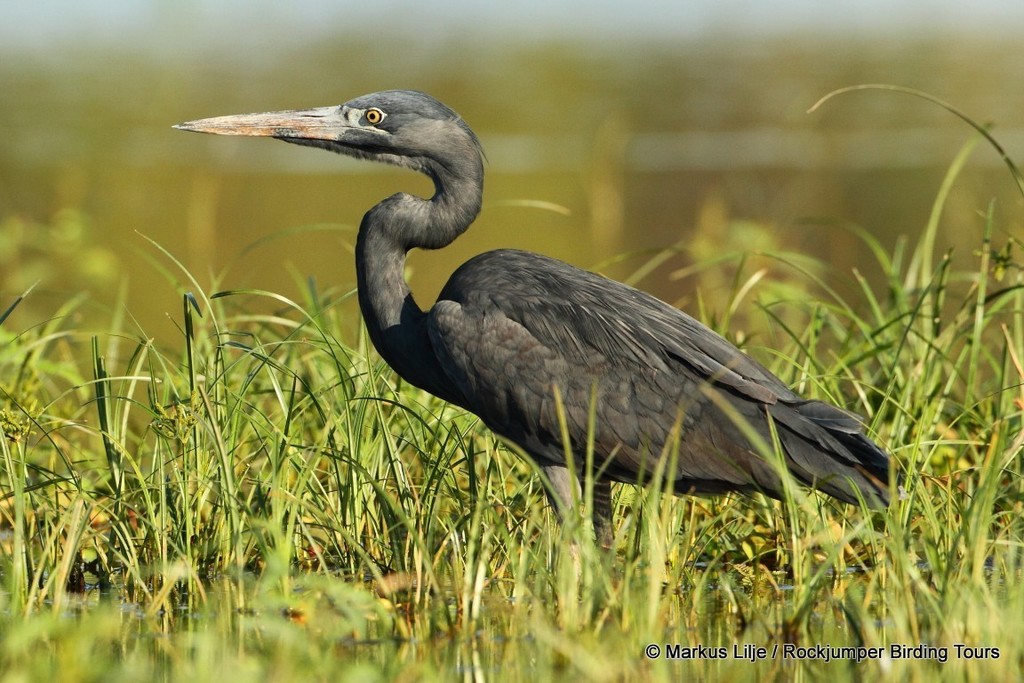
Humblot's heron (Ardea humbloti), also known as the Madagascar heron, is a species of heron. In Madagascar, it is uncommon to the north and west coasts as well as Lake Alaotra, but also inhabits the Comoro Islands and Mayotte. Humblot's heron is an endangered species, with a population estimated at only 1,500 mature individuals. Its population is apparently declining. The major threats the heron faces are poaching (both the bird itself and its eggs) and habitat...
From the article Humblot's heron on Wikipedia (CC BY-SA), quoted section by section
Description
Humblot's heron has a uniform dark gray plumage on its body and darker feathers on its forehead and chin. Its nape feathers are elongated to form a crest. It has a large, pale bill as well as pale eyes and legs. Humblot's heron is 92–100 cm (3.02–3.28 ft) tall. Its body weight can range between 1–1.6 kg (2.2–3.5 lb). The bill length ranges from 13–14.93 cm (5.12–5.88 in) while the bill depth ranges from 2.45–2.69 cm (0.96–1.06 in).
Range & habitat
Humblot's heron is endemic to the island of Madagascar and is most commonly found in the coastal lowlands of southern, western and northern Madagascar. Small populations have also been found in the neighboring islands of Comoros and Mayotte. There has been one recorded and accepted observation of the heron in mainland Africa, in a game reserve in Tanzania. The total population of Humblot's heron in Madagascar was estimated in 2006 at 1,000 to 3,000 individuals.
Humblot's heron inhabits fresh, brackish or saltwater wetlands. It prefers tidal areas but also inhabits lakes, rivers, mangroves and estuaries. It is found most commonly at low elevations but has been recorded up to an altitude of 1,500 m (4,900 ft). It does not migrate, however it is able to disperse over long distances, as shown by its presence in mainland Africa.
Wikipedia: “Distribution and habitat”
What it does
Humblot's heron primarily eats medium and large-sized fish as well as crustaceans. They forage on floating vegetation in clear, shallow water or in the ingoing and outgoing tides. They are passive feeders, therefore they remain stationary for long periods of time, often hunched or with their neck extended over the water. After catching their prey, they will fly to solid ground to consume it.
Wikipedia: “Diet”
Listen
Looking for field recordings…
Where it lives
Recorded sightings
—
geo-referenced records in GBIF, from museums, herbaria and field observers.
Drag the globe to turn it. Dots are where records exist, not a range map; darker means more records.
In the stacks
Searching the stacks…
Every page naming Ardea humbloti in the Biodiversity Heritage Library →
This page is assembled live from iNaturalist, GBIF, Wikipedia, the Source Library and the Internet Archive. It is not yet part of the hand-edited codex. iNaturalist taxon 4971.