 NL·0280
Herbarium of the Nature Library
- Name
- Pisaster ochraceus
- Family
- Asteriidae
- Native to
- Pacific coast of North America from Alaska to Baja California
- Habitat
- Rocky intertidal, Shallow subtidal
Ochre sea star
Pisaster ochraceus
Also calledPurple sea star (English) · Étoile de mer ocre (French) · Estrella de mar ocre (Spanish)
The sea star that gave ecology the idea of the 'keystone species'. When Robert Paine removed it from rocks in Washington State in the 1960s, mussels took over and the variety of shore life collapsed.
Pisaster ochraceus, generally known as the purple sea star, ochre sea star, or ochre starfish, is a common seastar found among the waters of the Pacific Ocean. Identified as a keystone species, P. ochraceus is considered an important indicator for the health of the intertidal zone. Wikipedia
What it can do
- iPulls mussel shells apart with hundreds of tube feet
- iiPushes its stomach out through its mouth to digest prey inside the shell
- iiiRegenerates lost arms
- ivCan survive hours out of water at low tide
In the field
Field marks
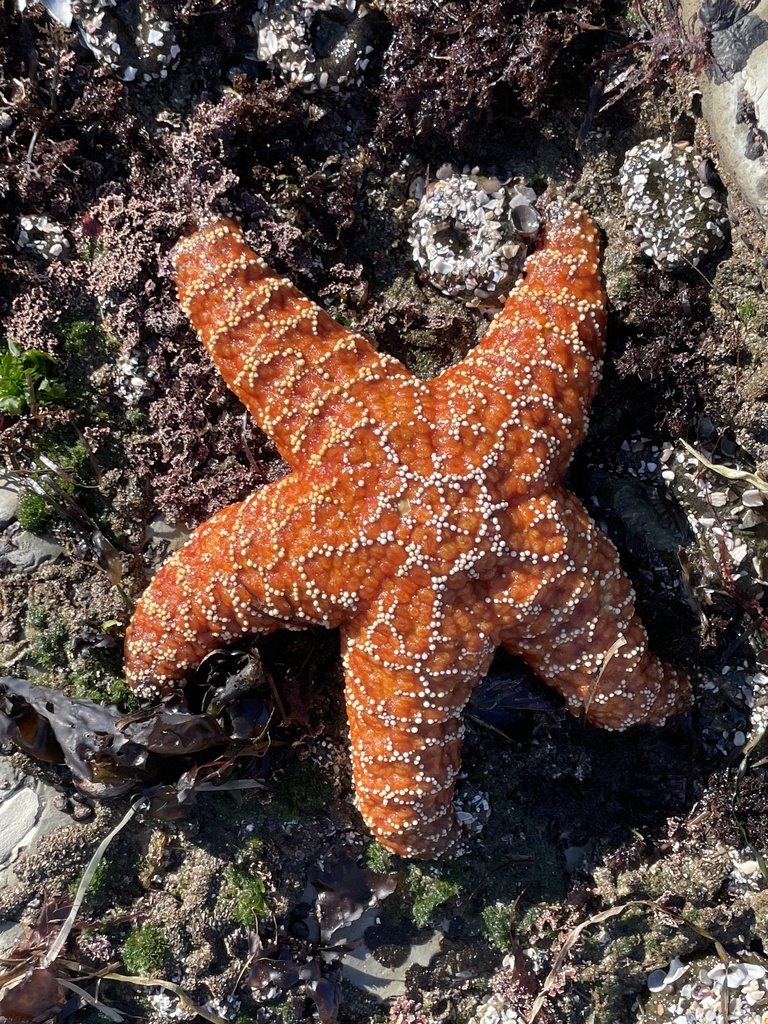
- aFive thick, stiff arms
- bColour purple, orange, ochre or brown
- cUpper surface covered with small white spines in a net-like or star-shaped pattern
- dFirm, rough texture
- Not to be confused with
- Giant spined star (Pisaster giganteus) has larger, blue-ringed spines. Mottled star (Evasterias troschelii) has slimmer arms and is mottled. Leather star (Dermasterias imbricata) is smooth and slippery.
- Where to see it
- Rocky shores at low tide from Vancouver Island to California, e.g. Olympic National Park, Monterey Bay and Mukkaw Bay (Washington).
- When
- Year-round; best seen on low spring tides
Life & habits
- Diet
- Mainly California mussels; also barnacles, limpets, snails and chitons
- Habitat
- Wave-exposed rocky shores and mussel beds, from mid-intertidal to about 90 m
- Size
- Usually 10–25 cm across, up to about 50 cm
- Lifespan
- Often 20 years or more
At high tide it moves up into mussel beds to feed; at low tide it clusters in crevices to avoid drying out.
Where it lives
Recorded sightings
—
geo-referenced records in GBIF, from museums, herbaria and field observers.
Native range
Pacific coast of North America from Alaska to Baja California
Drag the globe to turn it. Dots are where records exist, not a range map; darker means more records.
In the stacks
Searching the stacks…
Every page naming Pisaster ochraceus in the Biodiversity Heritage Library →
Marginalia
Robert Paine's experiments at Mukkaw Bay, published in 1966 and 1969, coined the term 'keystone species', one of the most influential ideas in conservation biology.
Curiosity
Sea star wasting syndrome killed most ochre stars along parts of the Pacific coast in 2013–2014, turning the animals into melting, disintegrating masses; many populations have since partly recovered.
Kinship

Photographs: iNaturalist contributors under the licences shown. Records: GBIF.org. Historical plates: Source Library (CC BY-SA 4.0; originals public domain). Summary text: Nature Library editors and Wikipedia (CC BY-SA). Medicinal and edibility notes are historical and educational, not advice. iNaturalist taxon 49699.