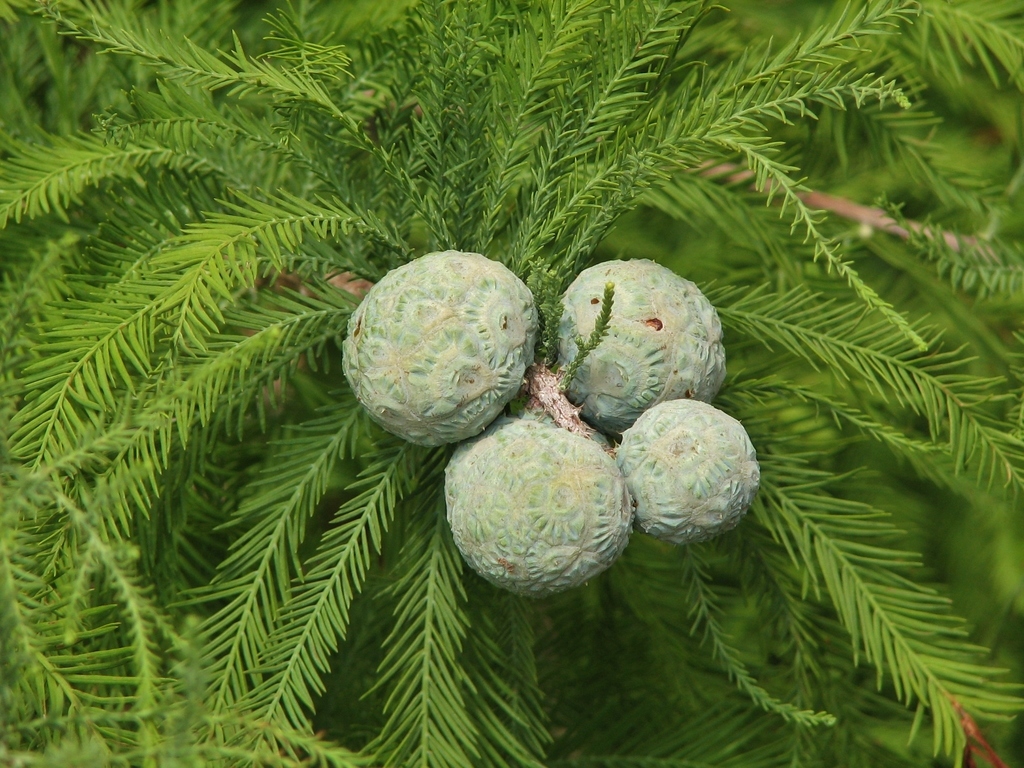
baldcypress
Taxodium distichum
Taxodium distichum, the bald cypress, bald-cypress, baldcypress, or swamp cypress; French: cyprès chauve;
cipre in Louisiana) is a deciduous conifer in the cypress family, Cupressaceae. It is native to the Southeastern United States. Hardy and tough, this tree adapts to a wide range of soil types, whether wet, salty, dry, or swampy. It is noted for the russet-red fall color of its lacy needles. It is both extremely flood tolerant and rather drought hardy.
From the article Taxodium distichum on Wikipedia (CC BY-SA), quoted section by section
Description
Taxodium distichum is a large, slow to fast-growing, and long-lived deciduous coniferous tree. It typically grows to heights of 35–120 feet (10–40 m) and has a trunk diameter of 3–7 feet (0.9–2.1 m). The main trunk is often surrounded by cypress knees. The bark is grayish brown to reddish brown, thin, and fibrous with a stringy texture. Young trees have more easily-peelable bark. The needle-like leaves are 1⁄2 to 3⁄4 inch (1.3 to 1.9 cm) long and are simple, alternate, green, and linear, with entire margins. In autumn, the leaves turn yellow or copper red. The bald cypress is deciduous. This species is monoecious, with male and female cones on a single plant forming on slender, tassel-like structures near the edge of branchlets. The tree produces cones in April and the seeds ripen in October. The male and female strobili are produced from buds formed in late autumn, with pollination in early winter, and mature in about 12 months. Male cones emerge on panicles that are 4–5 inches (10–13 cm) inches long. Female cones are round, resinous and green while young. They then turn hard and then brown as the tree matures. They are globular and 2.0–3.5 cm (3⁄4–1+3⁄8 in) in diameter. They have from 20 to 30 spirally arranged, four-sided scales, each bearing one, two, or rarely three triangular seeds. Each cone contains 20 to 40 large seeds. …
Range & habitat
The native range extends from southeastern New Jersey south to Florida and west to Central Texas and southeastern Oklahoma, and also inland up the Mississippi River to southernmost Illinois and Indiana. Ancient bald cypress forests, with some trees more than 1,700 years old, once dominated swamps in the Southeast. The original range had been thought to only reach as far north as Delaware, but researchers have now found a natural forest on the Cape May Peninsula in southern New Jersey. The species can also be found growing outside its natural native range, in New York and Pennsylvania. The largest remaining old-growth stands are at Corkscrew Swamp Sanctuary, near Naples, Florida, and in the Three Sisters tract along eastern North Carolina's Black River. The Corkscrew trees are around 500 years of age, and some exceed 40 m (130 ft) in height. In 1985, the Black River trees were cored by a dendrochronologist from the University of Arkansas, who found that some began growing as early as 364 AD. A subsequent visit to the area in 2019 revealed a tree dated by its tree-ring count to 605 BC, ranking as the ninth-oldest tree in the world.
In 2012, scuba divers discovered an underwater cypress forest several miles off the coast of Mobile, Alabama, in 60 feet of water. …
Wikipedia: “Habitat and distribution”
What it does
The bald cypress is monoecious. Male and female strobili mature in one growing season from buds formed the previous year. The male catkins are about 2 mm (0.079 in) in diameter and are borne in slender, purplish, drooping clusters 7 to 13 cm (2+3⁄4 to 5 in) long that are conspicuous during the winter on this deciduous conifer. Pollen is shed in March and April. Female conelets are found singly or in clusters of two or three. The globose cones turn from green to brownish-purple as they mature from October to December. The cones are 13 to 36 mm (0.51 to 1.42 in) in diameter and consist of 9 to 15 four-sided scales that break away irregularly after maturity. Each scale can bear two (rarely three) irregular, triangular seeds with thick, horny, warty coats and projecting flanges. The number of seeds per cone averages 16 and ranges from 2 to 34. Cleaned seeds number from about 5,600 to 18,430 per kg (2,540 to 8,360 per lb).
Seed production and dissemination. Some seeds are produced every year, and good seed crops occur at three- to five-year intervals. At maturity, the cone scales with their resin-coated seeds adhering to them, or sometimes entire cones, drop to the water or ground. This drop of mature seeds is often hastened by squirrels, which eat bald cypress seeds, but usually drop several scales with undamaged seeds still attached to each cone they pick. …
Wikipedia: “Reproduction and early growth”
At the table
The bald cypress is hardy and can be planted in hardiness zones 4 through 10 in the US or prehaps even down to USDA zone 11. The species is a popular ornamental tree that is cultivated for its light, feathery foliage and orangey brown to dull red autumnal color. In cultivation it thrives on a wide range of soils, including well-drained sites where it would not grow naturally because juvenile seedlings cannot compete with other vegetation. Cultivation is successful far north of its native range, even to southern Canada. It is also commonly planted in Europe, Asia, and other temperate and subtropical locales. Additionally it is sometimes planted in gardens and parks Eastern Australia with most specimens being found in Temperate to warm temperate areas although two trees are thriving in an open location along a drain on the side of the highway north of Port Douglas Queensland (the tree itself is at a latitude and longitude of-16.4853970, 145.4134609), so it would seem the species can grow well in tropical conditions. It does, however, require hot summers for good growth. When planted in locales with the cool summers of oceanic climates, growth is healthy but very slow; some specimens in northeastern England have only grown to 4–5 m (13–16 ft) tall in 50 years and do not produce cones. …
Wikipedia: “Cultivation and uses”
Where it lives
Recorded sightings
—
geo-referenced records in GBIF, from museums, herbaria and field observers.
Drag the globe to turn it. Dots are where records exist, not a range map; darker means more records.
In the old herbals & bestiaries

In the stacks
Searching the stacks…
Every page naming Taxodium distichum in the Biodiversity Heritage Library →
This page is assembled live from iNaturalist, GBIF, Wikipedia, the Source Library and the Internet Archive. It is not yet part of the hand-edited codex. iNaturalist taxon 49666.