- Animals
- ›Arthropods
- ›Chelicerates
- ›Arachnids
- ›Spiders
- ›Typical Spiders
- ›Entelegyne Spiders
- ›Orbweavers and Allies
- ›Orbweavers
- ›Gasteracanthinae
- ›Gasteracantha
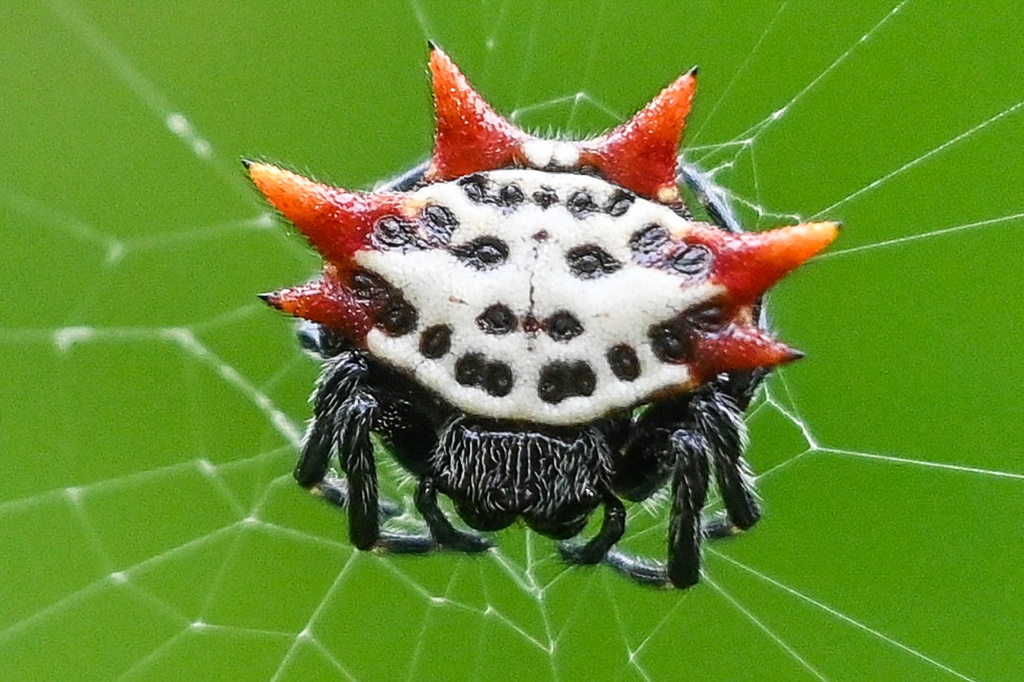
Spinybacked Orbweaver
Gasteracantha cancriformis
Gasteracantha cancriformis (spinybacked orbweaver) is a species of orb-weaver spider (family Araneidae). It is widely distributed in the New World.
The genus name Gasteracantha derives from the Ancient Greek γαστήρ (gastḗr), meaning "belly", and ἄκανθα (ákantha), meaning "thorn", while the specific epithet cancriformis derives from the Latin words cancer ("crab") and forma ("shape, form, appearance").
From the article Gasteracantha cancriformis on Wikipedia (CC BY-SA), quoted section by section
Description
Females are 5–9 mm (0.20–0.35 in) long and 10–13 mm (0.39–0.51 in) wide. The six abdominal spine-like projections on the abdomen are characteristic. The carapace, legs, and underside are black with white spots under the abdomen. Variations occur in the colour of the upperside of the abdomen - a white or yellow colour with both featuring black spots. A white upper side can have either red or black spines while a yellow upperside can only have black ones. Like with many other spiders, males are much smaller (2 to 3 mm long) and longer than wide. All morphs have six abdominal spines. They are similar to the females in colour, but have a gray abdomen with white spots and the spines are reduced to four or five stubby projections. This species of spider does not live very long. In fact, the lifespan lasts only until reproduction, which usually takes place in the spring following the winter when they hatched. Females die after producing an egg mass, and males die six days after a complete cycle of sperm induction to the female.
Range & habitat
G. cancriformis is native to North America, Central America, the Caribbean and South America. It has been introduced elsewhere, including Hawaii. It prefers living around the edge of woodland and shrubby gardens. Many studies about G. cancriformis are performed in citrus groves in Florida. G. cancriformis is seen to coexist within and on the edges of the colonies of other colonial orb-weaver spiders, mainly Metepeira incrassata. M. incrassata is known to form large colonies ranging from few hundreds to few thousands of spiders, and their colonies often accommodate other species of orb-weavers including G. cancriformis. A unique attribute of Gasteracantha members includes their abnormal 19-hour circadian rhythm, making them one of the few complex organisms with a non-nocturnal, non-diurnal wake-sleep cycle.
Wikipedia: “Distribution and habitat”
Where it lives
Recorded sightings
—
geo-referenced records in GBIF, from museums, herbaria and field observers.
Drag the globe to turn it. Dots are where records exist, not a range map; darker means more records.
In the stacks
Searching the stacks…
Every page naming Gasteracantha cancriformis in the Biodiversity Heritage Library →
This page is assembled live from iNaturalist, GBIF, Wikipedia, the Source Library and the Internet Archive. It is not yet part of the hand-edited codex. iNaturalist taxon 49540.