- Animals
- ›Chordates
- ›Vertebrates
- ›Ray-finned Fishes
- ›Carps, Characins, Catfishes and Allies
- ›Neotropical Knifefishes
- ›Ghost Knifefishes
- ›Typical Ghost Knifefishes
- ›Apteronotus
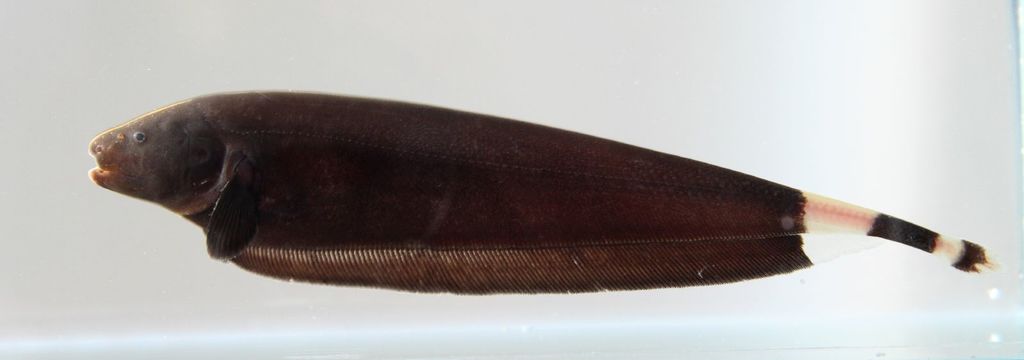
Black Ghost Knifefish
Apteronotus albifrons
The black ghost knifefish (Apteronotus albifrons) is a tropical ornamental fish belonging to the ghost knifefish family (Apteronotidae). They originate in freshwater habitats in South America where they range from Venezuela to the Paraguay–Paraná River, including the Amazon Basin. They are popular in aquaria. The fish is all black except for two white rings on its tail, and a white blaze on its nose, which can occasionally extend into a stripe down its back. It moves mainly by undulating a long fin on its underside. It will grow to a length of 45–50 centimetres (18–20 in).
Black ghost knifefish are nocturnal. They are a weakly electric fish which use an electric organ and receptors distributed over the length of their body in order to locate prey, including insect larvae.
From the article Black ghost knifefish on Wikipedia (CC BY-SA), quoted section by section
Description
The black ghost knifefish has an elongate compressed body with a finless back, short snout, large mouth and a long fin along its abdomen. This fin is a long fused ventral and anal fin as these fish typically have an absent caudal fin. It has cycloid scales. Adults can reach mature lengths of 45–50 cm (18–20 in). Its body is entirely black, save for two white bands circling the body: one near its caudal fin and the other near its anal fin. It may also have a white band extending from the snout to the top of its head. Pale bands on the tail are a synapomorphy for its monophyletic clade. The presence of these two semi-clear bands encircle the caudal end of the fish throughout its development, clearly signifying the A. albifrons species complex. The black ghost knifefish is benthopelagic, so they live in the water column and the bottom of bodies of water.
Range & habitat
The black ghost knifefish is distributed in the river systems and small creeks of South America, including the Orinoco, Guianas, the Amazon, Ucayale, Rio Paraguay, and Rio Parana. Some native-given names of this fish are "Cheeogaa" and "Tovira cavallo". They are often regarded as the most widespread apteronotid species, and can be seen from Ecuador to Brazil.
Wikipedia: “Distribution”
What it does
The black ghost knifefish is considered one of the large-mouthed species of the Apteronotidae family and has been observed eating other smaller fish and shrimp. They are carnivores and hunt during the night. Their diet mainly consists of insect larvae, small crustaceans, and smaller fish. Black ghost knifefish use their electrosensory systems to hunt in the dark of night and in turbid muddy water. Their high maneuverability allows for excellent foraging in cluttered environments. Prey is often captured with a short but quick lunge. Some predatory fish will prey on the black ghost knifefish in the wild and will result in lots of damage on the caudal end of the bodies of wild knifefish. As a response to this pressure, gymnotiforms have evolved the ability to regenerate tails and parts of the caudal spinal cord with efficiency.
Wikipedia: “Diet”
In human culture
In regards to reproduction, members of the gymnotiform order are fractional spawners, so the black ghost knifefish spawn their sticky eggs irregularly, as the number of eggs spawned is not consistent every time. Their fecundity can range from 1 to 105 eggs. They also choose spawning sites carefully to ensure well-hidden eggs. The Apteronotus species will hide eggs one at a time in tiny holes or gaps in the environment. Eggs are also deposited at night to early morning between 11 pm and 2 am using their electrosensory object location abilities. Juvenile black knife ghostfish often reach the minimum size of maturity when they are around 1 year old or even earlier. Research is limited on reproduction of Apteronotus albifrons, but it has been shown that they share many similarities with Apteronotus leptorhynchus. The juveniles are shown to have a larger head than their adult counterparts. Apteronotus also seem to have a larger yolk sac than other species in their order. Gonad maturation can be induced by decreasing the conductivity of and increasing the height level of water they reside in. The black ghost knifefish will choose a single male to spawn. If there is more than one male, a rivalry will occur while the males compete by driving away other males aggressively.
Wikipedia: “Life history”
Where it lives
Recorded sightings
—
geo-referenced records in GBIF, from museums, herbaria and field observers.
Drag the globe to turn it. Dots are where records exist, not a range map; darker means more records.
In the stacks
Searching the stacks…
Every page naming Apteronotus albifrons in the Biodiversity Heritage Library →
This page is assembled live from iNaturalist, GBIF, Wikipedia, the Source Library and the Internet Archive. It is not yet part of the hand-edited codex. iNaturalist taxon 493695.