- Animals
- ›Chordates
- ›Vertebrates
- ›Birds
- ›Pelicans, Herons, Ibises, and Allies
- ›Herons, Egrets, and Bitterns
- ›Typical Herons and Egrets
- ›Egretta
On eBird ↗
White-faced Heron
Live sightings near you, the range map, bar charts of when it is seen, and Macaulay Library photos and recordings.
White-faced Heron
Egretta novaehollandiae
The white-faced heron (Egretta novaehollandiae) also known as the white-fronted heron, and incorrectly as the grey heron, or blue crane, is a common bird throughout most of Australasia, including New Guinea, the islands of Torres Strait, Indonesia, New Zealand, and all but the driest areas of Australia.
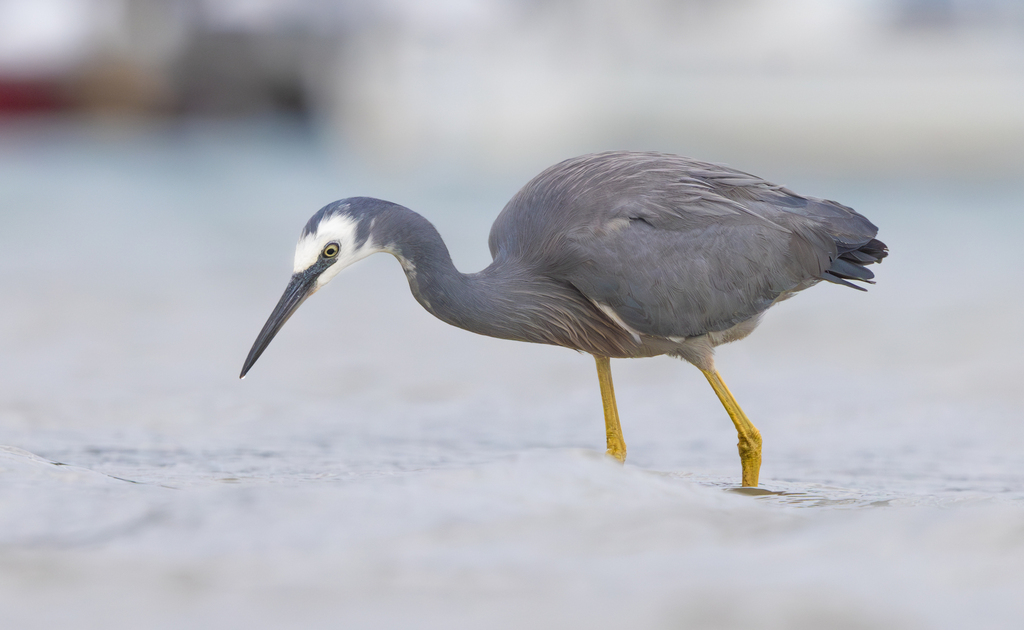
It is a medium-sized heron, pale, slightly bluish-grey, with yellow legs and white facial markings. It can be found almost anywhere near shallow water, fresh or salt, and although it is prompt to depart the scene on long, slow-beating wings if disturbed, it will boldly raid suburban fish ponds.
From the article White-faced heron on Wikipedia (CC BY-SA), quoted section by section
Description
The adult white-faced heron is medium-sized for the family and mostly pale blue-grey. The forehead, crown, chin and upper throat are white. The crown pattern is variable, with the white occasionally spreading down the neck; the variability makes identification of individuals possible. The iris may be grey, green, dull yellow or cinnamon. The regions between the eye and bill on the side of the head (lores) are black. The beak is black and often pale grey at the base. During the breeding season pinkish-brown or bronze nuptial plumes appear on the foreneck and breast, with blue-grey plumes appearing on the back. The adult typically weighs 550 g (1.21 lb) and ranges from 60 to 70 cm (24–28 in) in height. Immature birds are paler grey with only the throat white, and often have a reddish colour on the underparts. Chicks are typically covered with grey down.
Range & habitat
The white-faced heron is found throughout most of Australasia, including New Guinea, the islands of Torres Strait, Indonesia, New Caledonia, New Zealand, the islands of the Subantarctic, and all but the driest areas of Australia. The species is now resident on Christmas Island but has not yet been recorded breeding there. It is also commonly found on Lombok, Flores and Sumbawa, and has appeared as a vagrant in China, the Cocos Islands and the Solomon Islands. It is mostly a winter visitor to the Northern Territory. It was self-introduced to New Zealand in the late 1940s. It is the only heron recorded breeding in Tasmania. The white-faced heron is locally nomadic and found in both fresh and salty wetlands, farm dams, pastures, grasslands, crops, shores, saltmarsh, tidal mudflats, boat-harbours, beaches, golf courses, orchards or in garden fish-ponds. It is protected in Australia under the National Parks and Wildlife Act 1974.
Wikipedia: “Distribution and habitat”
What it does
The white-faced heron typically perches on fence-posts, trees, telephone poles and house roofs. Its flight is slow and bouncing.
Call. The most common call of the white-faced heron is a gravelly croak or gobble, graak or graaw and is typically given in flight, in interactions or in aggressive encounters. Another call, gow, gow, gow is typically given upon returning to a nest. High pitched wrank, oooooooooh or aaarrrgh calls are given as alarm calls.
Breeding. Breeding generally takes place in the austral spring, but the birds may breed at other times in response to rainfall. Breeding generally takes place in southern Australia, and birds disperse for long distances at other times of year. Both sexes share the task of building the nest, incubating the eggs and caring for the young. The nest is an untidy shallow bowl, made of sticks and usually placed on a leafy branch 5–12 m high, at altitudes from sea level to over 1000 m. When breeding the birds have long feathers (nuptial plumes) on the neck, head and back. A typical clutch has three to five pale blue eggs. with an average size of 48.5×35 mm. Normally only one brood is raised per year. Incubation lasts approximately 25 days. The parents guard the chicks for 3–4 weeks and fledging takes place 40 days after hatching. Typical nestling predators include kookaburras, Australian magpies, hawks and owls.
Feeding. …
Wikipedia: “Behaviour”
Listen
Looking for field recordings…
Where it lives
Recorded sightings
—
geo-referenced records in GBIF, from museums, herbaria and field observers.
Drag the globe to turn it. Dots are where records exist, not a range map; darker means more records.
In the stacks
Searching the stacks…
Every page naming Egretta novaehollandiae in the Biodiversity Heritage Library →
This page is assembled live from iNaturalist, GBIF, Wikipedia, the Source Library and the Internet Archive. It is not yet part of the hand-edited codex. iNaturalist taxon 4936.