- Animals
- ›Arthropods
- ›Crustaceans
- ›Typical Crustaceans
- ›Malacostracans
- ›Decapods, Isopods, and allies
- ›Decapods and Krill
- ›Decapods
- ›Crabs, Lobsters, Shrimps, and Allies
- ›True Crabs
- ›Eubrachyuran Crabs
- ›Thoracotrematan Crabs
- ›Shore and marsh crabs
- ›Varunid crabs
- ›Varuninae
- ›Hemigrapsus
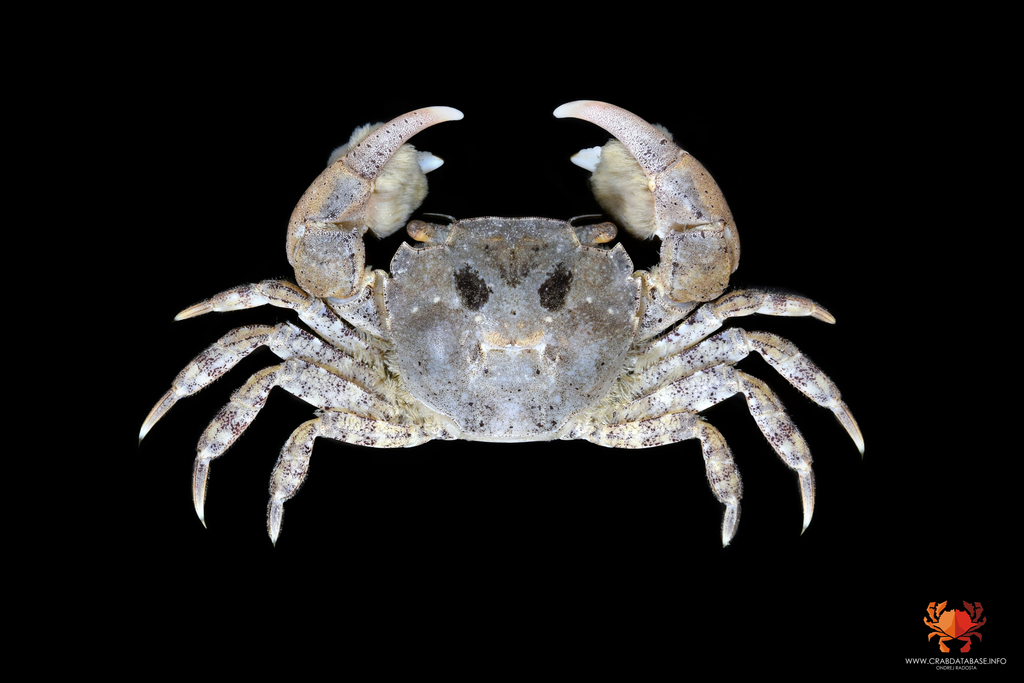
Brush-clawed Shore Crab
Hemigrapsus takanoi
Hemigrapsus takanoi, the brush-clawed shore crab or Asian shore crab, is a small crab of the family Varunidae (formerly classified as Grapsidae) that lives on rocky shores surrounding the Pacific Ocean, and which is invasive along the European coastlines. This crab is omnivorous and eats small fish, invertebrates and algae.
From the article Hemigrapsus takanoi on Wikipedia (CC BY-SA), quoted section by section
Description
Prior to 2005, the name Hemigrapsus penicillatus was used to cover animals that are now known to represent two distinct species. Hemigrapsus penicillatus (sensu stricto) has smaller patches of setae (bristles) on the chelae (claws) in males; Hemigrapsus takanoi has larger setal patches and larger coloured spots on the exoskeleton. It can be a variety of colors, including orange-brown, maroon, or green, with striped legs and spotted claws. Male brush-clawed shore crabs have a patch of light brown or yellow bristles (known as setae) on their chelae (pincers). Their carapace width typically reaches about 2.5 centimetres (1.0 in), and has three spines. Before developing into juvenile crabs, larval brush-clawed crabs spend almost one month floating in the ocean. This allows them to find food and new habitats.
Range & habitat
Hemigrapsus takanoi is native to Japan, Korea, Russia and China, although the limits of its distribution are still unclear.
Introduced distribution. Hemigrapsus takanoi has been introduced to the coasts of Europe by human agency, and has become an invasive species there. Although originally reported as Hemigrapsus penicillatus, that species has since been divided into two species, and it is H. takanoi, not H. penicillatus which occurs on the coasts of Europe. It is thought to have arrived in 1993, having been discovered in La Rochelle, France, in 1994. A study of hull fouling animals on ships in Hamburg Dockyard and Bremerhaven at the time found six specimens of H. takanoi on the car-carrying ship SPICA, which travelled between the Asian ports of Tokyo, Osaka, Kobe and Pusan, and Europe. The ship was known to have passed the French coast in 1993, and it is thought that the introduction is likely to have occurred when crabs fell from the hull of the SPICA at that time. By 1997, its range in Europe extended from Fromentine in France (adjacent to the Île de Noirmoutier) to Laredo, Spain, covering a coastline of 700 kilometres (430 mi) around the Bay of Biscay. By 1999, it had reached Le Havre on the English Channel, and by 2005, it had reached the French Opal Coast at the entrance to the North Sea. Based on the native climate, it was predicted in 1999 that H. …
Wikipedia: “Distribution”
Where it lives
Recorded sightings
—
geo-referenced records in GBIF, from museums, herbaria and field observers.
Drag the globe to turn it. Dots are where records exist, not a range map; darker means more records.
In the stacks
Searching the stacks…
Every page naming Hemigrapsus takanoi in the Biodiversity Heritage Library →
This page is assembled live from iNaturalist, GBIF, Wikipedia, the Source Library and the Internet Archive. It is not yet part of the hand-edited codex. iNaturalist taxon 491876.