On eBird ↗
Shore Plover
Live sightings near you, the range map, bar charts of when it is seen, and Macaulay Library photos and recordings.
Shore Plover
Thinornis novaeseelandiae
The shore plover (Māori: tūturuatu, Moriori: tchūriwat', Thinornis novaeseelandiae), also known as the shore dotterel, is a small plover endemic to New Zealand. Once found all around the New Zealand coast, it is now restricted to a few offshore islands. It is one of the world's rarest shorebirds, with a population of roughly 250.
From the article Shore plover on Wikipedia (CC BY-SA), quoted section by section
Description
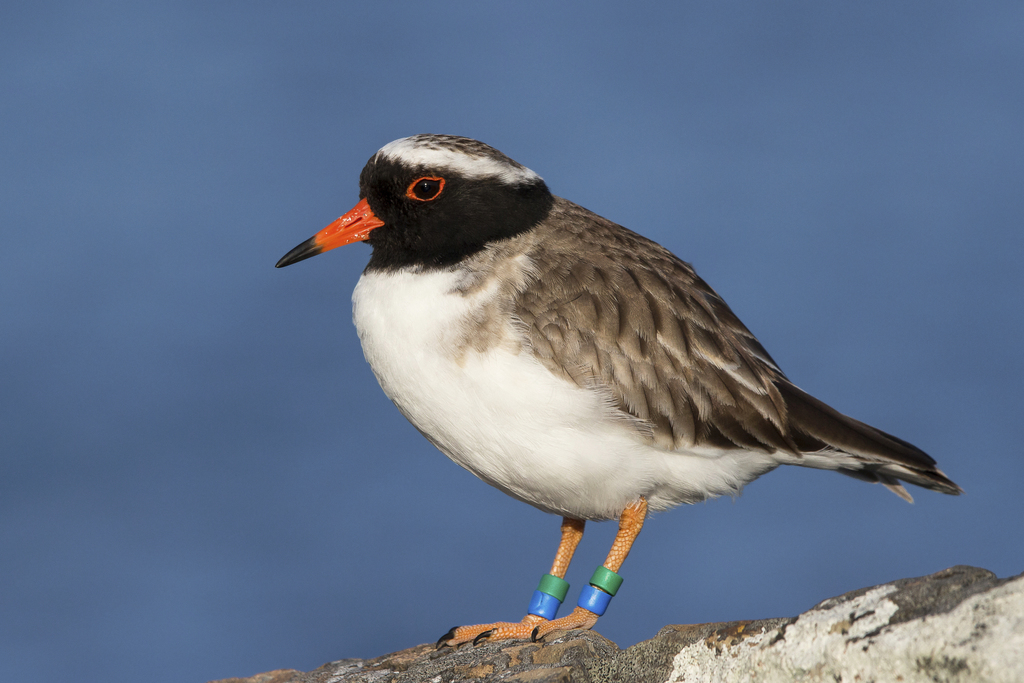
The shore plover is about 20 cm long, brown above and white below, with a black (male) or brown (female) mask; the brown back feathers have narrow pale fringes, giving a scaly appearance at close range. There is a distinctive white strip circling its head below its brown skullcap. Its legs are bright orange-red, and the bill orange-red (brighter in males than females) with a sharply defined dark tip. The wings are brown with a narrow white wingbar along the full length, and the tail brown with white sides. Juveniles differ in lacking the full dark face mask, and having the brown back feathers with broader pale fringes, giving a more strongly scaly appearance above.
Range & habitat
Although this species was historically found only on the New Zealand coast, subfossil shore plover bones have been recovered from roosts of the extinct laughing owl near rivers many kilometres inland. Cook's second expedition collected them from opposite ends of the South Island, in Fiordland and the Marlborough Sounds. There are 19th century reports of shore plovers from the South Island and several parts of the North Island, but by the 1870s they had vanished from the mainland, surviving only on the Chatham Islands. Introduced predators such as feral cats and brown rats were the main culprits in their decline. In 2026 the Shore Plover Recovery Group confirmed that a chick had fledged on Pitt Island, the first time this has occurred in 150 years.
Wikipedia: “Distribution”
Listen
Looking for field recordings…
Where it lives
Recorded sightings
—
geo-referenced records in GBIF, from museums, herbaria and field observers.
Drag the globe to turn it. Dots are where records exist, not a range map; darker means more records.
In the stacks
Searching the stacks…
Every page naming Thinornis novaeseelandiae in the Biodiversity Heritage Library →
This page is assembled live from iNaturalist, GBIF, Wikipedia, the Source Library and the Internet Archive. It is not yet part of the hand-edited codex. iNaturalist taxon 4912.