- Animals
- ›Arthropods
- ›Hexapods
- ›Entognathans
- ›Springtails
- ›Globular Springtails
- ›Dicyrtomoidea
- ›Dicyrtomidae
- ›Ptenothricinae
- ›Ptenothrix
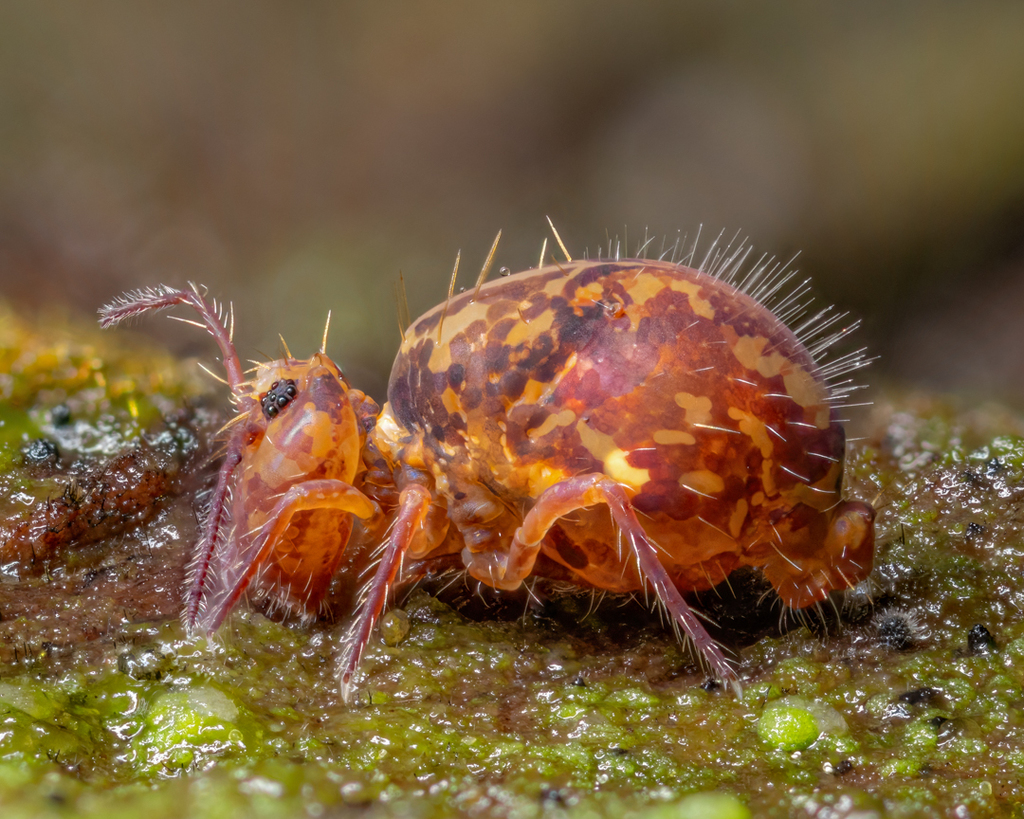
Ptenothrix maculosa
Ptenothrix maculosa is a species of globular springtail in the family Dicyrtomidae found on the temperate west coast of North America.
From the article Ptenothrix maculosa on Wikipedia (CC BY-SA), quoted section by section
Description
The species is described in terms of microscopic features that are unique, such as the arrangement and size of setae on the small abdomen at the posterior of the body, as well as relative lengths of certain setae on the tip of the furca (the jumping organ). Over time several visual patterns have been noted that will distinguish this species in photos, compared to other species found in the same locations. This photo identification has been critical for citizen science sites such as iNaturalist, to gain insight into the geographical range of the species.
Wikipedia: “Appearance and identification”
Range & habitat
This species is a common woodland species, ranging from Alaska to California. It is commonly found under rotting wood, and in and under leaf litter, where it plays the roll of a decomposer in natural areas. Ptenothrix maculosa is classified as native to, and likely endemic to North America.
Wikipedia: “Habitat”
In human culture
This species is extremely variable and has many color forms. Due to lack of microscopy, at least four other species of springtails have been mislabeled under its name. Some of the west coast springtails that were misidentified as Ptenothrix maculosa were Ptenothrix delongi, Ptenothrix beta, and Ptenothrix californica. Microscopic keying by citizen scientists across the west helped to find out the real maculosa, which had been labeled under "Undescribed Ptenothrix" by Belgian taxonomist Frans Janssens. Another misconception within the community was that the summer colour-pattern of Ptenothrix maculosa, which were misidentified as Ptenothrix palmata (a separate west coast species of springtail noted as being similar, and associated with alpine and arctic habitats). This was also proven false after multiple specimens keyed out to Ptenothrix maculosa. There was another misidentification done via pattern for this species as Ptenothrix marmorata (an east coast species of Ptenothrix) in 2021, which is thankfully the only of its kind. Another form of Ptenothrix maculosa that remained unidentified for some time was one listed on collembola.org as "Ptenothrix Species 4". Frans Janssens had conjectured that due to the different colour pattern, this may be a new species. Eventual microscopic identification showed that it was a color-pattern variant of P. maculosa. …
Wikipedia: “History and visual appearance”
Where it lives
Recorded sightings
—
geo-referenced records in GBIF, from museums, herbaria and field observers.
Drag the globe to turn it. Dots are where records exist, not a range map; darker means more records.
In the stacks
Searching the stacks…
Every page naming Ptenothrix maculosa in the Biodiversity Heritage Library →
This page is assembled live from iNaturalist, GBIF, Wikipedia, the Source Library and the Internet Archive. It is not yet part of the hand-edited codex. iNaturalist taxon 491087.