- Fungi Including Lichens
- ›Ascomycete Fungi
- ›Sac Fungi and Lichens
- ›Leotiomycetes
- ›Helotiales
- ›Gelatinodiscaceae
- ›Ascocoryne
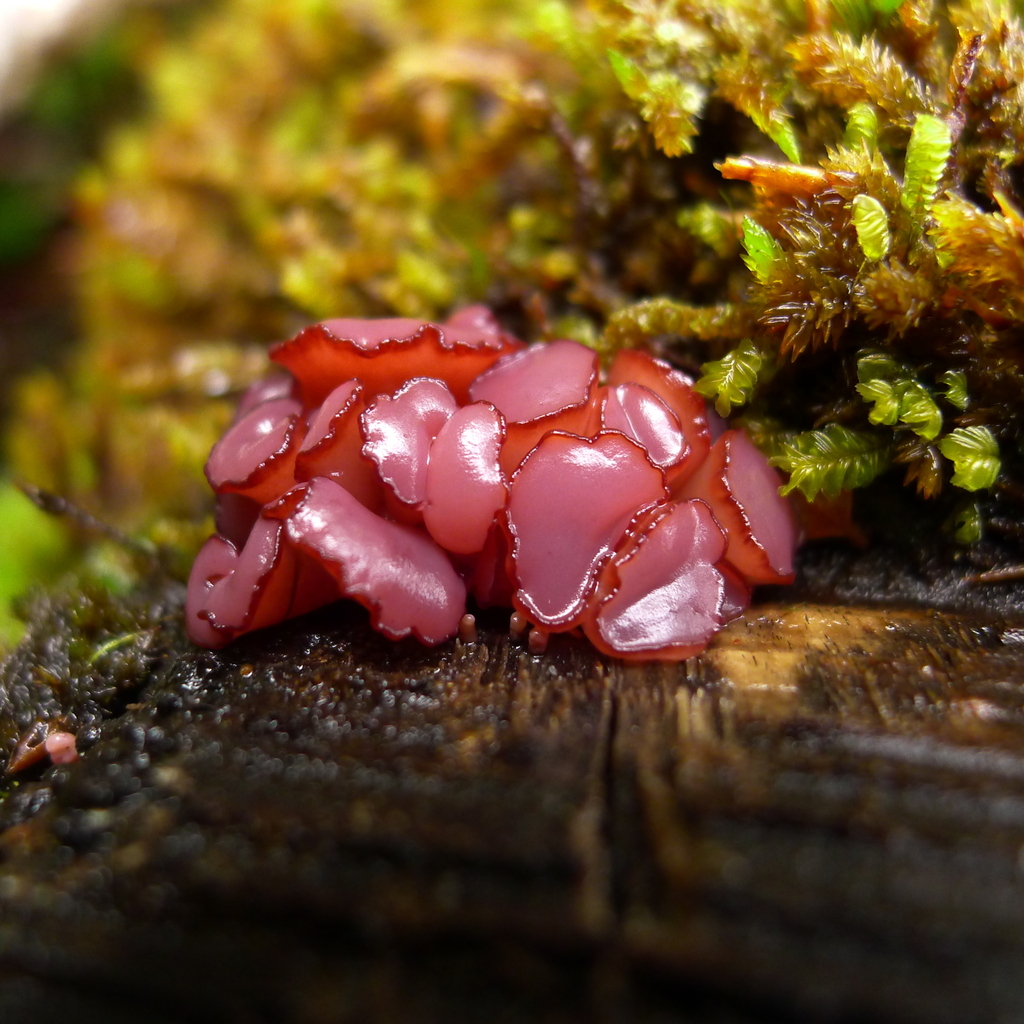
Purple Jellydisc
Ascocoryne sarcoides
Ascocoryne sarcoides is a species of fungus in the family Helotiaceae. The species name is derived from the Greek sarkodes (fleshy). Formerly known as Coryne sarcoides, its taxonomical history has been complicated by the fact that it may adopt both sexual and asexual forms. Colloquially known as jelly drops or the purple jellydisc, this common fungus appears as a gelatinous mass of pinkish or purple-colored discs. Distributed widely in North America, Eurasia, and Oceania, A. sarcoides is a saprobic fungus and grows in clusters on the trunks and branches of a variety of dead woods. Field studies suggest that colonization by A. sarcoides of the heartwood of black spruce confers some resistance to further infection by rot-causing fungi. A. sarcoides contains the antibiotic compound ascocorynin, shown in the laboratory to inhibit the growth of several gram-positive bacteria.
From the article Ascocoryne sarcoides on Wikipedia (CC BY-SA), quoted section by section
Description
This fungus is characterized by a fruiting body (technically an apothecium) with a pinkish-purple color and more or less gelatinous consistency. The apothecia, typically 0.5 to 1.5 centimetres (1⁄4 to 5⁄8 in) in diameter, start with a roughly spherical shape, then eventually flatten out to become shallowly cup-shaped with a wavy edge and smooth upper surface. The lower surface may be covered with small particles (granular), and the apothecia are either attached directly to the growing surface (sessile), or have a rudimentary stem. The apothecia are accompanied by a conidial form, where non-sexual spores are generated. The conidial form consists of sporodochia, a cushion-like asexual fruiting body mass consisting of short conidiophores (specialized stalks that bear conidia). The sporodochia are similar in color and consistency to the apothecia but very variable in shape, typically club-, spoon-, or tongue-shaped, and bearing minute, cylindrical, straight or curved conidia. As the fungus matures and the apothecia enlarge and press against each other, the apothecia coalesce to form a gelatinous, irregular mass. The flesh, similar to the appearance of the fungus, is pinkish-purple and gelatinous. The odor and taste of A. sarcoides are not distinctive. Ascocoryne sarcoides is not considered edible.
Microscopic features. …
Range & habitat
This species has a broad distribution in forested areas of North America and Europe. A saprobic fungus, it derives nutrients from decaying organic matter, and as such is usually found growing on the stumps and logs of fallen deciduous trees. However, it is also found on a variety of living trees as well. For example, in Europe it has been found on the stems of living spruce (Picea abies) in Finland, France, Great Britain, Norway, and Germany. Other collections sites include Australia, Chile, China, Cuba, Iceland, Korea, and Taiwan. In Hawaii, it grows on trunks of fallen Cibotium and Aleurites trees. A. sarcoides occurs most frequently in late summer and autumn.
Wikipedia: “Habitat and distribution”
Where it lives
Recorded sightings
—
geo-referenced records in GBIF, from museums, herbaria and field observers.
Drag the globe to turn it. Dots are where records exist, not a range map; darker means more records.
In the stacks
Searching the stacks…
Every page naming Ascocoryne sarcoides in the Biodiversity Heritage Library →
This page is assembled live from iNaturalist, GBIF, Wikipedia, the Source Library and the Internet Archive. It is not yet part of the hand-edited codex. iNaturalist taxon 49075.