- Animals
- ›Arthropods
- ›Chelicerates
- ›Arachnids
- ›Spiders
- ›Typical Spiders
- ›Entelegyne Spiders
- ›Salticoid Spiders
- ›Jumping Spiders
- ›Typical Jumping Spiders
- ›Plexippini
- ›Plexippina
- ›Evarcha
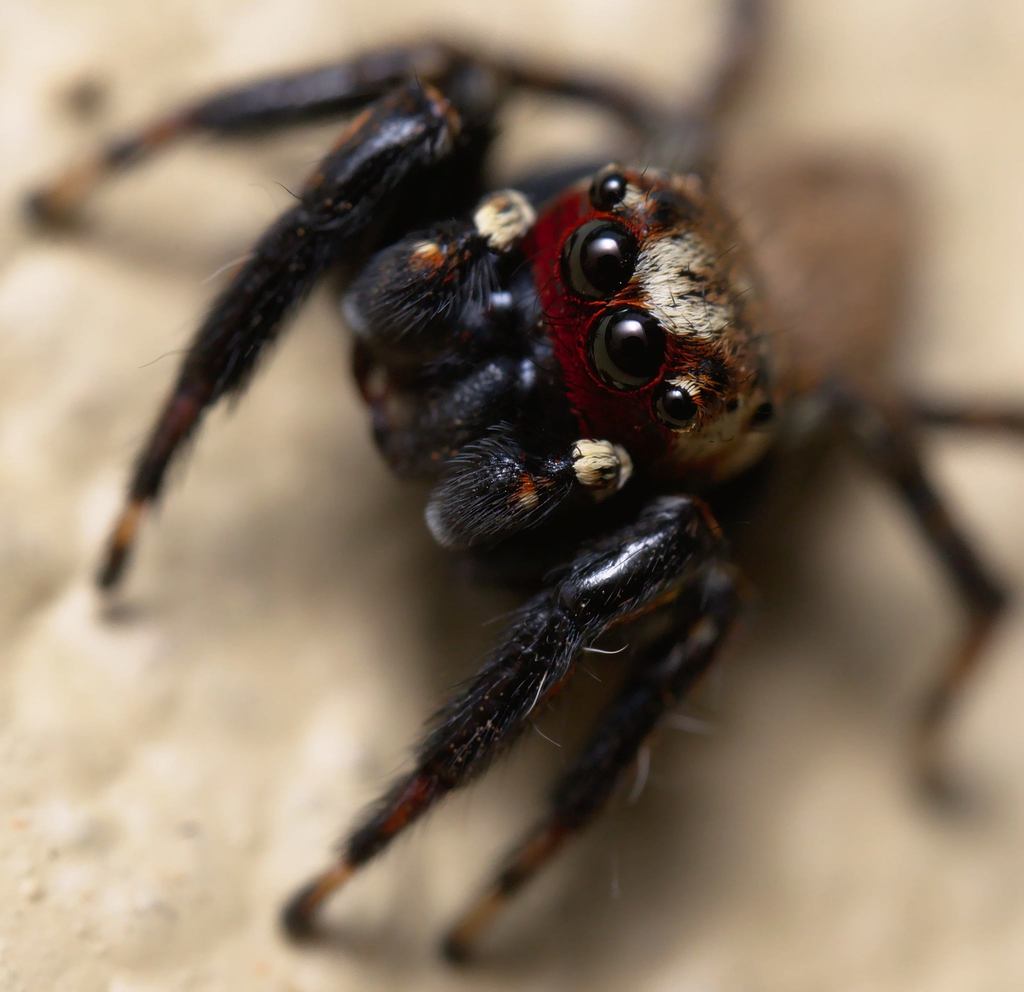
Vampire Jumping Spider
Evarcha culicivora
Evarcha culicivora is a species of jumping spider (family Salticidae) found only around Lake Victoria in Kenya and Uganda. At maturity, E. culicivora spiders have an average size of 5 mm for both males and females. The range in size for either sex is quite small, with females being only slightly larger on average (4–7 mm compared to 3–6 mm).
It is commonly known as the vampire spider because it indirectly desires the blood of vertebrates. It does this by predating on blood-sucking female mosquitoes in the genus Anopheles, the mosquito responsible for transmitting malaria in the region, as well as other vector-borne diseases in humans. Experimentally, these spiders are considered Anopheles specialists. Evarcha culicivora has an association with the introduced Lantana camara and the native Ricinus communis plants. They consume the nectar for food and preferentially use these plants as a location for courtship.
From the article Evarcha culicivora on Wikipedia (CC BY-SA), quoted section by section
Description
As juveniles, all E. culicivora are grey-brown in color, both on their bodies and face. Adult males have blood-red faces and white-hair patches above the principal eyes and at the side of the clypeus and on palp tibia. Juveniles and adult females have grey-brown faces, but adult females have a faint red tint. It is rare for adult females and juveniles to have white patches. Body lengths of males range from 3 mm to 6 mm, whereas females range from 4 mm to 7 mm.
Range & habitat
Evarcha culicivora is found only around Lake Victoria in Kenya and Uganda. This area is full of a variety of insect life and has a large number of Chaoboridae midges. These lake flies are similar in size and appearance to Anopheles mosquitos, common prey of E. culicivora, but E. culicivora disregards their presence as well as the majority of all other insects present. This species builds nests, where it primarily resides. Nests are built within closed spaces such as tree trunks or walls of buildings and are often made of dead foliage such as leaves. It hides in the grass or other plants close to the ground when it is quiescent. When it is hunting, it will go to more exposed locations such as the walls inside some mosquito-infested houses.
Wikipedia: “Habitat and distribution”
What it does
In female-female and male-male interactions, the intruder encroaches when the resident is quiescent in the nest. The intruder usually probes first and then pushes its face into the silk, chewing and tugging the silk. The resident pulls on the silk as a response. For male-female interaction at the nest, see the mating section. Observations have been made of males cohabiting with females. In cases of cohabitation, the two silk tubes are woven together and the two doors of the two chambers are aligned together. See the Courtship section for more information on how cohabitation plays a role in courtship.
Wikipedia: “Interactions at the nest”
Where it lives
Recorded sightings
—
geo-referenced records in GBIF, from museums, herbaria and field observers.
Drag the globe to turn it. Dots are where records exist, not a range map; darker means more records.
In the stacks
Searching the stacks…
Every page naming Evarcha culicivora in the Biodiversity Heritage Library →
This page is assembled live from iNaturalist, GBIF, Wikipedia, the Source Library and the Internet Archive. It is not yet part of the hand-edited codex. iNaturalist taxon 488910.