- Animals
- ›Echinoderms
- ›Sea Stars and Brittle Stars
- ›Sea Stars
- ›Forcipulatacean Sea Stars
- ›Forcipulatidan Sea Stars
- ›Asteriid Sea Stars
- ›Pisaster
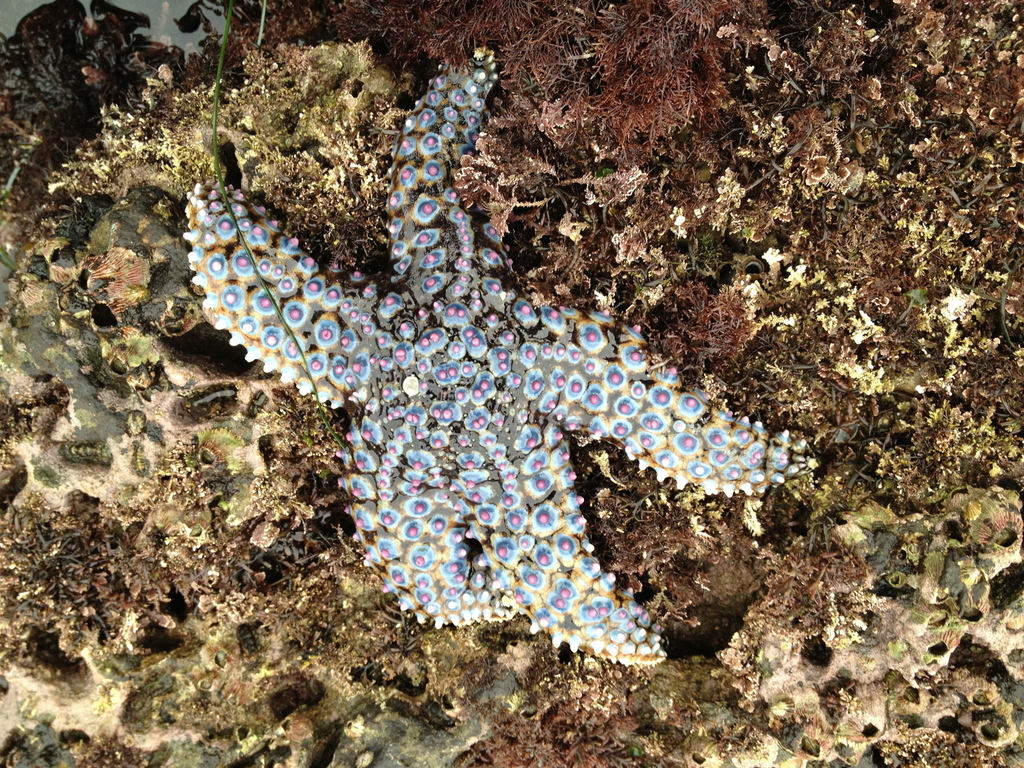
Giant Sea Star
Pisaster giganteus
Pisaster giganteus, the giant sea star, giant spined star, or knobby sea star is a species of sea star that lives along the western coast of North America from Southern California to British Columbia. It makes its home on rocky shores near the low tide mark. It preys on mollusks. It can grow as large as 24 in (61 cm) in diameter. Its color varies from brown to red or purple.
From the article Pisaster giganteus on Wikipedia (CC BY-SA), quoted section by section
Description
Giant sea stars have a dense body with wide arms. Its surface is either tan or brown, but on occasion the giant sea star can have a yellowish or grayish surface. They contain thick, blunt spines that are bluish in color with white, pink or purple tips that are swollen and surrounded by brown fuzz and pedicellariae that have a plier like shape. These pedicellariae are used as a protective mechanism against predators. They have no distinct pattern. They range from 36–48 cm (14–19 in) from the tip of one arm to the other. They are usually found up to 88 m (289 ft) down in the water.
Range & habitat
Giant sea stars are usually found around the protected coastlines with low tide. They can often be found attached to rocks, pier supports or in the sand.
Wikipedia: “Habitat”
What it does
Giant sea stars have small eggs, and their sperm contain spherical heads. Once their larvae are born, they are bilaterally symmetrical. By the time they mature and reach adulthood they are centered on a set point with radial symmetry to their bodies. The gonads of the giant sea star grow in a winters time just in time for spawning season between the months of March and April.
Wikipedia: “Reproduction and regeneration”
Where it lives
Recorded sightings
—
geo-referenced records in GBIF, from museums, herbaria and field observers.
Drag the globe to turn it. Dots are where records exist, not a range map; darker means more records.
In the stacks
Searching the stacks…
Every page naming Pisaster giganteus in the Biodiversity Heritage Library →
This page is assembled live from iNaturalist, GBIF, Wikipedia, the Source Library and the Internet Archive. It is not yet part of the hand-edited codex. iNaturalist taxon 48833.