- Animals
- ›Arthropods
- ›Crustaceans
- ›Typical Crustaceans
- ›Barnacles and Copepods
- ›Barnacles and Allies
- ›Barnacles
- ›Normal Barnacles
- ›Thoracican Barnacles
- ›Pollicipedomorpha
- ›Pollicipedidae
- ›Pollicipes
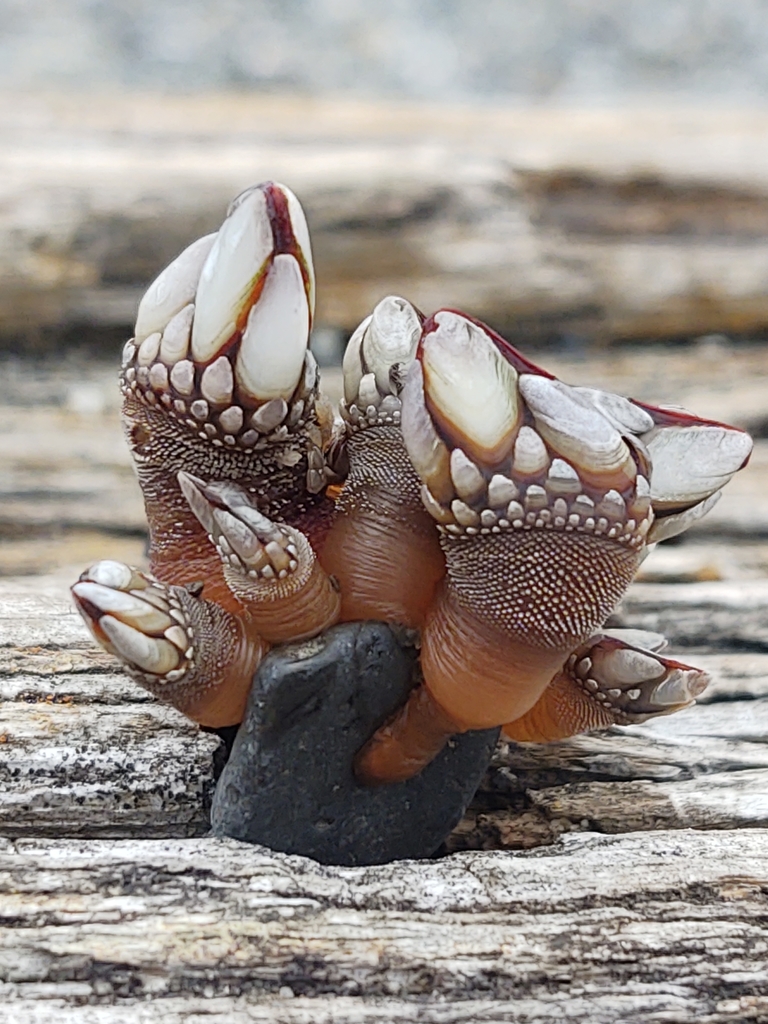
Gooseneck Barnacle
Pollicipes polymerus
Pollicipes polymerus, commonly known as the gooseneck barnacle or leaf barnacle, is a species of stalked barnacle. It is found, often in great numbers, on rocky shores on the Pacific coasts of North America.
It is a natural food resource for indigenous coastal peoples of central California, who cook them in hot ashes.
From the article Pollicipes polymerus on Wikipedia (CC BY-SA), quoted section by section
Description
Pollicipes polymerus is attached to rocks or other objects by a strong, rubbery stalk, the peduncle, which is up to 10 centimetres (4 in) long. It has a muscular interior and the leathery surface is covered in bands of minute spiny scales on short stalks. The capitulum, at the end of the peduncle, is up to 5 centimetres (2 in) long and contains the rest of the body including all the limbs and other appendages except the first pair of antennae. The outside of the capitulum bears five strengthening calcareous plates corresponding with the plates that protect an acorn barnacle. The largest of these is the carina, on the morphologically dorsal side of the capitulum, with a pair of smaller scuta and terga on either side below. Further calcification occurs from other centres on the capitulum with the formation of many small scales. The thoracic crustacean appendages are modified into feather-like cirri. They project through the aperture at the end of the capitulum and are used for feeding.
Range & habitat
Pollicipes polymerus is found in the north eastern Pacific Ocean, its range extending from southern Alaska to Baja California. It occurs on rocky coasts in the intertidal zone and favours exposed areas where there is much wave action. It tends to occur in closely associated groups and is often abundant.
Wikipedia: “Distribution and habitat”
What it does
Pollicipes polymerus is a hermaphrodite. Reproduction takes place during the summer and there may be several broods per year. The ovaries are in the upper part of the peduncle and liberate from 104,000 to 240,000 eggs at a time into the mantle cavity. Here they stick together to form egg masses. The numerous small testes lie alongside the gut. Sperm from these is passed along the extensible penis into the mantle cavity of an adjoining individual where fertilisation takes place. Self-fertilisation does not seem to occur and any individual that is more than 20 cm (8 in) from its nearest neighbour is effectively sterile. The eggs are brooded for 3 to 4 weeks until they hatch into nauplius larvae and are liberated into the sea. There they become planktonic and feed on phytoplankton. They grow and undergo 6 moults in about 40 days before becoming non-feeding cyprid larvae. These search out suitable places to settle where they undergo metamorphosis and attach themselves permanently to the substrate. They do this by secreting a strong adhesive substance from glands on the antennules. Settlement is stimulated by the presence of peduncles of other gooseneck barnacles, and may take place on the peduncles themselves.
Wikipedia: “Reproduction”
Where it lives
Recorded sightings
—
geo-referenced records in GBIF, from museums, herbaria and field observers.
Drag the globe to turn it. Dots are where records exist, not a range map; darker means more records.
In the stacks
Searching the stacks…
Every page naming Pollicipes polymerus in the Biodiversity Heritage Library →
This page is assembled live from iNaturalist, GBIF, Wikipedia, the Source Library and the Internet Archive. It is not yet part of the hand-edited codex. iNaturalist taxon 48786.