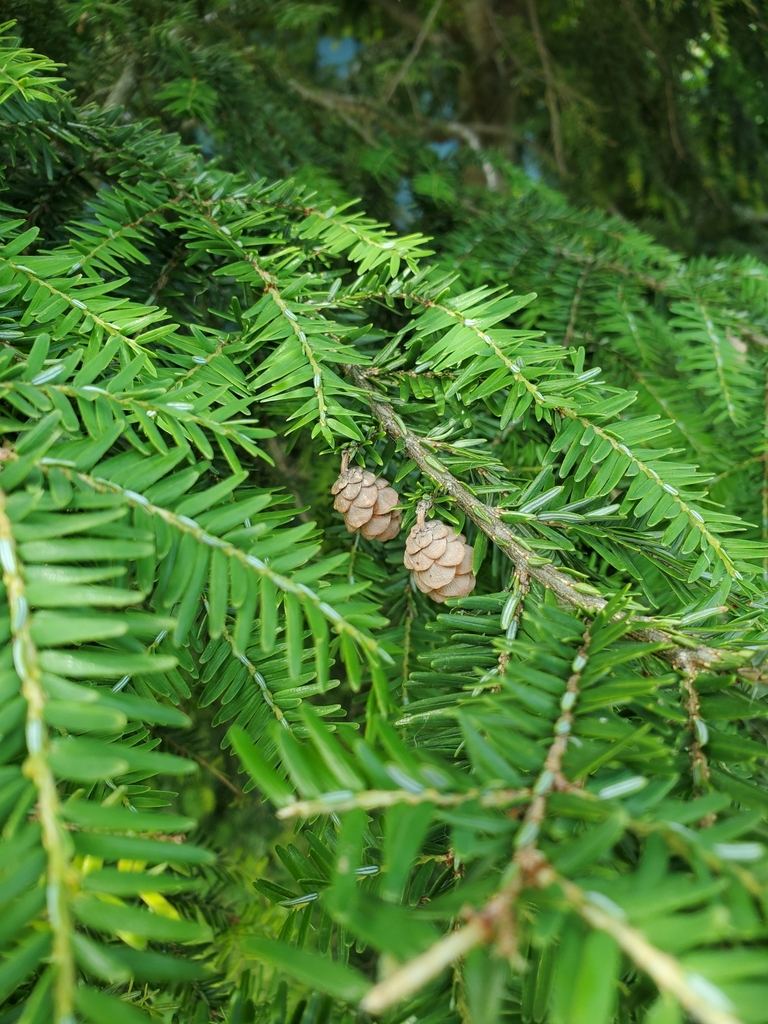
eastern hemlock
Tsuga canadensis
Tsuga canadensis, also known as Canadian hemlock, eastern hemlock-spruce, or eastern hemlock, and in the French-speaking regions of Canada as pruche du Canada, is a coniferous tree in the pine family, Pinaceae, native to eastern North America. It is the state tree of Pennsylvania. Eastern hemlocks are widespread throughout much of the Great Lakes region, the Appalachian Mountains, The Maritimes and the Northeastern United States. They have been introduced in the United Kingdom and mainland Europe, where they are used as ornamental trees.
Eastern hemlock populations in North America are threatened in much of their range by the spread of the invasive Hemlock woolly adelgid, which infests and eventually kills trees. Declines in population from hemlock wooly adelgid infestation have led to Tsuga canadensis being listed as Near Threatened on the IUCN Red List.
From the article Tsuga canadensis on Wikipedia (CC BY-SA), quoted section by section
Description
The eastern hemlock grows well in shade and is very long lived, with the oldest recorded specimen, found in Tionesta, Pennsylvania, being at least 554 years old. The tree generally reaches heights of about 31 m (102 ft), but exceptional trees have been recorded up to 53 m (174 ft). The diameter of the trunk at breast height is often 1.5 m (4 ft 11 in), but again, outstanding trees have been recorded up to 1.75 m (5 ft 9 in). The trunk is usually straight and monopodial, but very rarely is forked. The crown is broadly conic, while the brownish bark is scaly and deeply fissured, especially with age. The twigs are a yellow-brown in color with darker red-brown pulvini, and are densely pubescent. The buds are ovoid in shape and are very small, measuring only 1.5 to 2.5 mm (0 to 1⁄8 in) in length. These are usually not resinous, but may be slightly so. The leaves are typically 15 to 20 mm (0.59 to 0.79 in) in length, but may be as short as 5 mm (0.20 in) or as long as 25 mm (1 in).The leaves are arranged on little stalks, a characteristic that does not appear in the other evergreen trees. They are flattened and are typically distichous, or two-ranked. The bottom of the leaf is glaucous with two broad and clearly visible stomatal bands, while the top is a shiny green to yellow-green in color. The leaf margins are very slightly toothed, especially near the apex. …
Range & habitat
T. canadensis occurs at sea level in the north of its distribution, but is found primarily at elevations of 600–1,800 m (2,000–5,900 ft). It ranges from northeastern Minnesota eastward through southern Quebec and into Nova Scotia, and south in the Appalachian Mountains to northern Georgia and Alabama. Disjunct populations occur in the Piedmont region, northern Alabama, western Ohio and into Indiana, as well as western Wisconsin and eastern Minnesota. In Canada, it is present in Ontario and all provinces to the east except Newfoundland and Labrador. Its range completely overlaps that of the closely related Tsuga caroliniana. It is found primarily on rocky ridges, ravines, and hillsides with relatively high levels of moisture.
Climate. Eastern hemlock is generally confined to areas with highland climates, with cool and humid conditions. Precipitation in the areas where it grows is typically 740 mm (29 in) to more than 1,270 mm (50 in) per year. The lower number is more typical of northern forests that receive heavy snowfall; the higher number is common in southerly areas with high summer rainfall. Near the Atlantic coast and in the southern Appalachians where the trees often reach their greatest heights, annual rainfall often exceeds 1,520 mm (60 in). In the north of its range, the temperatures in January average −12 °C (10 °F), while in July they average only 16 °C (61 °F). …
Wikipedia: “Distribution and habitat”
What it does
The tree can be found living in association with many forest mushrooms, such as Ramaria flavosaponaria and Ganoderma tsugae (which has the common name hemlock varnish shelf.)
Wikipedia: “Ecology”
At the table
American pioneers made tea from the tree's leafy twigs and used its branches as brooms. Tea can be made from the needles. The inner bark, which is best in winter and coming into spring, can be eaten raw or boiled; it can also be used to make flour.
Wikipedia: “Uses”
How it is grown
Tsuga canadensis has long been a popular tree in cultivation. The tree's preference for partial shade and tolerance of full shade allows it to be planted in areas where other conifers would not easily grow. In addition, its very fine-textured foliage that droops to the ground, its pyramidal growth habit, and its ability to withstand hard pruning make it a desirable ornamental tree. In cultivation, it prefers sites that are slightly acidic to neutral with nutrient-rich and moist but well-drained soil. It is most often used as a specimen, for a screen, or in small group plantings, though it can also be trained as a dense formal hedge. It should not be used on roadsides where salt is used in winter, as its foliage is sensitive to salt spray. It is also poorly adapted as a windbreak tree, as wind exposure causes dieback in winter. It has several drawbacks, such as a fairly low tolerance of urban stress, intolerance for very wet or very dry soils, and susceptibility to attack by the hemlock woolly adelgid, though this is treatable. Its tendency to shed needles rapidly after being cut down renders it unsuitable as a Christmas tree. It was introduced to British gardens in 1736. In the UK, it is encountered frequently in gardens both large and small, as well as some parks, and is most common in the eastern areas of the country. …
Wikipedia: “Cultivation”
In human culture
Numerous place names in North America are named Hemlock. For a list, see Hemlock. Hemlocks are a recurring image in the novel Ethan Frome. Author Edith Wharton described "hemlock boughs bent inward to their trunks by the weight of the snow," "intensely blue shadows of hemlocks on sunlit snow," and darkness "dropping down like a black veil from the heavy hemlock boughs."
Wikipedia: “In popular culture”
Where it lives
Recorded sightings
—
geo-referenced records in GBIF, from museums, herbaria and field observers.
Drag the globe to turn it. Dots are where records exist, not a range map; darker means more records.
In the stacks
Searching the stacks…
Every page naming Tsuga canadensis in the Biodiversity Heritage Library →
This page is assembled live from iNaturalist, GBIF, Wikipedia, the Source Library and the Internet Archive. It is not yet part of the hand-edited codex. iNaturalist taxon 48734.