- Animals
- ›Arthropods
- ›Chelicerates
- ›Arachnids
- ›Spiders
- ›Typical Spiders
- ›Entelegyne Spiders
- ›Salticoid Spiders
- ›Jumping Spiders
- ›Typical Jumping Spiders
- ›Euophryini
- ›Saitis
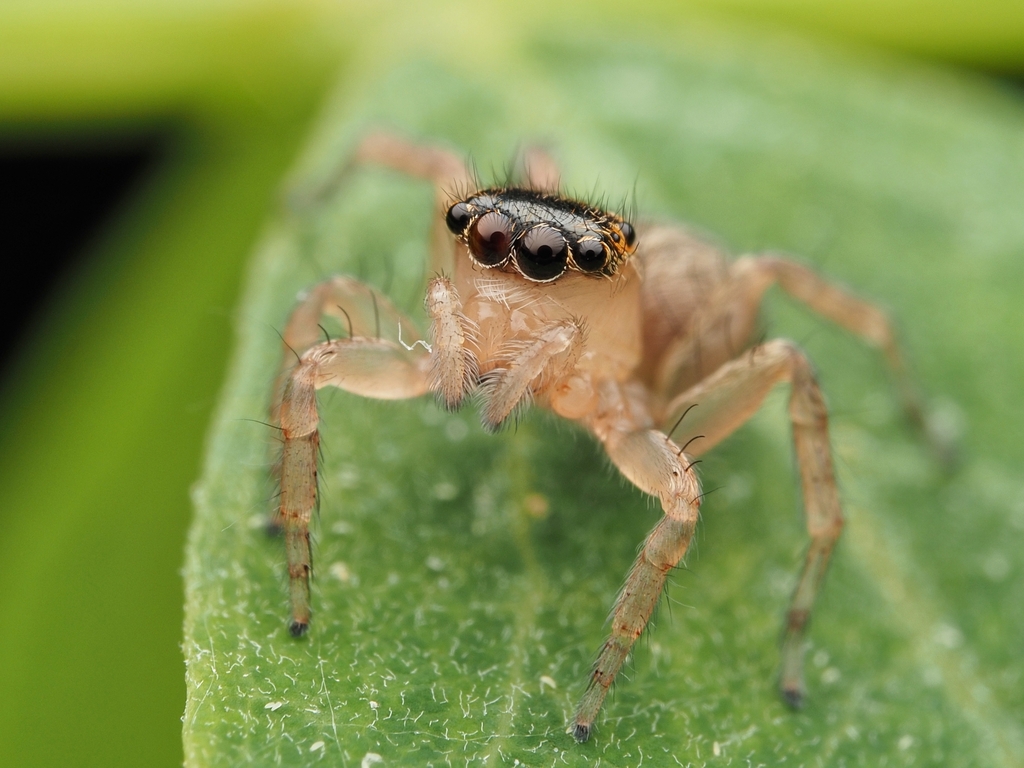
Beardfooted spider
Saitis barbipes
Saitis barbipes is a common jumping spider in the Mediterranean region, where it can be found on houses and rocks, as well as indoors.
From the article Saitis barbipes on Wikipedia (CC BY-SA), quoted section by section
Description
Saitis barbipes is characterized by a significant Sexual dimorphism. Males can reach a body length of 3.8–4 millimetres (0.15–0.16 in), while females measure 4.6–5.7 millimetres (0.18–0.22 in). The female shows a less evident coloration, with a dull brown body, a dark or blackish eyes field and pale brown legs with almost no drawing. On the contrary the smaller male is strikingly colored, especially when frontally viewed. It has bright emerald green eyes, the four white frontal legs are densely haired and regularly interspersed by black stripes and there is a red band above the eyes, which extends on the sides to the rear pair of eyes. The cephalothorax (prosoma) usually is pale brown and rather hairy above the eyes. The abdomen (opisthosoma) is provided on the upper side with a laterally dark bordered longitudinal band. Saitis barbipes is probably the most colorful species of jumping spiders in Europe. The most impressive feature however is the greatly enlarged third pair of legs. These are longer and colored red near the body, fading into black, with white tufts at the end.
Range & habitat
This species is present in the Mediterranean region, from southern Europe (Bulgaria, France, Germany, Greece, Italy, Netherlands, North Macedonia, Portugal, Spain and Switzerland) to Turkey and in North Africa.
Wikipedia: “Distribution”
What it does
Thanks to the long third pair of legs these spiders can jump at great distances. These legs are also used in courtship display. When the male spots a female, he raises vertically the third pair of legs. As he approaches her, from time to time he audibly vibrates them. A receptive female will then collapse on her legs and turn her abdomen ventral side upward. Sexually mature animals can be found year-round.
Wikipedia: “Behavior”
Where it lives
Recorded sightings
—
geo-referenced records in GBIF, from museums, herbaria and field observers.
Drag the globe to turn it. Dots are where records exist, not a range map; darker means more records.
In the stacks
Searching the stacks…
Every page naming Saitis barbipes in the Biodiversity Heritage Library →
This page is assembled live from iNaturalist, GBIF, Wikipedia, the Source Library and the Internet Archive. It is not yet part of the hand-edited codex. iNaturalist taxon 487303.