- Fungi Including Lichens
- ›Basidiomycete Fungi
- ›Higher Basidiomycetes
- ›Mushrooms, Bracket Fungi, Puffballs, and Allies
- ›Shelf Fungi
- ›Laetiporaceae
- ›Laetiporus
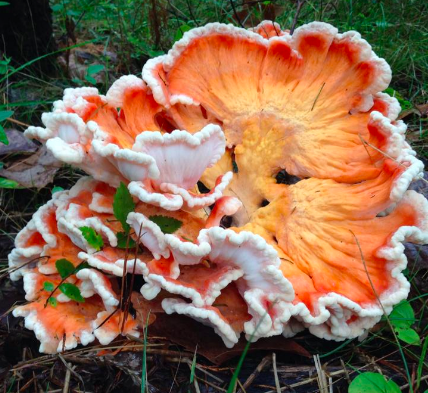
White-pored Chicken of the Woods
Laetiporus cincinnatus
Laetiporus is a genus of edible mushrooms found throughout much of the world. Some species, especially Laetiporus sulphureus, are commonly known as sulphur shelf, chicken of the woods, the chicken mushroom, or the chicken fungus because it is often described as tasting like and having a texture similar to that of chicken.
From the article Laetiporus on Wikipedia (CC BY-SA), quoted section by section
Description
Individual "shelves" range from 5 to 25 centimetres (2 to 10 inches) across. These shelves are made up of many tiny tubular filaments (hyphae). The mushroom grows in large brackets; some have been found that weigh over 45 kilograms (100 pounds).
Young fruiting bodies are characterized by a moist, rubbery, sulphur-yellow to orange body sometimes with bright orange tips. Older brackets become pale and brittle almost chalk-like, mildly pungent, and are often dotted with beetle or slug/woodlouse holes.
The name "chicken of the woods" is not to be confused with another edible polypore, Maitake (Grifola frondosa) known as "hen of the woods/rams head" or with Lyophyllum decastes, known as the "fried chicken mushroom".
Range & habitat
The sulphur shelf mushroom is most commonly found on wounds of trees, mostly oak, though it is also frequently found on eucalyptus, yew, sweet chestnut, and willow, as well as conifers in some species. Laetiporus species are parasitic and produce brown rot in the host on which they grow.
It sometimes comes back year after year when the weather suits its sporulation preferences. From late spring to early autumn, the sulphur shelf thrives. This fungus causes a brown cubical rot and embrittlement which in later stages ends in the collapse of the host tree, as it can no longer flex and bend in the wind.
Wikipedia: “Distribution and habitat”
At the table
The mushroom can be prepared in most ways that one can prepare chicken meat. It can also be used as a substitute for chicken in a vegetarian diet. Additionally, it can be frozen for long periods of time and retain its edibility. In certain parts of Germany and North America, it is considered a delicacy.
In some cases eating the mushroom "causes mild reactions ... for example, 'swollen lips' or in rare cases nausea, vomiting, dizziness and disorientation" to those who are sensitive. This is believed to be due to a number of factors that include allergies to the mushroom's protein or toxins which are only somewhat stable at high temperatures. As such, many field guides request that those who eat Laetiporus exercise caution by only eating fresh, young brackets and begin with small quantities to see how well it sits in their stomach.
L. sulphureus has a potent ability to inhibit staph bacteria (Staphylococcus aureus), as well as moderate ability to inhibit the growth of Bacillus subtilis.
Wikipedia: “Uses”
Where it lives
Recorded sightings
—
geo-referenced records in GBIF, from museums, herbaria and field observers.
Drag the globe to turn it. Dots are where records exist, not a range map; darker means more records.
In the stacks
Searching the stacks…
Every page naming Laetiporus cincinnatus in the Biodiversity Heritage Library →
This page is assembled live from iNaturalist, GBIF, Wikipedia, the Source Library and the Internet Archive. It is not yet part of the hand-edited codex. iNaturalist taxon 487301.