On eBird ↗
Southern Lapwing
Live sightings near you, the range map, bar charts of when it is seen, and Macaulay Library photos and recordings.
Southern Lapwing
Vanellus chilensis
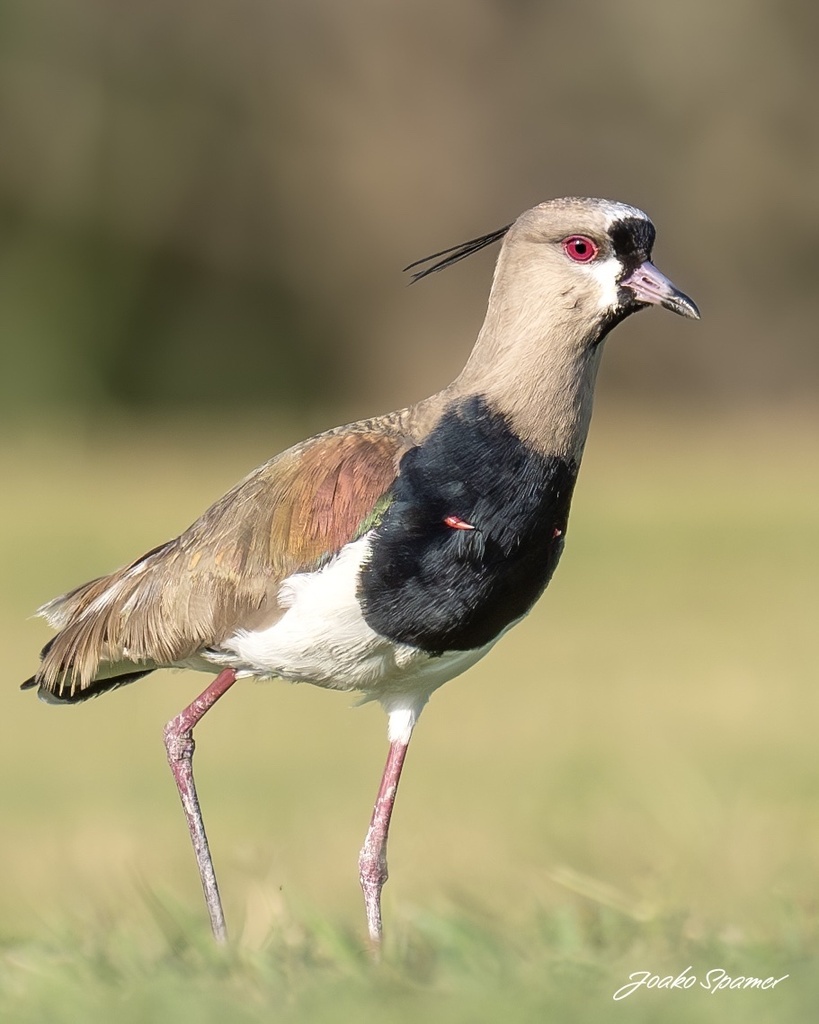
The southern lapwing (Vanellus chilensis), commonly called quero-quero in Brazil, or tero in Argentina and Uruguay, tero-tero in Paraguay, and queltehue in Chile is a wader in the order Charadriiformes. It is a common and widespread resident throughout South America, except in densely forested regions (e.g. most of the Amazon), the higher parts of the Andes, and the arid coast of a large part of western South America. This bird is particularly common in the basin of the Río de la Plata. It has also been spreading through Central America in recent years. It reached Trinidad in 1961, Tobago in 1974, and has rapidly increased on both islands, sporadically making its way North to Barbados where one pair mated, nested, and produced chicks in 2007.
From the article Southern lapwing on Wikipedia (CC BY-SA), quoted section by section
Description
This lapwing is the only crested wader in South America. It is 32 to 38 cm (13 to 15 in) in length and weighs approximately 250 to 425 g (8.8 to 15.0 oz). The upperparts are mainly brownish grey, with a bronze glossing on the shoulders. The head is particularly striking; mainly grey with a black forehead and throat patch extending onto the black breast. A white border separates the black of the face from the grey of the head and crest. The rest of the underparts are white and the eye ring, legs, and most of the bill are pink. It is equipped with red bony extensions under the wings (spurs), used to intimidate foes and fight birds of prey. During its slow flapping flight, the southern lapwing shows a broad white wing bar separating the grey-brown of the back and wing coverts from the black flight feathers. The rump is white and the tail black. The call is a very loud and harsh keek-keek-keek. There are three or four subspecies, differing slightly in head coloration and voice. Vanellus chilensis fretensis from Patagonia is sometimes included in the nominate subspecies V. c. chilensis. The northern subspecies—V. c. cayennensis from the north and V. c. lampronotus from the south of the Amazon River—are sometimes separated as a distinct species, Vanellus cayennensis. …
What it does
This is a lapwing of lake and river banks or open grassland. It has benefited from the extension of the latter habitat through widespread cattle ranching. When nesting in the vicinity of airports, it poses a threat to the safety of aerial traffic. Its food is mainly insects (such as grasshoppers) and other small invertebrates (including earthworms and cutworms), as well as small fish, hunted using a run-and-wait technique mainly at night, often in flocks. In urban areas like Rio de Janeiro, Montevideo, Buenos Aires and La Plata it can even be seen feeding or walking on parks or floodlit soccer pitches during televised matches. The southern lapwing breeds cooperatively in social groups and that social group consists of a breeding pair with one or two young from the previous breeding season. They breed on grassland and sometimes on ploughed fields, and have an aerobatic flapping display flight. It lays 2–3 (rarely 4) olive-brown eggs in a bare ground scape. The nest and young are defended noisily and aggressively against all intruders (including humans) by means of threats, vocalizations, and low flights. After the breeding season, it disperses into wetlands and seasonally-flooded tropical grassland.
Wikipedia: “Ecology”
Listen
Looking for field recordings…
Where it lives
Recorded sightings
—
geo-referenced records in GBIF, from museums, herbaria and field observers.
Drag the globe to turn it. Dots are where records exist, not a range map; darker means more records.
In the stacks
Searching the stacks…
Every page naming Vanellus chilensis in the Biodiversity Heritage Library →
This page is assembled live from iNaturalist, GBIF, Wikipedia, the Source Library and the Internet Archive. It is not yet part of the hand-edited codex. iNaturalist taxon 4867.