- Animals
- ›Molluscs
- ›Gastropods
- ›Heterobranchs
- ›Euthyneura
- ›Tectipleura
- ›Sea Hares and Akera Snails
- ›Aplysioidea
- ›Seahares
- ›Aplysia
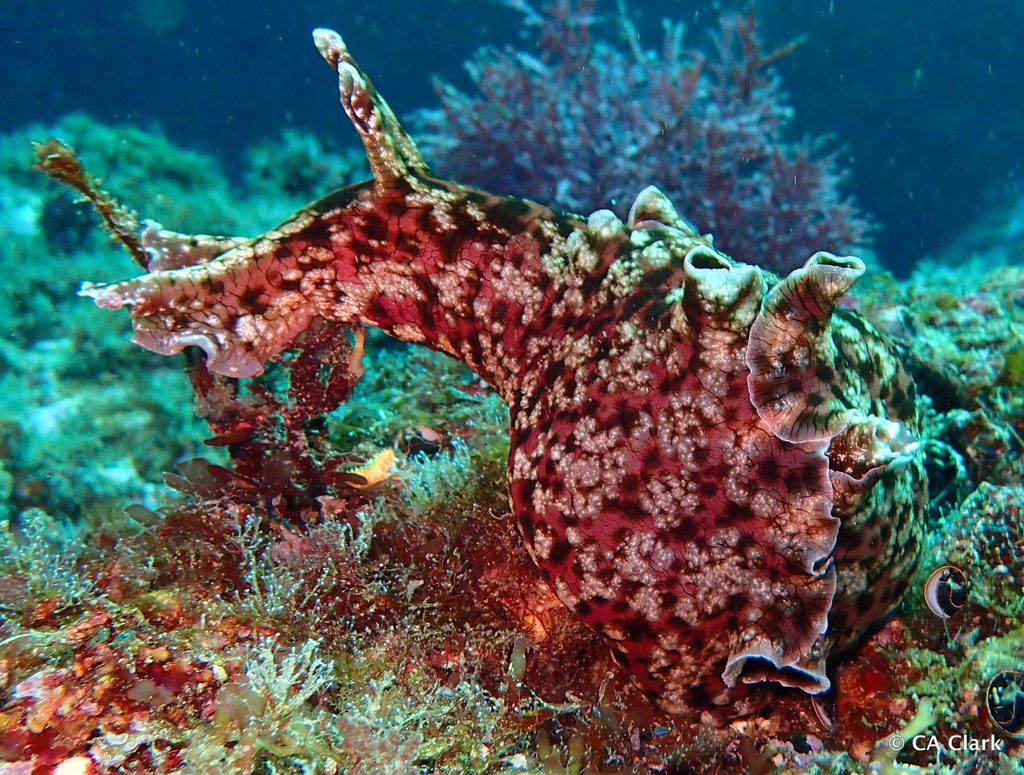
California Seahare
Aplysia californica
The California sea hare, also known as the California sea slug, scientific name Aplysia californica, is a species of sea slug, specifically a sea hare, a marine opisthobranch gastropod mollusk in the sea hare family, Aplysiidae.
From the article California sea hare on Wikipedia (CC BY-SA), quoted section by section
Description
The maximum length recorded for the California sea hare is 75 cm (30 in) when crawling, thus fully extended, although most adult specimens are half this size or smaller. Adult animals can weigh up to 7 kg (15 lb). A closely related species, Aplysia vaccaria, the black sea hare, can grow larger still.
Original description: The animal's coloration ranges from pale gray to greenish, transitioning to purplish on its sides. The mantle folds are adorned with scattered white specks, from which an irregular network of brown lines extends across the remainder of the body, interspersed with large brown blotches. The inner surface of the mantle is distinctively patterned with alternating, interlocking bars of white and dark brown. The sole of the foot is black. The eyes are very minute and black.The shell, embedded within the cartilaginous substance of the mantle, is translucent and exhibits a trapezoidal or hatchet shape. Its margins are rounded, and the dorsal surface is slightly convex. In older specimens, the nucleus (or center) is positioned distantly from the posterior end or apex. Faint radiating lines diverge from the nucleus, intersected by an irregular network of darker lines. All these lines terminate abruptly at a distance from the shell's margin, thus creating a wide, nearly transparent border. …
Range & habitat
A. californica is found along the coast of California, the United States, and northwestern Mexico (including the Gulf of California). Aplysia species inhabit the photic zone to graze on algae, mainly the intertidal, usually not deeper than 18–20 m (59–66 ft).
Wikipedia: “Distribution”
What it does
At the base of the right anterior tentacle is the aperture from which the penis can protrude. The genital aperture lies at the anterior end of the mantle cavity, a seminal grove arises from it and runs forward to the penis, at the base of the anterior tentacle. Coupling lasts for hours or sometimes for days, although the actual passage of the sperm may take only a few minutes. Egg laying normally has to be triggered by copulation, but it occurs spontaneously in individuals kept in isolation for up to 3–4 months (typically these eggs are unfertilized). Copulation occurs most frequently in the early morning, and rarely after 12:30 pm. An individual animal weighing 2,600 g was recorded to have laid about 500 million eggs at 27 separate times during less than five months.
Wikipedia: “Sexual reproduction”
Where it lives
Recorded sightings
—
geo-referenced records in GBIF, from museums, herbaria and field observers.
Drag the globe to turn it. Dots are where records exist, not a range map; darker means more records.
In the stacks
Searching the stacks…
Every page naming Aplysia californica in the Biodiversity Heritage Library →
This page is assembled live from iNaturalist, GBIF, Wikipedia, the Source Library and the Internet Archive. It is not yet part of the hand-edited codex. iNaturalist taxon 48655.