- Animals
- ›Chordates
- ›Vertebrates
- ›Mammals
- ›Therians
- ›Placental Mammals
- ›Ungulates, Carnivorans, and Allies
- ›Bats
- ›Yangochiroptera
- ›Vespertilionoid Bats
- ›Free-tailed Bats
- ›Molossinae
- ›Otomops
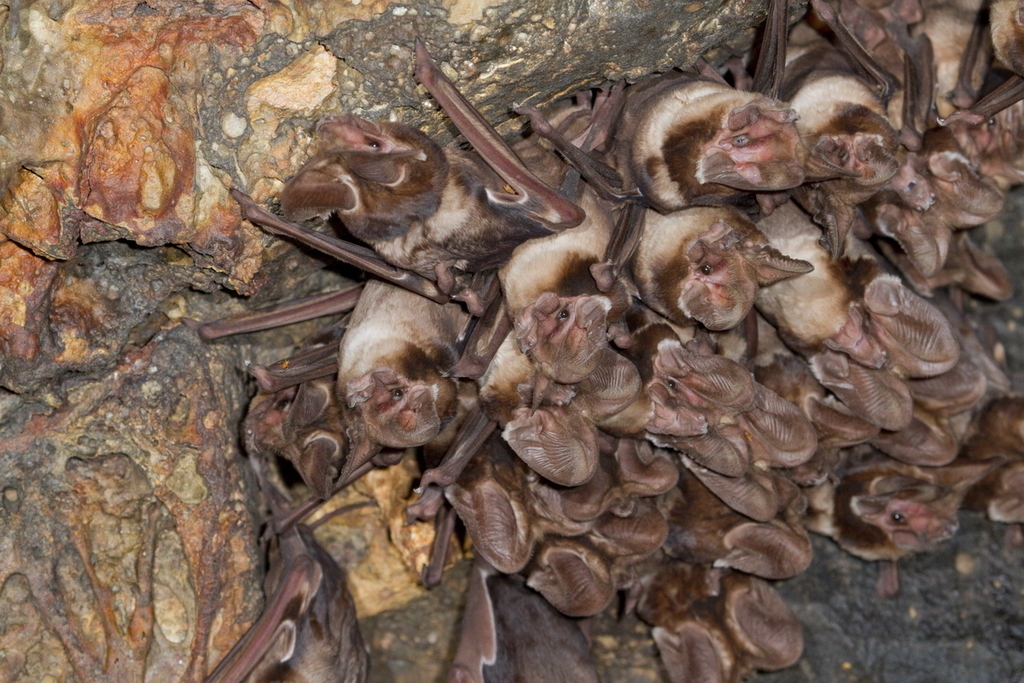
Harrison's Large-eared Giant Mastiff Bat
Otomops harrisoni
Harrison's large-eared giant mastiff bat (Otomops harrisoni) is a species of bat found in Northeast Africa and the Arabian Peninsula. It was described as a new species in 2015. The IUCN evaluates it as a vulnerable species.
From the article Harrison's large-eared giant mastiff bat on Wikipedia (CC BY-SA), quoted section by section
Description
It is the largest member of its genus, and possesses the most robust skull. Males weigh between 31.5–45 g (1.11–1.59 oz), while females weigh between 26.8–45 g (0.95–1.59 oz). Its forearm length is 63.8–74 mm (2.51–2.91 in). Its total body length is 138–163 mm (5.4–6.4 in). Its tail is 30–48 mm (1.2–1.9 in) long; its hind foot is 11–16 mm (0.43–0.63 in) long; its ear is 34–46 mm (1.3–1.8 in). Its dental formula is 1.1.2.32.1.2.3, for a total of 30 teeth. Its ears project over its face, meeting in the middle over its nose. It has a minute tragus. Around its lips are loose folds of skin. Males have a gular gland located at the base of their throats. Its hind feet are broad, with long white hairs. It can be differentiated from other members of its genus based on its long cranium and exceptionally high braincase. Its fur is short and velvety. On its back, the fur is dark chocolate brown; it has a "distinct cream-coloured collar" around its neck. Fur on its ventral side is lighter than its back. The edges of its body and of its wing membranes have a thin, but distinct, band of white fur.
Range & habitat
Its range includes Yemen, Djibouti, Ethiopia, and Kenya. It is most likely to occur in the eastern portion of Sub-Saharan Africa, also including Eritrea. Distribution modeling predicts that it prefers areas that receive at least 20 mm (0.79 in) of rain in the driest month, altitudes greater than 1,500 m (4,900 ft) above sea level, and locations with a total annual rainfall of less than 500 mm (20 in). They have been documented in woodlands, shrublands, montane grasslands, xeric grasslands, and thickets. During the day, they roost in mountain caves or lava caves.
Wikipedia: “Range and habitat”
In human culture
It was described as a result of a taxonomic split in the large-eared free-tailed bat, Otomops martiensseni. It was split from O martiensseni based on morphological and genetic data. It has a genetic distance from O. martiensseni of 2.10%. The authors chose the species name "harrisoni" after the late mammalogist David L. Harrison. Of Harrison, they wrote: "[his] numerous publications on Afro-Arabian Chiroptera, in particular the Molossidae, have significantly improved our knowledge of this poorly known family."
Wikipedia: “Taxonomy and etymology”
Listen
Looking for field recordings…
Where it lives
Recorded sightings
—
geo-referenced records in GBIF, from museums, herbaria and field observers.
Drag the globe to turn it. Dots are where records exist, not a range map; darker means more records.
In the stacks
Searching the stacks…
Every page naming Otomops harrisoni in the Biodiversity Heritage Library →
This page is assembled live from iNaturalist, GBIF, Wikipedia, the Source Library and the Internet Archive. It is not yet part of the hand-edited codex. iNaturalist taxon 485417.