On eBird ↗
American Wigeon
Live sightings near you, the range map, bar charts of when it is seen, and Macaulay Library photos and recordings.
American Wigeon
Mareca americana
The American wigeon (Mareca americana), also called a baldpate, is a species of dabbling duck found in North America. Formerly assigned to Anas, this species is classified with the other wigeons in the dabbling duck genus Mareca. It is the New World counterpart of the Eurasian wigeon. Mareca is from the Brazilian-Portuguese word Marréco for a small duck and americana refers to America.
From the article American wigeon on Wikipedia (CC BY-SA), quoted section by section
Description
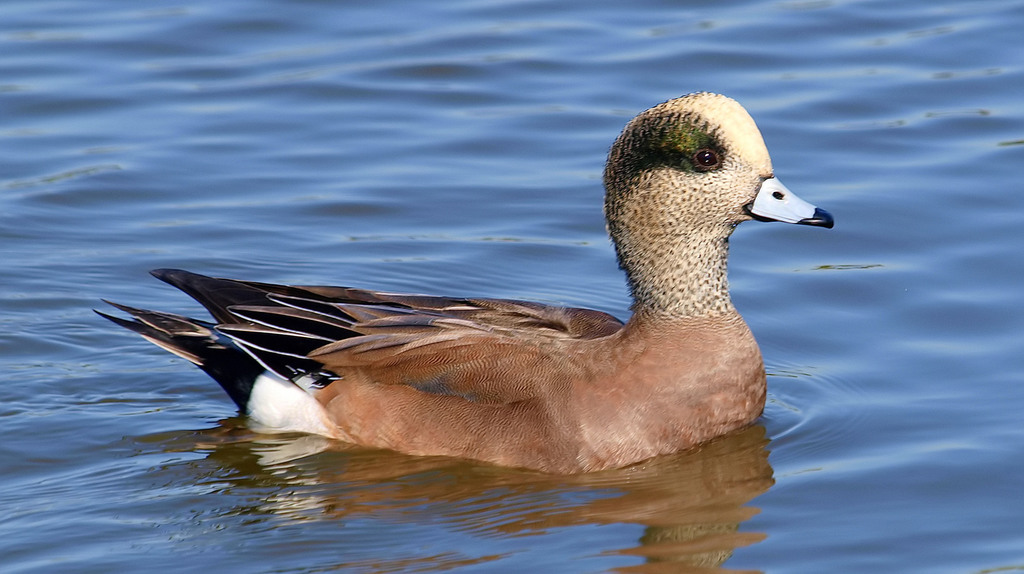
The American wigeon is a medium-sized bird; it is larger than a teal but smaller than a pintail. In silhouette, the wigeon can be distinguished from other dabblers by its round head, short neck, and small bill. It is 42–59 cm (17–23 in) long, with a 76–91 cm (30–36 in) wingspan and a weight of 512–1,330 g (1.129–2.932 lb). This wigeon has two adult molts per year and a juvenile molt in the first year, as well. The breeding male (drake) is a striking bird with a mask of green feathers around its eyes and a cream-colored cap running from the crown of his head to his bill. This white patch gives the wigeon its other common name, baldpate (pate is another word for head). His belly is also white. In flight, drakes can be identified by the large white shoulder patch on each wing. These white patches flash as the birds bank and turn. In nonbreeding (eclipse) plumage, the drake looks more like the female. The hens are much less conspicuous, having primarily gray and brown plumage. Both sexes have a pale blue bill with a black tip, a white belly, and gray legs and feet. The wing patch behind the speculum is gray. They can be distinguished from most ducks, apart from Eurasian wigeon, by shape. However, that species has a darker head and all-grey underwing. The head and neck coloring of the female is different from the Eurasian wigeon. …
Range & habitat
It is common and widespread, breeding in all but the extreme north of Canada and Alaska and also in the Interior West through Idaho, Colorado, the Dakotas, and Minnesota, as well as eastern Washington and Oregon. The conservation status of this bird is least concern. The majority of the population breeds on wetlands in the Boreal Forest and subarctic river deltas of Canada and Alaska. Although wigeons are found in each flyway, they are most numerous in the Pacific Flyway. Key wintering areas here include the Central Valley of California and Washington's Puget Sound. Farther east, the Texas Panhandle, the Gulf Coast of Louisiana and Texas, and the Caribbean also support large numbers of wintering wigeons. This dabbling duck is migratory and winters farther south than its breeding range, in the southern half of the United States, Idaho, Washington, Oregon, and the Mid-Atlantic coastal region, and further south into Central America, the Caribbean, and northwestern South America. It is a rare but regular vagrant to western Europe, and has been observed in significant numbers in Great Britain and Ireland since at least 1958. In the United Kingdom, American wigeons are most commonly observed in autumn and winter. In 2009, an estimated 2.5 million breeding wigeons were tallied in the traditional survey area—a level just below the 1955–2009 average. …
Wikipedia: “Distribution and habitat”
What it does
The American wigeon is a bird of open wetlands, such as wet grassland or marshes with some taller vegetation, and usually feeds by dabbling for plant food or grazing, which it does very readily. While on the water, wigeons often gather with feeding coots and divers and are known to grab pieces of vegetation brought to the surface by diving water birds—so are sometimes called "poacher" or "robber" ducks. Wigeons also commonly feed on dry land, eating waste grain in harvested fields and grazing on pasture grasses, winter wheat, clover, and lettuce. Having a largely vegetarian diet, most wigeons migrate in the fall well before northern marshes begin to freeze. The American wigeon is highly gregarious outside of the breeding season and forms large flocks.
Breeding. Breeding begins in April-May. The nest is a depression on dry ground, often some distance from water. It is lined with grass and down and is hidden in vegetation. The clutch is 7–9, cream-colored eggs, which measure on average 52.9 mm × 37.5 mm (2.08 in × 1.48 in) and weigh 43 g (1.5 oz). They are incubated for 23–25 days by the female only. The male usually deserts the female before the end of the incubation period. The young are precocial and leave the nest within 24 hours of hatching. They can feed themselves. The young can fly when around 47 days of age.
Wikipedia: “Behavior”
Listen
Looking for field recordings…
Where it lives
Recorded sightings
—
geo-referenced records in GBIF, from museums, herbaria and field observers.
Drag the globe to turn it. Dots are where records exist, not a range map; darker means more records.
In the stacks
Searching the stacks…
Every page naming Mareca americana in the Biodiversity Heritage Library →
This page is assembled live from iNaturalist, GBIF, Wikipedia, the Source Library and the Internet Archive. It is not yet part of the hand-edited codex. iNaturalist taxon 485176.