On eBird ↗
Pied Stilt
Live sightings near you, the range map, bar charts of when it is seen, and Macaulay Library photos and recordings.
Pied Stilt
Himantopus leucocephalus
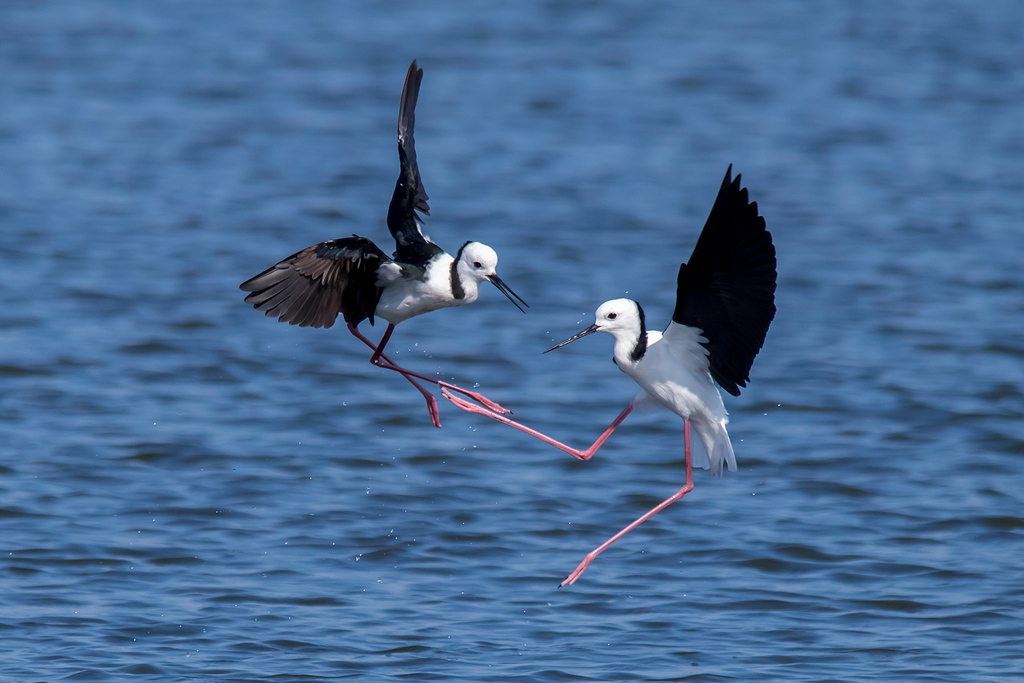
The pied stilt (Himantopus leucocephalus), also known as the white-headed stilt, is a shorebird in the family Recurvirostridae. It is widely distributed with a large total population size and apparently stable population trend, occurring in Malaysia, Japan, the Philippines, Brunei, Christmas Island, Indonesia, Palau, Papua New Guinea, Australia, and New Zealand. It is listed as Least Concern on the IUCN Red List. It is sometimes considered a subspecies of the black-winged stilt (H. himantopus).
From the article Pied stilt on Wikipedia (CC BY-SA), quoted section by section
Description
The pied stilt grows to a length of about 14 in (36 cm) with a wingspan of about 26.5 in (67 cm). The back of the head and neck, the back and the upper surfaces of the wings are glossy greenish-black. The undersides of the wings are plain black and the remainder of the plumage is white, apart from the tail feathers which are tinged with grey. The long, thin legs are pink and the toes have black claws. The long slender beak is black and the irises and the eyelids are red.
Range & habitat
The pied stilt is resident in southern Sumatra, Java, Sulawesi and most of Australia, New Zealand and Papua New Guinea. There are non-breeding populations in Sri Lanka, the Philippines, Brunei, Palau, South Kalimantan, West Nusa Tenggara, East Nusa Tenggara, East Timor and New Guinea. This bird is a vagrant to Japan and Christmas Island. Its habitat is in wetlands and estuaries.
Wikipedia: “Distribution and habitat”
What it does
The pied stilt is a waterbird and feeds in shallow water, probing into the sediment with its beak. It is gregarious, and in New Zealand sometimes forms mixed flocks with the black stilt (Himantopus novaezelandiae). It feeds largely on aquatic insects and on small molluscs. It emits a repeated yelping cry as it flies, and the legs trail behind it, tending to sway from side-to-side. The pied stilt breeds in spring, choosing as a nesting site an area of sand or shingle by an estuary, beside a dried up riverbed, on a flat bit of coast or in a grassy field near the sea. It seems particularly attracted to locations near where the red duck-weed (Azolla rubra) flourishes. It prepares a nest in a shallow depression or in a scrape in the ground where it usually lays four, ovoido-conical eggs. These are yellowish-brown dappled irregularly with dark blotches and spots. The nest is difficult to find as the eggs are well-camouflaged. But the parent birds give away the presence of the nest by mounting into the air and flying in circles, uttering distress cries. The chicks are able to leave the nest almost as soon as they have hatched. They are difficult to detect because their downy plumage is well-camouflaged and they "freeze" when alarmed. A parent bird sometimes feigns a leg injury to draw intruders away from its chicks.
== References ==
Wikipedia: “Behaviour and ecology”
Listen
Looking for field recordings…
Where it lives
Recorded sightings
—
geo-referenced records in GBIF, from museums, herbaria and field observers.
Drag the globe to turn it. Dots are where records exist, not a range map; darker means more records.
In the stacks
Searching the stacks…
Every page naming Himantopus leucocephalus in the Biodiversity Heritage Library →
This page is assembled live from iNaturalist, GBIF, Wikipedia, the Source Library and the Internet Archive. It is not yet part of the hand-edited codex. iNaturalist taxon 4832.