- Plants
- ›Vascular Plants
- ›Ferns
- ›Leptosporangiate Ferns
- ›Polypod Ferns
- ›Pteridineae
- ›brake family
- ›lip fern subfamily
- ›Myriopteris
- ›Myriopteris lanosa
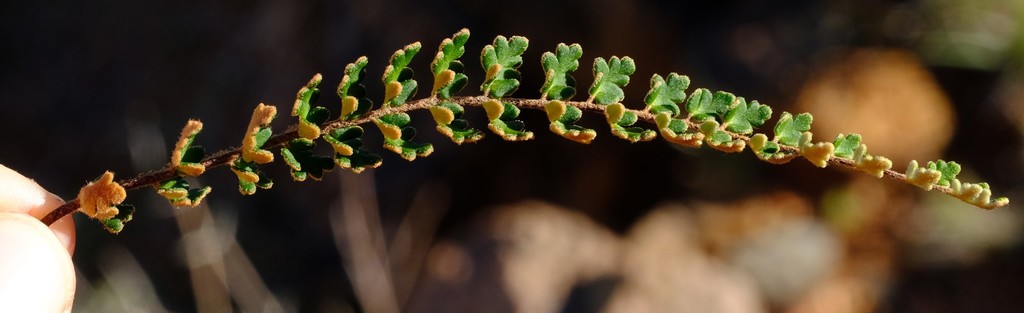
Myriopteris rawsonii
Myriopteris rawsonii is a small fern native to Namaqualand in Southern Africa. It is adapted to dry conditions, bearing a thick layer of pale hairs on the underside of its pinnate-pinnatifid leaves. One of the cheilanthoid lip ferns, it was usually classified in the genus Cheilanthes as Cheilanthes rawsonii until 2013, when the genus Myriopteris was again recognized as separate from Cheilanthes. It is the only African representative of Myriopteris, which is otherwise American. Living on rocky hillsides, it spends much of the year in a dried-out, dormant state, rehydrating and putting out new growth during winter rains. Its name honors the botanist and civil servant Sir Rawson W. Rawson.
From the article Myriopteris rawsonii on Wikipedia (CC BY-SA), quoted section by section
Description
The fronds arise from a creeping rhizome about 2.5 millimetres (0.098 in) in diameter. The rhizome bears linear scales up to 2 millimetres (0.08 in) long, which are blackish-brown in color, growing pale brown at the margins. The scales are jagged at the edges, or ciliate (bearing hair-like projections). The fronds are closely spaced along the rhizome, standing erect or arching somewhat. They emerge as fiddleheads (circinate vernation). The stipe (the stalk of the leaf, below the blade) is about 50 millimetres (2 in) long. It is brown and covered with a mat of pale hairs in freshly-grown leaves; the hairs are shed as the leaf ages. The leaf blade is linear-elliptic in shape and pinnate-pinnatifid (cut into deeply lobed pinnae), sometimes almost bipinnate. The blades range from 80 to 250 millimeters (3.1 to 9.8 in) long and from 15 to 22 millimetres (0.59 to 0.87 in) wide. The rachis (leaf axis) is similar in appearance to the stipe, but largely retains its hairs even in older fronds. The pinnae (leaflets) are oblong-ovate in shape and relatively widely spaced from each other, with entire (untoothed) margins. Those closer to the base of the leaf are more deeply lobed than those above. The veins are not netted and do not stand out strongly from the rest of the leaf tissue. …
Range & habitat
Myriopteris rawsonii occurs only in Namaqualand, ranging from southern Namibia into the northern part of the Northern Cape province of South Africa. It is found on hot, rocky hillsides, often on south- or east- facing slopes where crevices or boulders offer some shade and help preserve moisture for the plant. It occurs at elevations of 400 to 1,660 metres (1,310 to 5,450 ft).
Wikipedia: “Distribution and habitat”
What it does
The fronds typically remain dormant most of the year, shriveled and curled around their central axis. They rehydrate, unfurl, and new growth appears when refreshed by winter rains.
Wikipedia: “Ecology and conservation”
Where it lives
Recorded sightings
—
geo-referenced records in GBIF, from museums, herbaria and field observers.
Drag the globe to turn it. Dots are where records exist, not a range map; darker means more records.
In the stacks
Searching the stacks…
Every page naming Myriopteris rawsonii in the Biodiversity Heritage Library →
This page is assembled live from iNaturalist, GBIF, Wikipedia, the Source Library and the Internet Archive. It is not yet part of the hand-edited codex. iNaturalist taxon 481740.