- Plants
- ›Vascular Plants
- ›Ferns
- ›Leptosporangiate Ferns
- ›Polypod Ferns
- ›Pteridineae
- ›brake family
- ›lip fern subfamily
- ›Myriopteris
- ›Myriopteris covillei
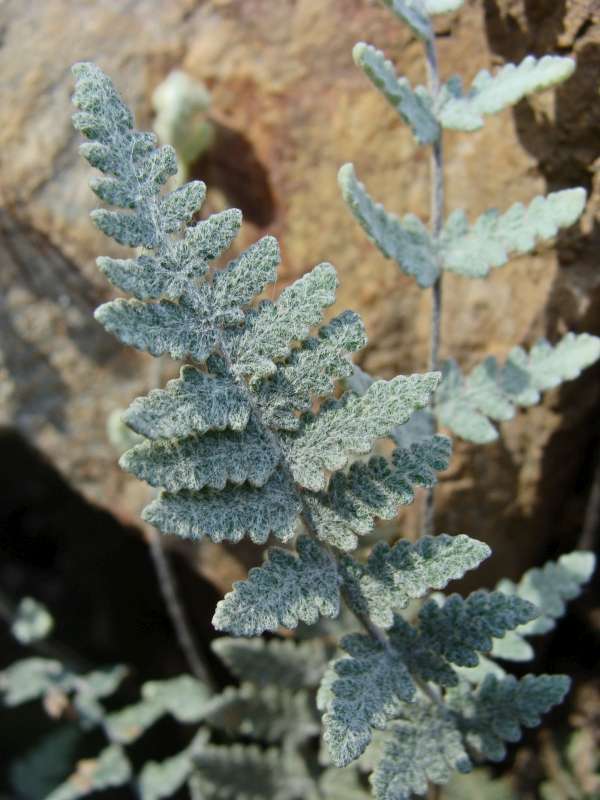
Newberry's lip fern
Myriopteris newberryi
Myriopteris newberryi, formerly Cheilanthes newberryi, is a species of lip fern known by the common name Newberry's lip fern. It is native to southern California and Baja California, where it grows in rocky places in mostly dry habitat such as the California chaparral and woodlands.
From the article Myriopteris newberryi on Wikipedia (CC BY-SA), quoted section by section
Description
Myriopteris newberryi has leaves up to about 30 centimeters long which are coated in matted white, gray, or brownish hairs. Each leaf is made up of subdivided segments where the ultimate segment is oval in shape, mostly flat, and hard to visualize due to its thick coat of hairs. On the underside are scattered sori containing sporangia. Each sporangium may have either 64 or 32 spores.
Range & habitat
In Mexico, Myriopteris newberryi is found in extreme northwestern Baja California from Tecate south to Punta Colonet, and also on the Pacific island of Guadalupe, off the shore of Baja California. In California it is found mostly in the coastal mountains from the San Bernardino Mountains and south, and on San Clemente Island just offshore. It grows in rocky places in mostly dry habitats such as the California chaparral and woodlands.
Wikipedia: “Range and Habitat”
How it is grown
Myriopteris newberryi can be cultivated, and should be grown under high light in well-drained garden soil with sand. The soil should be moist-dry to moist.
Wikipedia: “Cultivation”
Where it lives
Recorded sightings
—
geo-referenced records in GBIF, from museums, herbaria and field observers.
Drag the globe to turn it. Dots are where records exist, not a range map; darker means more records.
In the stacks
Searching the stacks…
Every page naming Myriopteris newberryi in the Biodiversity Heritage Library →
This page is assembled live from iNaturalist, GBIF, Wikipedia, the Source Library and the Internet Archive. It is not yet part of the hand-edited codex. iNaturalist taxon 481729.