- Fungi Including Lichens
- ›Basidiomycete Fungi
- ›Higher Basidiomycetes
- ›Mushrooms, Bracket Fungi, Puffballs, and Allies
- ›Agaricomycetidae
- ›Common Gilled Mushrooms and Allies
- ›Tricholomatineae
- ›Tricholomataceae
- ›Tricholomatoideae
- ›Tricholoma
- ›Terrea
- ›Atrosquamosa
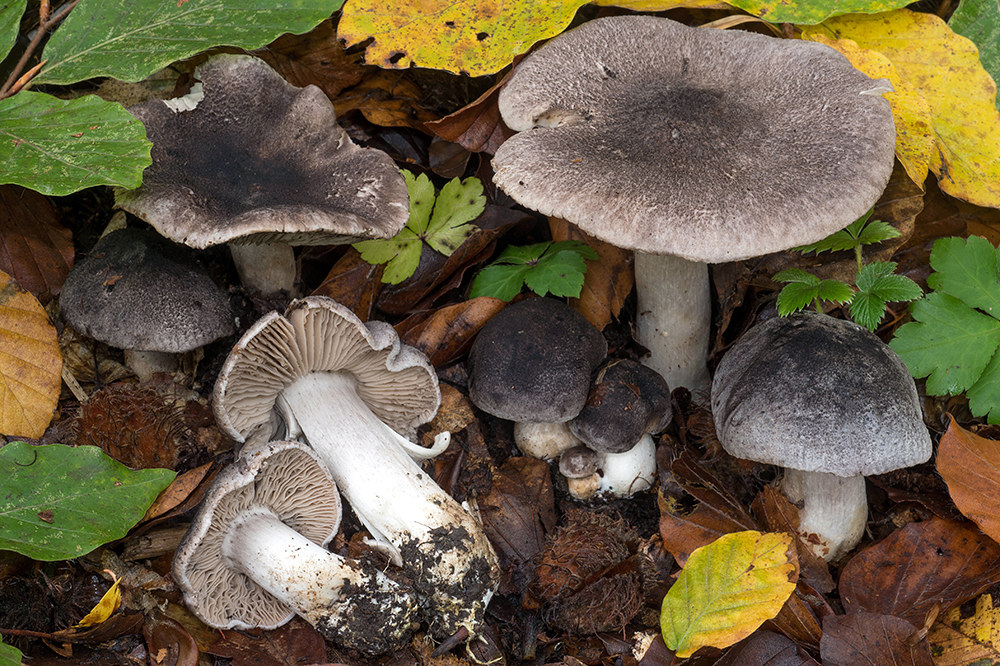
Tricholoma orirubens
Tricholoma orirubens, commonly known as blushing tricholoma, is an edible gilled mushroom native to Europe. The grey-capped fruit bodies are generally found singly or in small groups in deciduous and coniferous woodland in autumn.
From the article Tricholoma orirubens on Wikipedia (CC BY-SA), quoted section by section
Description
Tricholoma orirubens has a dark grey or grey-brown cap up to 7.5 cm (3.0 in) in diameter with darker blackish scales, and a straight or undulating margin. The cap is conical with a slight boss before opening and flattening, eventually with either a boss or central depression. The thick grey gills are emarginate or adnate and widely spaced, and turn red when bruised. The white or pale grey ringless stipe measures 4.5 to 8 cm tall and 0.7 to 2.5 cm wide, and has a distinctive blue tinged base.
Range & habitat
Widespread across Europe, Tricholoma orirubens is not common. It is rare in the Netherlands. Found singly or in small groups in deciduous and coniferous woodland in autumn, it prefers clayey or chalky soils. It is ectomycorrhizal. Tricholoma orirubens can also form fairy rings. One found in Germany had a diameter of around 80 m (260 ft) and contained an estimated 10,000 mushrooms.
Wikipedia: “Distribution and habitat”
At the table
Smelling and tasting strongly of flour, T. orirubens is one of the more appetising members of the genus. It can taste sweet as well.
Wikipedia: “Edibility”
Where it lives
Recorded sightings
—
geo-referenced records in GBIF, from museums, herbaria and field observers.
Drag the globe to turn it. Dots are where records exist, not a range map; darker means more records.
In the stacks
Searching the stacks…
Every page naming Tricholoma orirubens in the Biodiversity Heritage Library →
This page is assembled live from iNaturalist, GBIF, Wikipedia, the Source Library and the Internet Archive. It is not yet part of the hand-edited codex. iNaturalist taxon 480658.