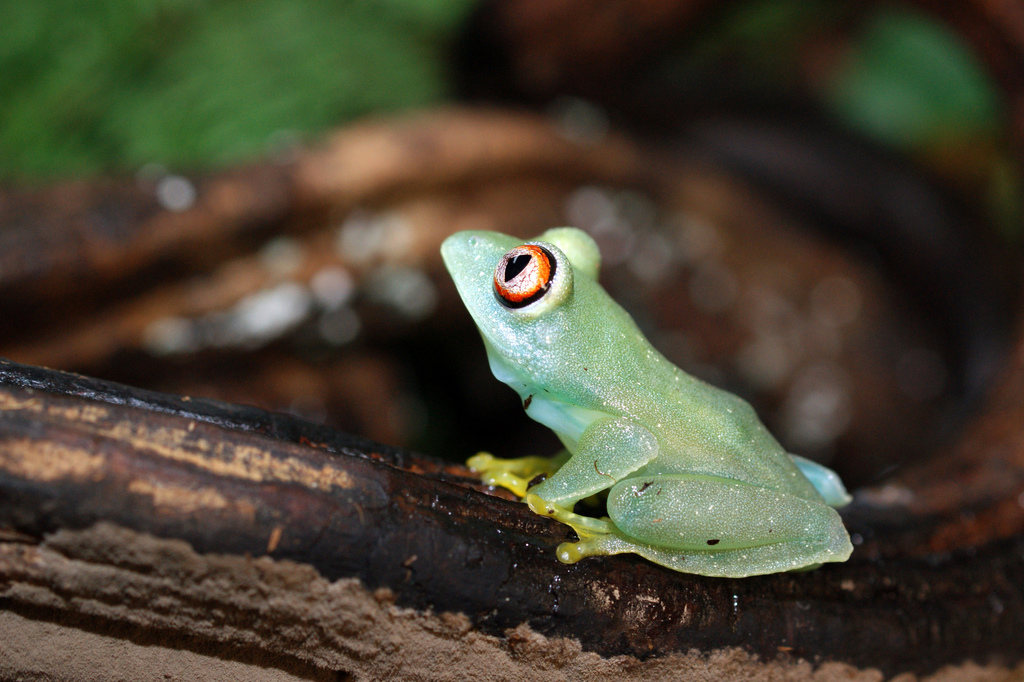
Barbour's Tree Frog
Leptopelis grandiceps
Leptopelis grandiceps, the large headed forest treefrog, is a species of small tree frog. Females are thought to be larger than males based on the male lectotype and female allotype. They are endemic to the Eastern Arc Mountains in Tanzania, where they inhabit forests near a water source. It's closely related to L. barbouri and L. uluguruensis. It's listed Vulnerable on the IUCN Red List and populations are thought to be decreasing. Notably, L. grandiceps has a controversial nomenclature history.
From the article Leptopelis grandiceps on Wikipedia (CC BY-SA), quoted section by section
Range & habitat
L. grandiceps's geographic range includes the Eastern Arc Mountains and Southern Highlands in Tanzania and Kenya. They inhabit humid montane and lowland rainforests. However, until more thorough genetic analyses are conducted, Gvoždík et al. (2014) proposed that L. grandiceps should only include populations in East Usambara mountains and L. cf. grandiceps should be tentatively used for populations in other locations.
Wikipedia: “Geographic range and habitat”
What it does
Males make mating calls from the top of branches near streams. The sound is distinct from other similar-looking Leptopelis as is described as such: The voice is a brief buzzing with an indistinct frequency-intensity maximum at about 1500 cps. and a rate of about 100 figures per second (Schiotz 2014). Furthermore, They have been found buried in mud near streams with only their heads visible above ground. They can also be found in elevations up to 2,100 m (6,900 ft), with a minimum elevation of 180 m (590 ft).
Wikipedia: “Behaviour and communication”
In human culture
L. grandiceps is not commonly encountered so there is little socioeconomic relevance. The history of naming L. grandiceps could be considered relevant and controversial in the scientific community. This is because synonymizations and namings were done without seeing the type or collections.
Wikipedia: “Socioeconomic relevance and history”
Listen
Looking for field recordings…
Where it lives
Recorded sightings
—
geo-referenced records in GBIF, from museums, herbaria and field observers.
Drag the globe to turn it. Dots are where records exist, not a range map; darker means more records.
In the stacks
Searching the stacks…
Every page naming Leptopelis grandiceps in the Biodiversity Heritage Library →
This page is assembled live from iNaturalist, GBIF, Wikipedia, the Source Library and the Internet Archive. It is not yet part of the hand-edited codex. iNaturalist taxon 476938.