On eBird ↗
Great Green Macaw
Live sightings near you, the range map, bar charts of when it is seen, and Macaulay Library photos and recordings.
Great Green Macaw
Ara ambiguus
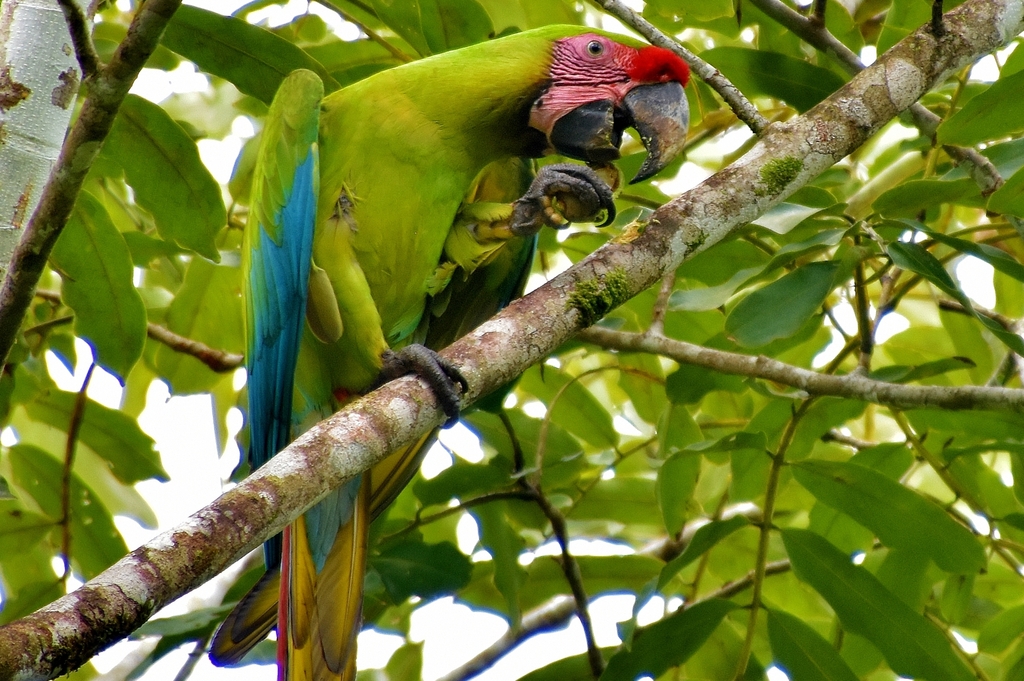
The great green macaw (Ara ambiguus), also known as Buffon's macaw or the great military macaw, is a critically endangered Central and South America parrot found in Nicaragua, Honduras, Costa Rica, Panama, Colombia and Ecuador. Two allopatric subspecies are recognized; the nominate subspecies, Ara ambiguus ssp. ambiguus, occurs from Honduras to Colombia, while Ara ambiguus ssp. guayaquilensis appears to be endemic to remnants of dry forests on the southern Pacific coast of Ecuador. The nominate subspecies lives in the canopy of wet tropical forests and in Costa Rica is usually associated with the almendro tree, Dipteryx oleifera.
From the article Great green macaw on Wikipedia (CC BY-SA), quoted section by section
Description
Great green macaws are the largest parrots in their natural range, the second heaviest macaw species (although they are relatively shorter tailed than other large macaws such as the red-and-green macaw and are thus somewhat shorter), and the third heaviest parrot species in the world. This species averages 85–90 cm (33.5–35.5 in) in length and 1.3 kg (2.9 lb) in weight. They are mainly green and have a reddish forehead and pale blue lower back, rump and upper tail feathers. The tail is brownish-red tipped with very pale blue. The bare facial skin is patterned with lines of small dark feathers, which are reddish in older and female parrots. Juveniles have grey-coloured eyes instead of black, are duller in colour and have shorter tails which are tipped in yellow. The main morphological distinction with the subspecies guayaquilensis is that this bird has a smaller, narrower bill. The great green macaw appears superficially similar to, and may easily be confused with, the military macaw where their ranges overlap.
Range & habitat
The great green macaw lives in tropical forests in the Atlantic wet lowlands of Central America from Honduras to Panama and Colombia, and in South America in the Pacific coastal lowlands in Panama, Colombia and western Ecuador, where they also occur in deciduous (seasonal), dry tropical forests. In Colombia, where both species occur, it prefers more humid woodlands than the closely related military macaw. The habitat where it breeds in Costa Rica is practically non-seasonal, evergreen rainforest, with rain some ten months of the year, a precipitation of 1,500 to 3,500 mm a year, and an average temperature of 27 °C throughout the year. In Costa Rica the habitats where great green macaws occur during breeding season is dominated by the almendro (Dipteryx oleifera) and Pentaclethra macroloba, with secondarily raffia palms (Raphia spp.) dominated wetlands. …
Wikipedia: “Distribution and habitat”
What it does
To improve the state of knowledge of the natural history the great green macaw in Costa Rica a large study using radio telemetry was launched by George V. N. Powell and conducted by a team of researchers from 1994 to 2000. The main objectives were to determine the home range of A. ambiguus, characterize the habitats that it frequents and learn more about its feeding habits, ecological associations, abundance, and reproduction and nesting habits.
Behaviour. Birds are usually observed in pairs or small groups of up to four to eight birds, very rarely more. In Costa Rica it breeds in the lowlands, but disperses to higher elevations afterwards, gathering together in flocks which migrate in search of food. In Costa Rica these flocks usually consist of up to 18 birds. This species rests and forages in the upper areas of the canopy. In Nicaragua these macaws are notably unwary of humans and when feeding will often allow a person to come quite close to them. Older residents of the region where Ara ambiguus ssp. guayaquilensis lives relate that until the 1970s or 1980s it would gather together to undertake a daily migration from the mangrove forests at estuaries along the seashore near the village of Puerto Hondo, crossing the Guayaquil-Salinas road in flocks, to the dry hilly woodlands of the Cerro Blanco Forest.
Vocalisation. …
Wikipedia: “Ecology”
In human culture
With a 2004 resolution, the city council voted to consider the subspecies Ara ambiguus ssp. guayaquilensis, known in the city as papagayo de Guayaquil, as an emblematic symbol of Guayaquil in Ecuador. A July 2005 city ordinance declared it so. A 12m high ceramic monument to this subspecies by the artist Juan Marcelo Sánchez was unveiled in the city in 2006. The macaw was also declared an official symbol of the village of El Castillo, Nicaragua, in the 2000s. A festival organised by the Centro Científico Tropical, the Fundación del Río and more recently The Ara Project promoting great green macaw conservation and bi-national relations is held each year since 2002 in alternatively Costa Rica and then Nicaragua. During the festival nest caretakers receive prizes for helping in the conservation of the species. The 2018 event was planned for El Castillo, Nicaragua, while the 2017 festival was held in Rio Cuarto, Costa Rica.
Vernacular names. In Spanish it is known as guacamayo verdelimón or guacamayo verde mayor and locally as lapa verde in Costa Rica and Nicaragua. The southern Ecuadorian population of Ara ambiguus ssp. guayaquilensis is locally known as papagayo de Guayaquil in Spanish.
Aviculture. This species is bred in captivity. A large enclosure of 15m in length is recommended for housing outside of the breeding season. …
Wikipedia: “Cultural associations”
Listen
Looking for field recordings…
Where it lives
Recorded sightings
—
geo-referenced records in GBIF, from museums, herbaria and field observers.
Drag the globe to turn it. Dots are where records exist, not a range map; darker means more records.
In the stacks
Searching the stacks…
Every page naming Ara ambiguus in the Biodiversity Heritage Library →
This page is assembled live from iNaturalist, GBIF, Wikipedia, the Source Library and the Internet Archive. It is not yet part of the hand-edited codex. iNaturalist taxon 47675.