- Animals
- ›Echinoderms
- ›Sea Stars and Brittle Stars
- ›Sea Stars
- ›Forcipulatacean Sea Stars
- ›Forcipulatidan Sea Stars
- ›Asteriid Sea Stars
- ›Pycnopodiinae
- ›Pycnopodia
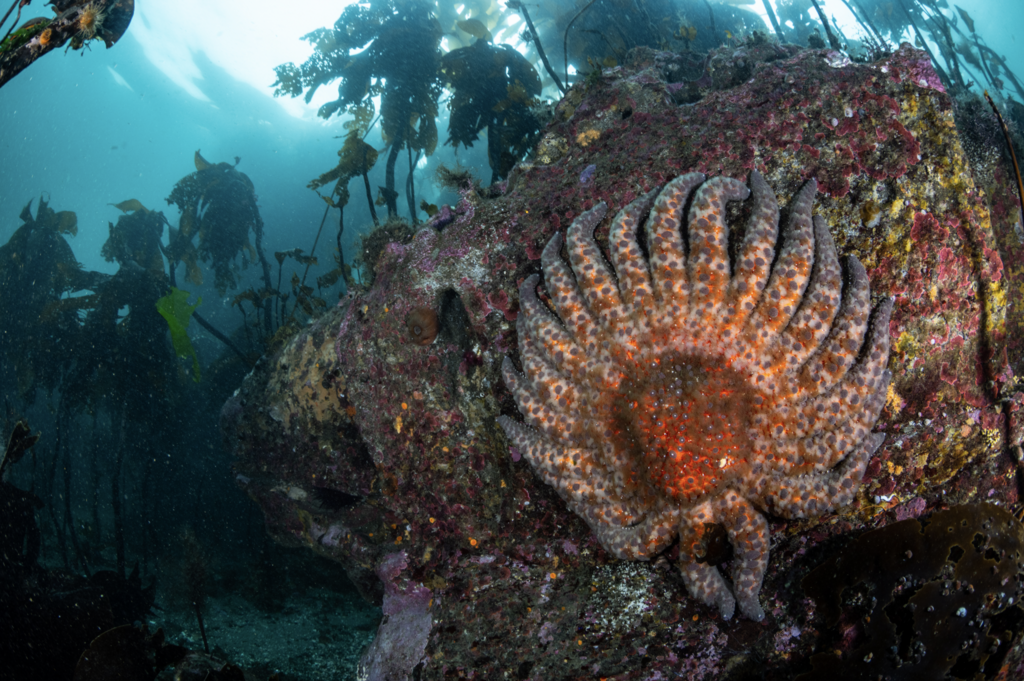
Sunflower Sea Star
Pycnopodia helianthoides
Pycnopodia helianthoides, commonly known as the sunflower sea star, is a large sea star found in the northeastern Pacific Ocean. The only species of its genus, it is among the largest sea stars in the world, with a maximum arm span of 1 m (3.3 ft). Adult sunflower sea stars usually have 16 to 24 limbs. They vary in color. Sunflower sea stars are predatory and carnivorous, feeding mostly on sea urchins, clams, sea snails, and other small invertebrates. Although the species was widely distributed throughout the northeast Pacific, its population rapidly declined from 2013. The sunflower sea star is classified as Critically Endangered on the IUCN Red List.
From the article Sunflower sea star on Wikipedia (CC BY-SA), quoted section by section
Description
Sunflower sea stars can reach an arm span of 1 m (3.3 ft). They are the heaviest known sea star, weighing about 5 kg. They are the second-biggest sea star in the world, second only to the little known deep water Midgardia xandaros, whose arm span is 134 cm (53 in) and whose body is 2.6 cm (roughly 1 inch) wide. Growth begins rapidly, but slows as the animal ages. Researchers estimate a growth rate of 8 cm (3.1 in)/year in the first several years of life, and a rate of 2.5 cm (0.98 in)/year later. Their color ranges from bright orange, yellow-red to brown, and sometimes purple, with soft, velvet-textured bodies and 5–24 arms with powerful suckers. Most sea star species have a mesh-like skeleton that protects their internal organs.
Range & habitat
Sunflower sea stars were once common in the northeast Pacific from Alaska to southern California, and were dominant in Puget Sound, British Columbia, northern California, and southern Alaska. Between 2013 and 2015, the population declined rapidly due to sea star wasting disease and warmer water temperatures caused by global climate change. The species disappeared from its habitats in the waters off the coast of California and Oregon, and saw its population reduced by 99.2% in the waters near Washington. Ecologists using shallow-water observations and deep offshore trawl surveys found that, in their study period (2004–2017), mean biomass of sunflower sea stars declined 80–100%. In 2020, the species was declared critically endangered by the International Union for Conservation of Nature. Sea star wasting disease is now known to be caused by the bacterial pathogen Vibrio pectenicida, which also infects scallops.
Sunflower sea stars generally inhabit low subtidal and intertidal areas up to 435m deep that are rich in seaweed, kelp, sand, mud, shells, gravel, or rocky bottoms. They do not venture into high- and mid-tide areas because their body structure is heavy, and requires water to support it.
Wikipedia: “Distribution and habitat”
What it does
Sunflower sea stars are efficient hunters, moving at a speed of 1 m/min (3.3 ft/min) using 15,000 tube feet that lie on their undersides. They are commonly found around urchin barrens, as the sea urchin is a favorite food. They also eat mussels, clams, snails, abalone, other gastropods, crustaceans (crabs and barnacles), fish, sea cucumbers, sand dollars and other sea stars, as well as occasionally algae and sponges. In Monterey Bay, California, they may feed on dead or dying squid. Sea star appetites and food can depend on environmental factors in their habitats, such as climate, amount of prey in the area, and latitude. Although the sunflower sea star can extend its mouth for larger prey, the stomach can extend outside the mouth to digest prey, such as abalone. Easily stressed by predators such as large fish and other sea stars, they can shed arms to escape, which regrow within a few weeks. They are preyed upon by the king crab.
Wikipedia: “Diet and behavior”
Where it lives
Recorded sightings
—
geo-referenced records in GBIF, from museums, herbaria and field observers.
Drag the globe to turn it. Dots are where records exist, not a range map; darker means more records.
In the stacks
Searching the stacks…
Every page naming Pycnopodia helianthoides in the Biodiversity Heritage Library →
This page is assembled live from iNaturalist, GBIF, Wikipedia, the Source Library and the Internet Archive. It is not yet part of the hand-edited codex. iNaturalist taxon 47673.