- Animals
- ›Arthropods
- ›Crustaceans
- ›Typical Crustaceans
- ›Malacostracans
- ›Decapods, Isopods, and allies
- ›Decapods and Krill
- ›Decapods
- ›Crabs, Lobsters, Shrimps, and Allies
- ›True Crabs
- ›Eubrachyuran Crabs
- ›Heterotrematan Crabs
- ›Dorippoidea
- ›Dorippidae
- ›Dorippe
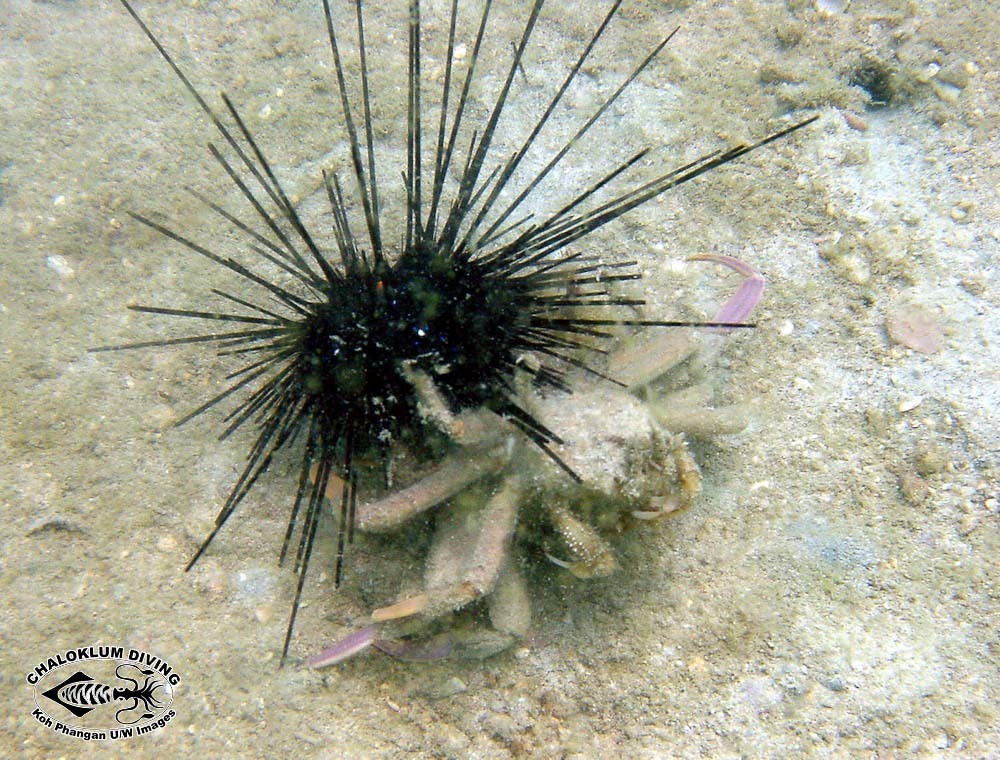
Urchin Carrier Crab
Dorippe frascone
Dorippe frascone, the urchin crab or carrier crab, is a small species of crab in the family Dorippidae that was first described scientifically by J.F.W. Herbst, in 1785. It is found in the Red Sea and parts of the western and eastern Indian Ocean. It often has a symbiotic relationship with a long-spined sea urchin and carries one around on its carapace.
From the article Dorippe frascone on Wikipedia (CC BY-SA), quoted section by section
Description
The urchin crab is a brownish-pink colour and grows to a length of about 5 cm (2 in). It has long-stalked eyes, a rounded carapace and long, slender legs. It uses only the first two pairs of legs for locomotion because the third and fourth pairs are used to grip a sea urchin which it carries around on its back. It is similar in morphology to the jellyfish crab (Ethusa spp.) but is easily distinguished by the different invertebrate transported. It also resembles decorator crabs but those actually stick living creatures such as sponges, hydroids and bryozoans, bits of algae and inert objects to their shells.
Range & habitat
Dorippe frascone is found in the Red Sea and off the coast of East Africa, including Mozambique and Cargados Carajos, an atoll north east of Mauritius.
Wikipedia: “Distribution”
What it does
The urchin crab is so called because of its habit of carrying a sea urchin on its carapace. This is usually the red urchin (Astropyga radiata), the black long-spined urchin (Diadema setosum) or the banded diadem urchin (Diadema savignyi). All these urchins have long, hollow spines and may provide protection to the crab by reducing the risk of predation by fish while not being too heavy to carry. The urchin obtains benefit by being transported to new feeding grounds. Even large and mobile individuals submit passively to being carried in this way.
Wikipedia: “Ecology”
Where it lives
Recorded sightings
—
geo-referenced records in GBIF, from museums, herbaria and field observers.
Drag the globe to turn it. Dots are where records exist, not a range map; darker means more records.
In the stacks
Searching the stacks…
Every page naming Dorippe frascone in the Biodiversity Heritage Library →
This page is assembled live from iNaturalist, GBIF, Wikipedia, the Source Library and the Internet Archive. It is not yet part of the hand-edited codex. iNaturalist taxon 474842.