On eBird ↗
Yellow-billed Stork
Live sightings near you, the range map, bar charts of when it is seen, and Macaulay Library photos and recordings.
Yellow-billed Stork
Mycteria ibis
The yellow-billed stork (Mycteria ibis), sometimes also called the wood stork or wood ibis, is a large African wading stork species in the family Ciconiidae. It is widespread in regions south of the Sahara and also occurs in Madagascar.
From the article Yellow-billed stork on Wikipedia (CC BY-SA), quoted section by section
Description
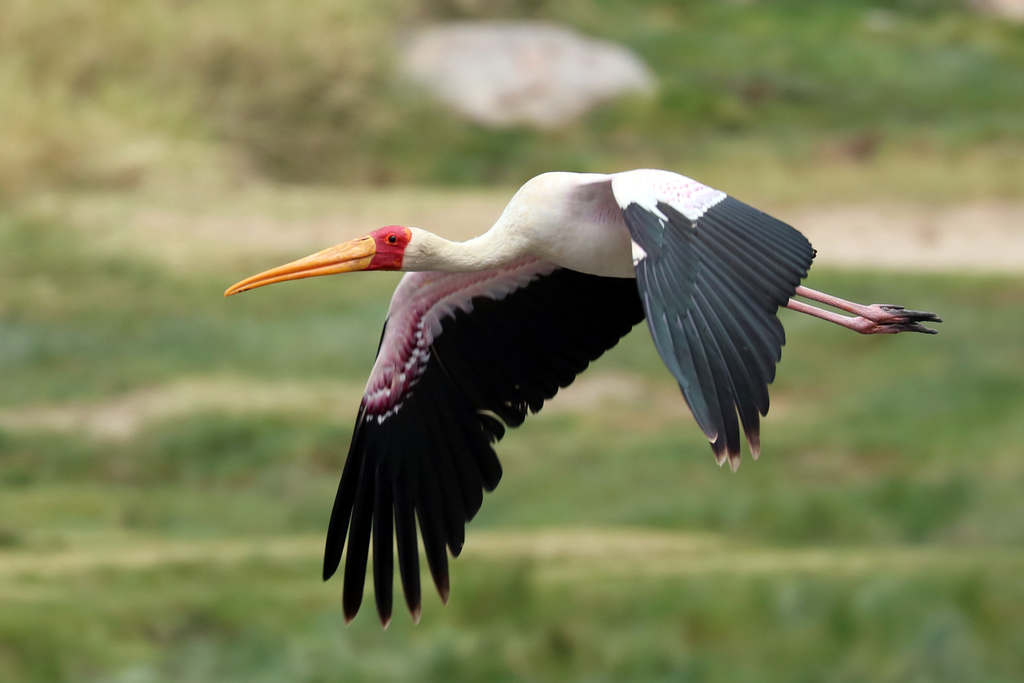
[[File:]] This medium-sized stork stands 90–105 cm (35–41 in) tall. Its body is white with a short black tail that is glossed green and purple when freshly moulted. The bill is deep yellow, slightly decurved at the end and with a rounder cross-section than in other stork species outside the Mycteria. Feathers extend onto the head and neck just behind the eyes, with the face and forehead being covered by deep red skin. Both sexes are similar in appearance, but the male is larger and has a slightly longer heavier bill. Males and females weigh approximately 2.3 kg (5.1 lb) and 1.9 kg (4.2 lb) respectively. Colouration becomes more vivid during the breeding season. In the breeding season, the plumage is coloured pink on the upperwings and back; the ordinarily brown legs also turn bright pink; the bill becomes a deeper yellow and the face becomes a deeper red. Juveniles are greyish-brown with a dull, partially bare orange face and a dull yellowish bill. The legs and feet are brown and feathers are blackish-brown all over. At fledging, salmon-pink colouration in the underwings begins to develop and after about one year, the plumage is greyish-white. Flight feathers on the tail and wing also become black. Later, the pink colouration typical of adult plumage appears. These storks walk with a high-stepped stalking gait on the ground of shallow water. …
Range & habitat
The yellow-billed stork occurs primarily in Eastern Africa, but is widely distributed in areas extending from Senegal and Somalia down to South Africa and in some regions of western Madagascar. During one observation of a mixed species bird colony on the Tana River in Kenya, it was found to be the commonest species there, with 2000 individuals being counted at once. It is also the dominant species in large breeding colonies at Lake Manyara and the Ihefu wetlands fringing the Ripera River in Tanzania. The species does not generally migrate far, at least not outside its breeding range; but does usually make short migratory movements which are influenced by rainfall. It makes local movements in Kenya and has also been found to migrate from North to South Sudan with the rainy season. It may also migrate regularly to and from South Africa. However, little is actually known about this bird's general migratory movements. Due to apparent observed variation in migratory patterns throughout Africa, the yellow-billed stork has been termed a facultative nomad. It may migrate simply to avoid areas where water or rainfall conditions are unfavourable for feeding on prey. Some populations migrate considerable distances between feeding or breeding sites; usually by using thermals to soar and glide. …
Wikipedia: “Distribution and habitat”
What it does
This stork's diet mainly comprises small, freshwater fish of about 60-100mm length and maximally 150g, which they swallow whole. They also feed on crustaceans, worms, aquatic insects, frogs and occasionally small mammals and birds. This species appears to rely principally on sense of touch to detect and capture prey, rather than by vision. They feed patiently by wading through the water with partially open bills, probing for prey at intervals. Contact of the bill with a prey item prompts a rapid snap-bill reflex, whereby the bird snaps shut its mandibles, raises its head and swallows the prey whole. The speed of this reflex in the closely related American woodstork (Mycteria americana) has been recorded as 25 milliseconds and although the corresponding reflex in the yellow-billed stork has not been quantitatively measured, the yellow-billed stork's feeding mechanism appears to be at least qualitatively identical to that of the American wood stork. In addition to the snap-bill reflex, the yellow-billed stork also uses a systematic foot stirring technique to sound out evasive prey. It prods and churns up the bottom of the water as part of a "herding mechanism" to force prey out of the bottom vegetation and into the bird's bill. The bird does this several times with one foot before bringing it forwards and repeating with the other foot. …
Wikipedia: “Diet and feeding”
In human culture
The yellow-billed stork has appeared on postage stamps in several African countries.
Wikipedia: “In culture or relationships to humans”
Listen
Looking for field recordings…
Where it lives
Recorded sightings
—
geo-referenced records in GBIF, from museums, herbaria and field observers.
Drag the globe to turn it. Dots are where records exist, not a range map; darker means more records.
In the stacks
Searching the stacks…
Every page naming Mycteria ibis in the Biodiversity Heritage Library →
This page is assembled live from iNaturalist, GBIF, Wikipedia, the Source Library and the Internet Archive. It is not yet part of the hand-edited codex. iNaturalist taxon 4744.