On eBird ↗
Red-throated Caracara
Live sightings near you, the range map, bar charts of when it is seen, and Macaulay Library photos and recordings.
Red-throated Caracara
Ibycter americanus
The red-throated caracara (Ibycter americanus) is a social species of bird of prey in the family Falconidae. It is placed in the monotypic genus Ibycter, or sometimes united in Daptrius with the black caracara. Unique among caracaras, it mainly feeds on the larvae of bees and wasps, but also takes the adult insects and fruits and berries.
It is found from far southern Mexico through parts of Central and South America south to Peru, Bolivia, and Brazil. Its natural habitats are subtropical or tropical moist lowland forests and subtropical or tropical moist montane forests.
From the article Red-throated caracara on Wikipedia (CC BY-SA), quoted section by section
Description
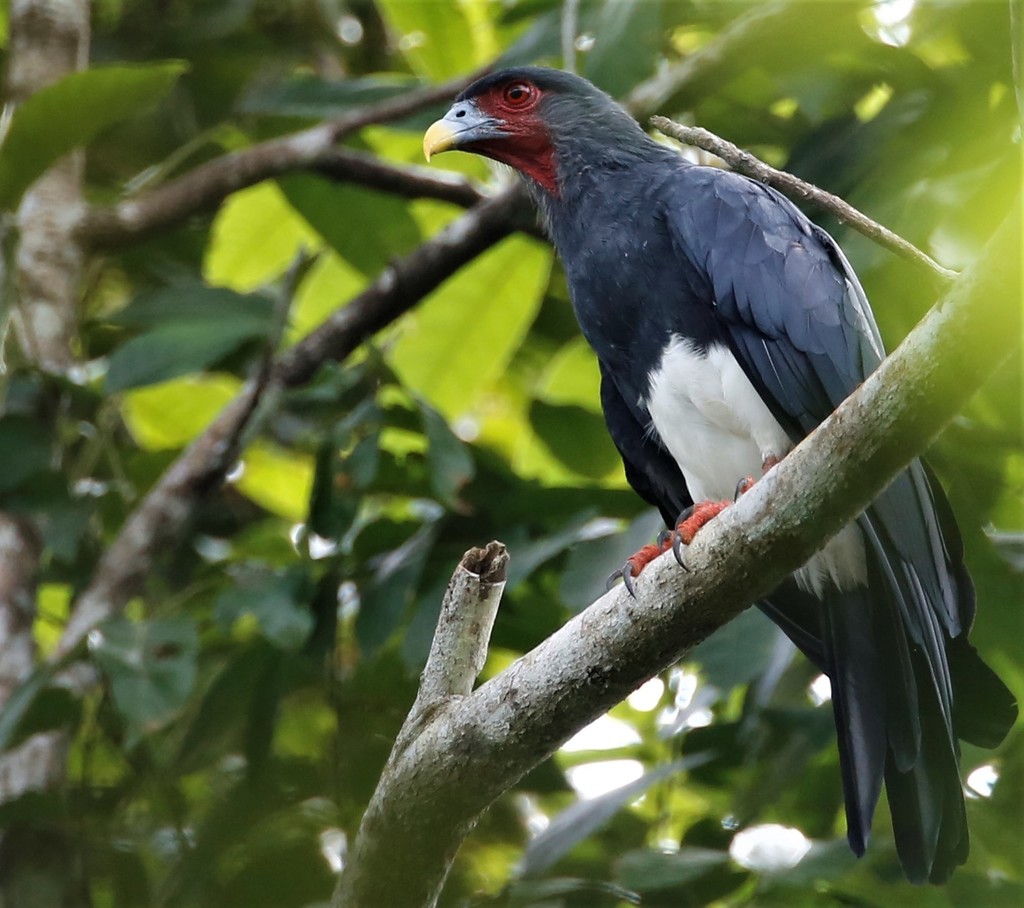
Males average 20.1 in (51 cm) long, while females average 22.1 in (56 cm); they are distinguished from the black caracara by larger size and plumage that is mainly black, with the belly, tail feathers, and undertail feathers being white. Both their faces and throats are bare, with a few black feathers scattered on the throat; the exposed skin is red. Both male and female red-throated caracaras are similar in appearance. Males have a wing length of 35.55 cm, a tail length of 24.96 cm, a bill length of 2.5 cm, and a tarsal length of 5.41 cm. Females have a wing length of 35.93 cm, a tail length of 25.31 cm, a bill length of 2.58 cm, and a tarsal length of 5.62 cm.
Range & habitat
This species inhabits the humid lowland forests of Brazil, Bolivia, Colombia, Costa Rica, El Salvador, Ecuador, French Guiana, Guatemala, Guyana, Honduras, Mexico, Nicaragua, Panama, Peru, and Venezuela. The slow flight of the red-throated caracara makes it suited it to fly in the understory of the forest where the vegetation is thin. The sparse vegetation gives the red-throated caracara greater visibility to spot food and predators. The ornate hawk-eagle and the black-and-white hawk-eagle are predators of the red-throated caracara.
Wikipedia: “Distribution and habitat”
What it does
The red-throated caracara hunts in the canopy and the understory of the lowland jungle, foraging mainly for insect nests. Most red-throated caracaras hunt silently, but occasionally make soft caws and sometimes hunt in groups. When hunting in groups, one or two individuals scout for predators in the canopy, while the remaining flock hunts in the understory. The red-throated caracara is highly territorial, with four to eight individuals in a group. Their diet consists mainly of wasp and bee larvae, though they eat mature insects and also forage on fruits and berries found in the humid subtropical and tropical lowlands, and mountainous regions of their Central and South American habitat. Biodiversity of the forest ecosystem is paramount for the birds' special diet, since wasps and bees often make their nests in hollows or amongst branches of mature trees found in old-growth forests. Deforestation and intensive agriculture practices severely hamper the red-throated caracara's population, likely accounting for its rare sightings today. After the 1950s, both its population and range rapidly declined in Costa Rica, Honduras, Panama, Ecuador, and French Guiana, causing the species to be placed on the World Wildlife endangered list. …
Wikipedia: “Food and feeding”
Listen
Looking for field recordings…
Where it lives
Recorded sightings
—
geo-referenced records in GBIF, from museums, herbaria and field observers.
Drag the globe to turn it. Dots are where records exist, not a range map; darker means more records.
In the stacks
Searching the stacks…
Every page naming Ibycter americanus in the Biodiversity Heritage Library →
This page is assembled live from iNaturalist, GBIF, Wikipedia, the Source Library and the Internet Archive. It is not yet part of the hand-edited codex. iNaturalist taxon 4729.