- Animals
- ›Chordates
- ›Vertebrates
- ›Ray-finned Fishes
- ›Spiny-rayed fishes
- ›Jacks, Flounders, Barracudas, and Allies
- ›Snooks, Barracudas, and Allies
- ›Barracudas
- ›Sphyraena
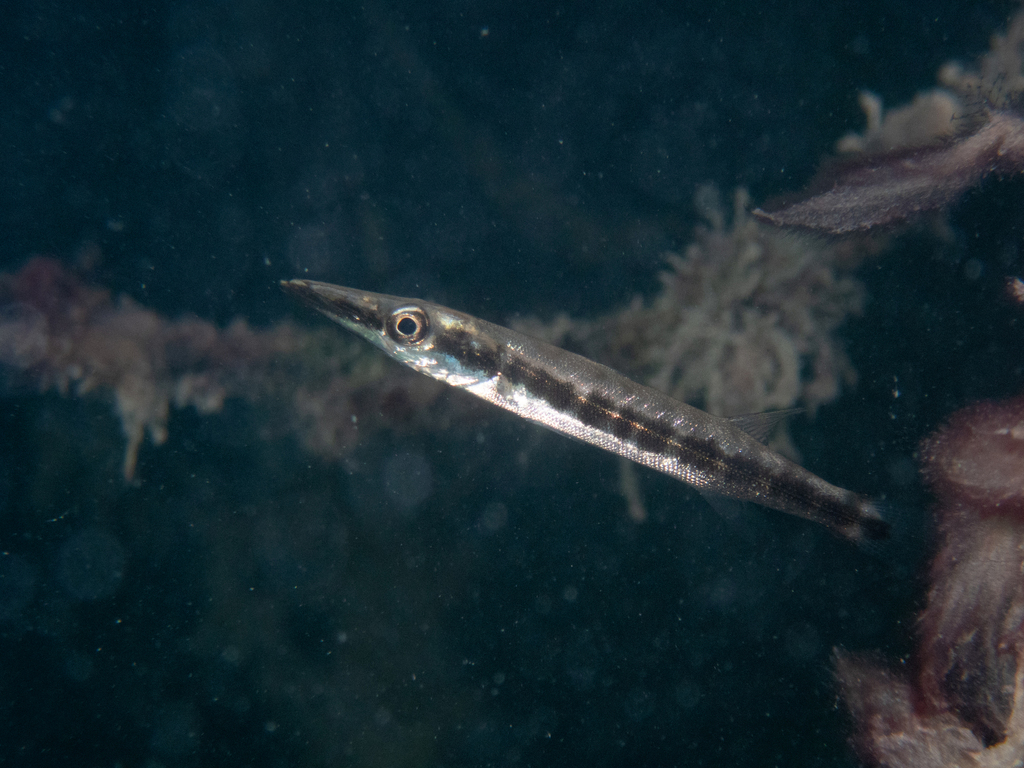
Great Barracuda
Sphyraena barracuda
The great barracuda (Sphyraena barracuda) also known as the giant barracuda, is a common species of barracuda found in subtropical oceans around the world. It is a type of ray-finned fish.
From the article Great barracuda on Wikipedia (CC BY-SA), quoted section by section
Description
Great barracudas are elongated fish with powerful jaws. The lower jaw of their large mouth juts out beyond their upper one. Barracudas possess strong, fang-like teeth that are unequal in size, set in sockets in the jaws and on the roof of the mouth. Their head is quite large, pointed and pike-like in appearance.
The great barracuda is blue gray above, fading to silvery and chalky-white below. Sometimes, a row of darker stripes occurs on its upper side, with black blotches on each lower side. The second dorsal fin, as well as the anal and caudal fins, range from dark violet to black with white tips. Great barracudas are also large fish, and the largest of its genus. Mature specimens are usually around 60–100 cm (24–39 in) in length and weigh 2.5–9.0 kg (5.5–19.8 lb). Exceptionally large specimens can exceed 1.5 m (4.9 ft) and weigh over 23 kg (51 lb). A record-sized specimen caught on rod-and-reel weighed 46.72 kg (103.0 lb) and measured 1.7 m (5.6 ft), while an even longer specimen measured 2 m (6.6 ft). The largest great barracuda was said to have measured 3 m (9.8 ft).
Range & habitat
The great barracuda is present in tropical to warm temperate waters, in subtropical parts of the Indian, Pacific, and Atlantic oceans. Primarily found in oceans near the equator, the great barracuda finds refuge in mangroves to deep reefs, and seagrass beds, up to depths of 110 m (360 ft). Juveniles and small adults typically inhabit locations near the shore, such as mangroves and seagrass meadows, while adults are typically found further away from shore around artificial structures, reefs, and rock outcroppings. These fish use these structures as a form of refuge. Studies conducted by a research group that tagged and monitored these fish in the Bahamas concluded that a significant proportion of the population stayed in their residential habitats for a long period of time; however, a small portion of the population have traveled outwards, suggesting they are capable of large-scale migration.
Wikipedia: “Distribution and habitat”
What it does
Barracudas live in open seas. They are voracious predators and hunt by ambush. They rely on surprise and short bursts of speed up to 36 mph (58 km/h) to overrun their prey, sacrificing maneuverability. The Barracuda's dorsal and anal fin are located in the posterior segment of its body. This is an evolutionary trait that allows the fish to move quickly and have an ambush attack style. The gill covers do not have spines and are covered with small scales. The two dorsal fins are widely separated, with the first having five spines and the second having one spine and nine soft rays. The second dorsal fin equals the anal fin in size and is situated more or less above it. The lateral line is prominent and extends straight from head to tail. The spinous dorsal fin is situated above the pelvis. The hind end of the caudal fin is forked or concave, and it is set at the end of a stout peduncle. The pectoral fins are low down on the sides. The barracuda has a large swim bladder. Barracudas are more or less solitary. Young and half-grown fish frequently congregate in schools. The great barracuda captures small prey through the ram-capturing method. This is done by opening their mouth and engulfing the prey with just one bite. While with bigger prey, the ram capture method is still used. …
Wikipedia: “Behavior and biology”
Where it lives
Recorded sightings
—
geo-referenced records in GBIF, from museums, herbaria and field observers.
Drag the globe to turn it. Dots are where records exist, not a range map; darker means more records.
In the stacks
Searching the stacks…
Every page naming Sphyraena barracuda in the Biodiversity Heritage Library →
This page is assembled live from iNaturalist, GBIF, Wikipedia, the Source Library and the Internet Archive. It is not yet part of the hand-edited codex. iNaturalist taxon 47251.