- Animals
- ›Chordates
- ›Vertebrates
- ›Ray-finned Fishes
- ›Spiny-rayed fishes
- ›Butterflyfishes, Angelfishes, and Allies
- ›Angelfishes
- ›Holacanthus
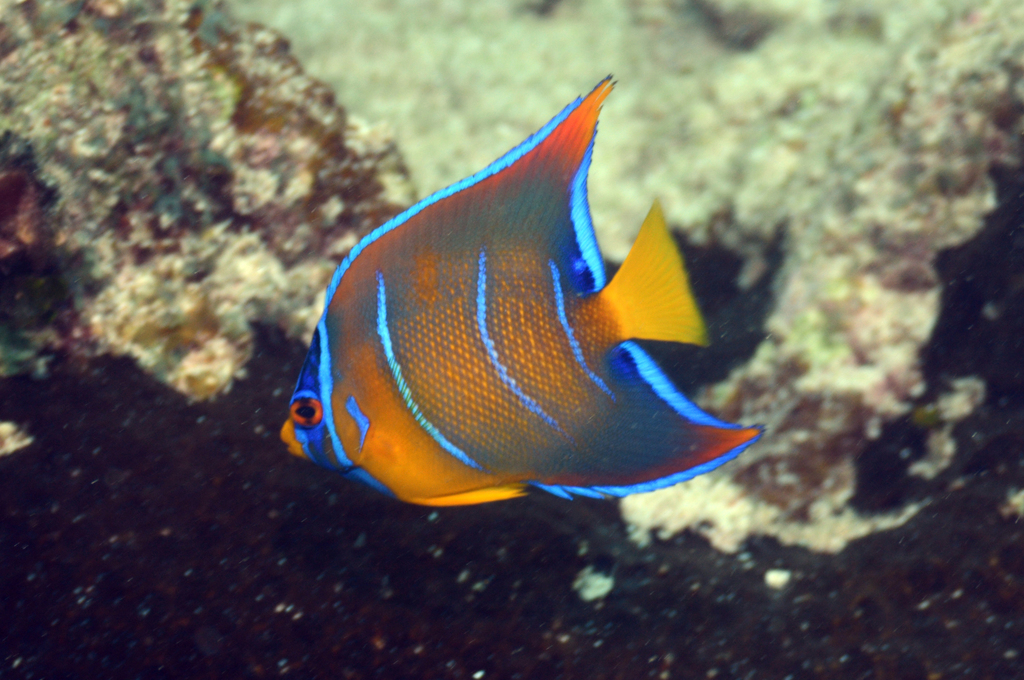
Queen Angelfish
Holacanthus ciliaris
The queen angelfish (Holacanthus ciliaris), also known as the blue angelfish, golden angelfish, or yellow angelfish, is a species of marine angelfish found in the western Atlantic Ocean. It is a benthic (ocean floor) warm-water species that lives in coral reefs. It is recognized by its blue and yellow coloration and a distinctive spot or "crown" on its forehead. This crown distinguishes it from the closely related and similar-looking Bermuda blue angelfish (Holacanthus bermudensis), with which it overlaps in range and can interbreed.
Adult queen angelfish are selective feeders and primarily eat sponges. Their social structure consists of harems which include one male and up to four females. They live within a territory where the females forage separately and are tended to by the male. Breeding in the species occurs near a full moon. The transparent eggs float in the water until they hatch. Juveniles of the species have different coloration than adults and act as cleaner fish.
From the article Queen angelfish on Wikipedia (CC BY-SA), quoted section by section
Description
The queen angelfish has a broad, flattened, oval-shaped body with triangular tail fin, a reduced, dulled snout and a small mouth containing bristle-like teeth. The dorsal fin contains 14 spines and 19–21 soft rays, and the anal fin has 3 spines and 20–21 soft rays. The dorsal and anal fins both dangle behind the body. This species attains a maximum total length of 45 cm (18 in) and weight of 1,600 g (56 oz). Males may be larger than females. The species is covered in yellow-tipped blue-green scales, with a bright yellow tail, pectoral and pelvic fins. Both the dorsal and anal fins have orange-yellow end points, while the pectoral fins have blue patches at the base. On the forehead is an eye-like spot or "crown" that is cobalt blue with an electric blue outer ring and dotted with electric blue spots. This crown is the main feature distinguishing the species from the Bermuda blue angelfish. Juveniles are dark blue with bright blue vertical stripes and a yellow pectoral area. They resemble juvenile blue angelfish and are distinguished by more curved vertical stripes. Growing juveniles develop transitional patterns as they reach their adult coloration.
Seven other color morphs have been recorded off the coast of the Saint Peter and Saint Paul Archipelago, Brazil. The most commonly recorded is a mostly gold or bright orange morph. …
What it does
Queen angelfish are found in tropical and subtropical areas of the Western Atlantic Ocean around the coasts and islands of the Americas. They occur from Florida along the Gulf of Mexico and the Caribbean Sea down to Brazil. Their range extends as far east as Bermuda and the Saint Peter and Saint Paul Archipelago. Queen angelfish are benthic or bottom-dwelling and occur from shallow waters close to shore down to 70 m (230 ft). They live in coral reefs, preferring soft corals, and swim either alone or in pairs. Queen angelfish eat sponges, tunicates, jellyfish, corals, plankton, and algae. Juveniles act as cleaner fish and establish and remove ectoparasites from bigger fish. Off St. Thomas Island and Salvador, Bahia, 90% of the diet of adults is sponges. Off the Saint Peter and Saint Paul Archipelago, more than 30 prey species may be consumed, 68% being sponges, 25% being algae, and 5% being bryozoans. Queen angelfish appear to be selective feeders as the proportion of prey in their diet does not correlate with their abundance. On the species level, the angelfish of the Saint Peter and Saint Paul Archipelago target the less common sponges Geodia neptuni, Erylus latens, Clathria calla, and Asteropus niger.
Wikipedia: “Ecology”
Where it lives
Recorded sightings
—
geo-referenced records in GBIF, from museums, herbaria and field observers.
Drag the globe to turn it. Dots are where records exist, not a range map; darker means more records.
In the stacks
Searching the stacks…
Every page naming Holacanthus ciliaris in the Biodiversity Heritage Library →
This page is assembled live from iNaturalist, GBIF, Wikipedia, the Source Library and the Internet Archive. It is not yet part of the hand-edited codex. iNaturalist taxon 47235.