- Animals
- ›Chordates
- ›Vertebrates
- ›Ray-finned Fishes
- ›Spiny-rayed fishes
- ›Butterflyfishes, Angelfishes, and Allies
- ›Threadfin Breams
- ›Scolopsis
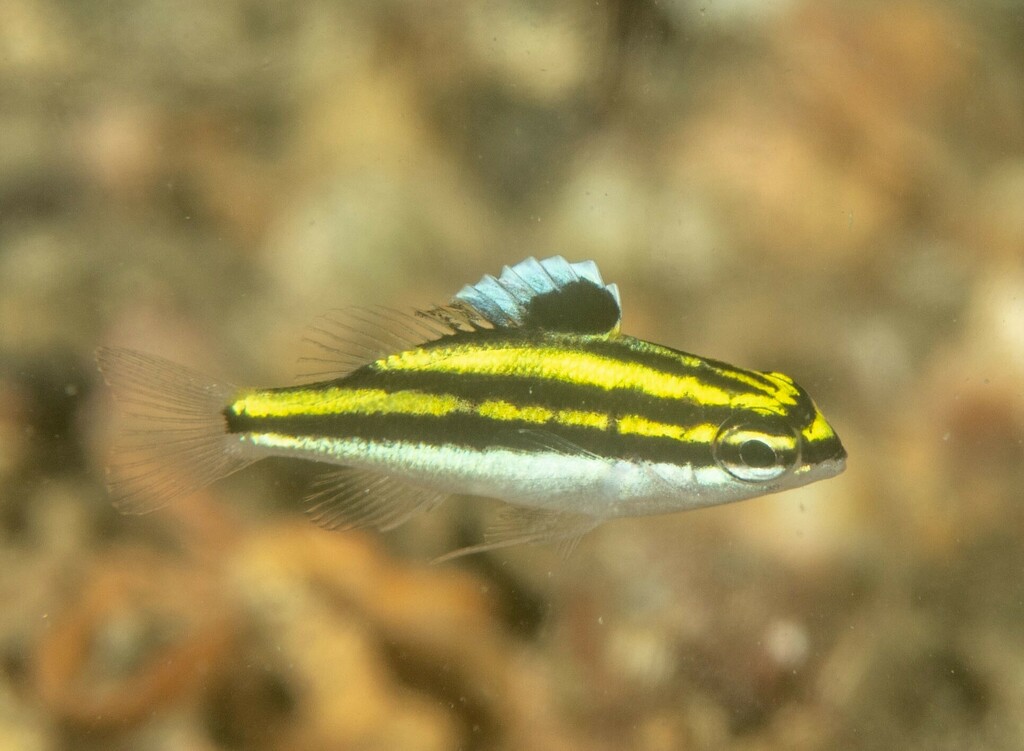
Bridled Monocle Bream
Scolopsis bilineata
The two-lined monocle bream (Scolopsis bilineata) is a species of threadfin bream native to the Indian Ocean and the western Pacific Ocean. An inhabitant of coral reefs, this species can be found at depths from 1 to 25 m (3.3 to 82.0 ft). They are carnivorous, preying on smaller fishes, as well as benthic invertebrates. This species can reach a length of 25 cm (9.8 in), though most only reach a length of around 13 cm (5.1 in). This species is sought-after...
From the article Scolopsis bilineata on Wikipedia (CC BY-SA), quoted section by section
Description
The dorsal fin of Scolopsis bilineata is supported by 10 spines and 7 soft rays while the anal fin contains 3 spines and 7 soft rays. The standard length is 2.5 to 3 times the body depth, and the length of the snout is less than the diameter of the eye. The pelvic fins are long, extending to or nearly to the level of the origin of the anal fin. The caudal fin is forked. There is a black-margined white stripe that arcs upwards from underneath the eye to the center of the dorsal-fin base, as well as a pair of white lines over and to the rear of the eyes. The spiny part of the dorsal fin is yellow, and there is a white area on the back underneath the soft-rayed part of the dorsal fin. In juveniles, the upper half of the body is black with two yellow stripes, and the middle of the flanks has a wide poorly defined white stripe. Additionally, there is a prominent black mark on the dorsal fin.
This species has a maximum published total length of 25 cm (9.8 in), although 13 cm (5.1 in) standard length is more typical.
Range & habitat
Scolopsis bilineata is found in the eastern Indian Ocean and the western Pacific Ocean. It ranges from the Maldives and Sri Lanka in the west to Fiji, the Caroline Islands and Tonga in the east. Its range extends north to the Ryukyu Islands and south to Australia. Its Australian range extends from the Houtman Abrolhos in Western Australia along the western, northern and eastern coasts as far as Sydney. It has also been recorded from the Rowley Shoals and Scott Reef off Western Australia, the Ashmore Reef in the Timor Sea, Christmas Island, Cocos (Keeling) Islands, Elizabeth and Middleton Reefs Marine National Park Reserve and Lord Howe Island. It is found at depths between 1 and 25 m (3 ft 3 in and 82 ft 0 in) on coral reefs, with the juveniles being found inshore, in lagoons or in areas of rubble.
Wikipedia: “Distribution and habitat”
What it does
Scolopsis bilineata is found typically solitarily or in pairs, although it frequently gathers in small groups. Its prey is mainly benthic invertebrates and smaller fishes. It is a protogynous hermaphrodite, but there is no evidence that this is functional, and the sex change occur prior to sexual maturation.
Wikipedia: “Reproduction”
In human culture
The specific name bilineata is Latin for "two lined"; it is a reference to the two curved, parallel dark stripes on the head of adults.
Wikipedia: “Etymology”
Where it lives
Recorded sightings
—
geo-referenced records in GBIF, from museums, herbaria and field observers.
Drag the globe to turn it. Dots are where records exist, not a range map; darker means more records.
In the stacks
Searching the stacks…
Every page naming Scolopsis bilineata in the Biodiversity Heritage Library →
This page is assembled live from iNaturalist, GBIF, Wikipedia, the Source Library and the Internet Archive. It is not yet part of the hand-edited codex. iNaturalist taxon 471636.