- Animals
- ›Chordates
- ›Vertebrates
- ›Ray-finned Fishes
- ›Spiny-rayed fishes
- ›Blennies, Damselfishes and Allies
- ›Damselfishes
- ›Typical Damselfishes and Anemonefishes
- ›Chrysiptera
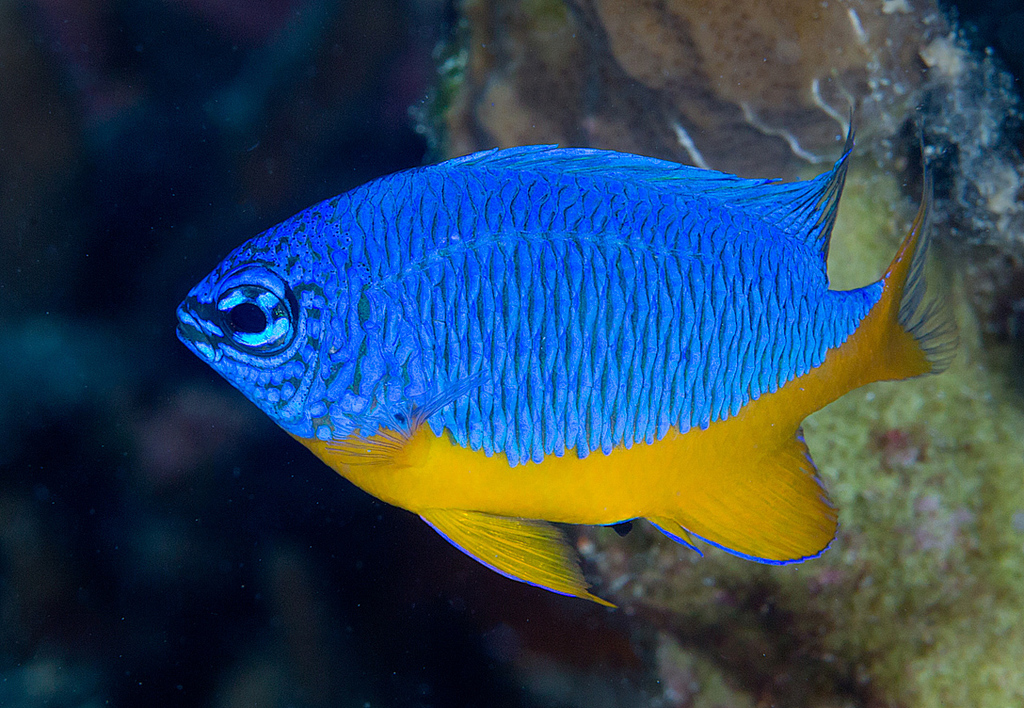
Azure Demoiselle
Chrysiptera hemicyanea
Chrysiptera hemicyanea, known commonly as the azure damselfish, azure demoiselle, half-blue demoiselle, and yellow-dipped damsel, is a species of damselfish. It is native to the eastern Indian Ocean and western Pacific. It has also recently been found in the central Mediterranean, in the waters around Sicily and Malta.
From the article Chrysiptera hemicyanea on Wikipedia (CC BY-SA), quoted section by section
Description
This tropical marine fish reaches 7 centimetres (2.8 in) in length. It is mostly bright blue in color, with a bright yellow bottom. Different species in this genus have varied amounts of gold coloring.
Wikipedia: “Appearance”
Range & habitat
It is native to the eastern Indian Ocean and western Pacific. It has also recently been filmed in the Mediterranean Sea off Malta. Being a reef species, these fish are found in greatest population in whats known as the Coral triangle, which is one of the largest concentrations of coral reefs in the world, located form the Solomon Islands to Indonesia, Bali and the Philippines. Typically found in waters 1 to 38 m (3 to 125 ft) deep and are non migratory.
Wikipedia: “Distribution”
What it does
The reproduction of Chrysiptera hemicyanea is not well studied. Reproduction in the genus Chrysiptera involves mating pairs, followed by a benthic egg-laying life cycle, where eggs are adhered to a substrate and a male stays around to guard and aerate the eggs. In addition this genus has a shorter larval stage when compared to other damselfish and because of these two things have issues distributing. Population has the ability to double in 15 months.
Wikipedia: “Reproduction”
In human culture
The generic name, Chrysiptera, is a compound of the Greek words chrysos, meaning "golden" and pteron meaning "fin" or "wing", while the specific name, hemicyanea, means "half blue" referring to the blue head and upper body.
Wikipedia: “Etymology”
Where it lives
Recorded sightings
—
geo-referenced records in GBIF, from museums, herbaria and field observers.
Drag the globe to turn it. Dots are where records exist, not a range map; darker means more records.
In the stacks
Searching the stacks…
Every page naming Chrysiptera hemicyanea in the Biodiversity Heritage Library →
This page is assembled live from iNaturalist, GBIF, Wikipedia, the Source Library and the Internet Archive. It is not yet part of the hand-edited codex. iNaturalist taxon 470653.