- Animals
- ›Chordates
- ›Vertebrates
- ›Mammals
- ›Therians
- ›Placental Mammals
- ›Ungulates, Carnivorans, and Allies
- ›Shrews, Moles, Hedgehogs, and Allies
- ›Shrews, Moles, and Hedgehogs
- ›Moles and Desmans
- ›Old World Moles and Desmans
- ›Desmans
- ›Galemys
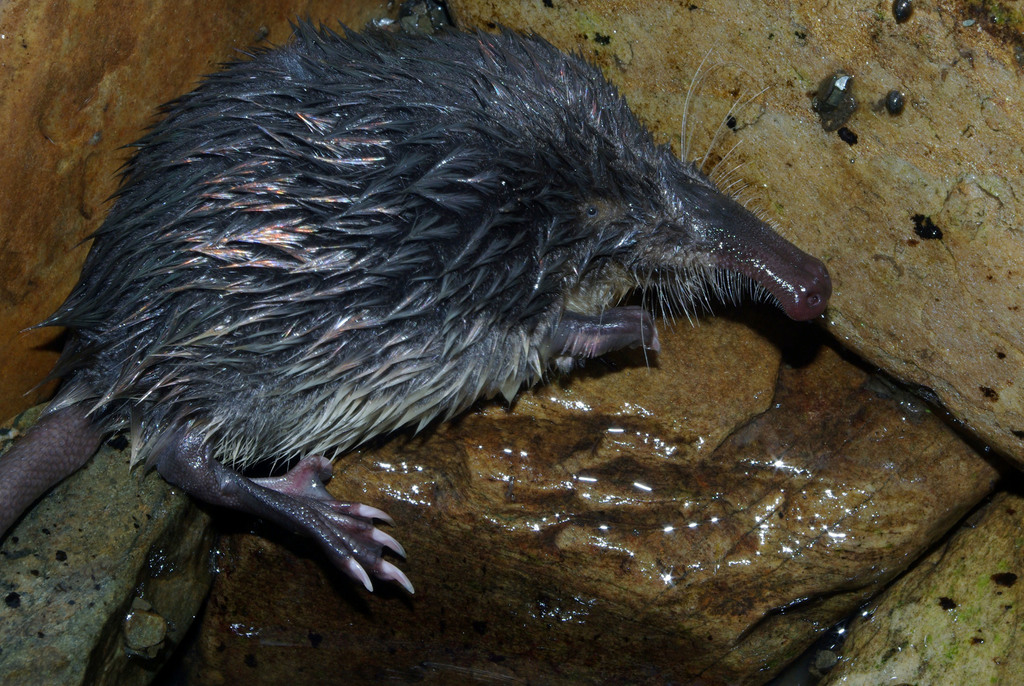
Pyrenean Desman
Galemys pyrenaicus
The Pyrenean desman (Galemys pyrenaicus), also known as the Iberian desman or trumpet rat, is a species of small semiaquatic mammal in the family Talpidae. It is endemic to the mountain ranges of the Pyrenees and to mountainous areas of the northwestern Iberian Peninsula, primarily the Cantabrian Mountains and the Sistema Central. Its distribution includes four European countries: Andorra, Spain, France, and Portugal. The species is closely related to the Russian desman.
The Pyrenean desman shows anatomical features that resemble those of several other mammals, including the brown rat (notably a robust tail adapted for swimming), the European mole (with strong, clawed forelimbs and a sensitive snout), and the common shrew (with an elongated snout used to capture small arthropods). The distinctive trunk-like snout gives rise to the alternative name "trumpet rat". The species has very limited vision and relies primarily on a highly developed sense of touch for orientation and foraging. Its mobile, prehensile snout bears vibrissae at the base and Eimer's organs at the tip, specialized tactile structures.
From the article Pyrenean desman on Wikipedia (CC BY-SA), quoted section by section
Range & habitat
The Pyrenean desman is an endemic species of mountainous regions of the Pyrenees, the Cantabrian Mountains, and the Iberian Sistema Central. It occurs primarily along specific rivers and their tributaries (listed from north to south and from west to east):
France: Nivelle, Nive, Gave d'Aspe, Gave d'Ossau, Adour, Neste, Pique, Garonne, Hers-Vif, Salat, Arize, Ariège, Aude, Rébenty, Agly, Têt, and Tech; Spain: Bidasoa, Leitzaran, Deba, Artibai, Lea, Gobelas, Oka, Auritz, Irati, Aragon, Gállego, sierra de Guara, Ara, Cinca, Noguera Ribagorçana, Noguera Pallaresa, Segre, Ter, Oviedo, Pisuerga, Xallas, Tambre, Lérez, Oitavén, Sil, Tâmega, Arandilla, Duero; Portugal: Minho, Rio Âncora, Lima, Neiva, Cávado River, Ave, Rio Leça, Douro, Vouga, Mondego, Zêzere. Many of these rivers are separated by continental divides or belong to distinct and non-contiguous drainage basins; as a result, the species' distribution is highly fragmented. At a broad scale, the current range is considered a remnant of post-glacial expansion into newly available habitats, facilitated by terrestrial corridors and possibly a denser river network during the Holocene. At a finer scale, however, movements between neighbouring drainage basins may have occurred more recently.
Wikipedia: “Geographic range”
What it does
Sexual activity occurs from December to May in males and from February to June in females, with timing varying by region according to temperature, climate, and altitude. There is no clearly defined breeding season, although three peaks in gestation have been identified in February, March, and May. Females may produce more than one litter per year, but this has not been conclusively demonstrated. The duration of gestation has not been directly observed, and neither gestation nor neonates younger than three months have been documented. By comparison with other members of the Talpidae family, gestation is estimated to last approximately 30–40 d (3,500 ks). Lactation is reported to last around four to five weeks. Parturition has not been observed directly but is presumed to take place in underground burrows. Litter size does not exceed five individuals and more commonly comprises three to four. Females possess eight teats: two pectoral, two abdominal, and four inguinal. Sexual maturity is reported to be reached within a few weeks.
Wikipedia: “Reproduction”
At the table
The desman has a high metabolic rate and must consume approximately one-third to one-half of its body mass daily (20–30 g (0.71–1.06 oz)). During mid-winter, when water temperatures are lowest, daily intake may reach its entire body mass (60 g (2.1 oz)). The mountain winter period (January–April) coincides with both the reproductive phase and peak prey availability.
Analyses of stomach contents, faeces, and observations of captive individuals indicate that the diet consists primarily of benthic invertebrate larvae belonging to three insect orders: mayflies, stoneflies, and caddisflies. Early morphological studies characterised the species as a specialised predator. Molecular analyses of faeces conducted in the 2010s refined this assessment, showing that these three orders account for about 80% of prey items but represent only one-third of the identified prey species. Additional prey include dipteran larvae and crustaceans such as freshwater shrimp. A broad range of other taxa is consumed opportunistically, including beetles, lacewings, true bugs, moths, dragonflies, myriapods, arachnids, newts, snails, and occasionally fish.Strictly terrestrial prey, such as spiders, grasshoppers, and earthworms, account for around 10% of prey items and more than one-third of identified species. …
Wikipedia: “Food”
In human culture
The generic name Galemys is derived from the Ancient Greek γαλῆ (galễ, meaning "weasel") and μῦς (mûs, meaning "mouse"). The term "desman" originates from the Swedish desman ("musk"), a diminutive of desmanrätte ("muskrat"). This word ultimately derives from Middle Low German Desem and Medieval Latin bisamum, both of which refer to musk.
Wikipedia: “Etymology”
Listen
Looking for field recordings…
Where it lives
Recorded sightings
—
geo-referenced records in GBIF, from museums, herbaria and field observers.
Drag the globe to turn it. Dots are where records exist, not a range map; darker means more records.
In the stacks
Searching the stacks…
Every page naming Galemys pyrenaicus in the Biodiversity Heritage Library →
This page is assembled live from iNaturalist, GBIF, Wikipedia, the Source Library and the Internet Archive. It is not yet part of the hand-edited codex. iNaturalist taxon 47041.