On eBird ↗
Blue Crane
Live sightings near you, the range map, bar charts of when it is seen, and Macaulay Library photos and recordings.
Blue Crane
Grus paradiseus
The blue crane (Grus paradisea), also known as the Stanley crane and the paradise crane, is the national bird of South Africa. The species is listed as Vulnerable by the IUCN.
From the article Blue crane on Wikipedia (CC BY-SA), quoted section by section
Description
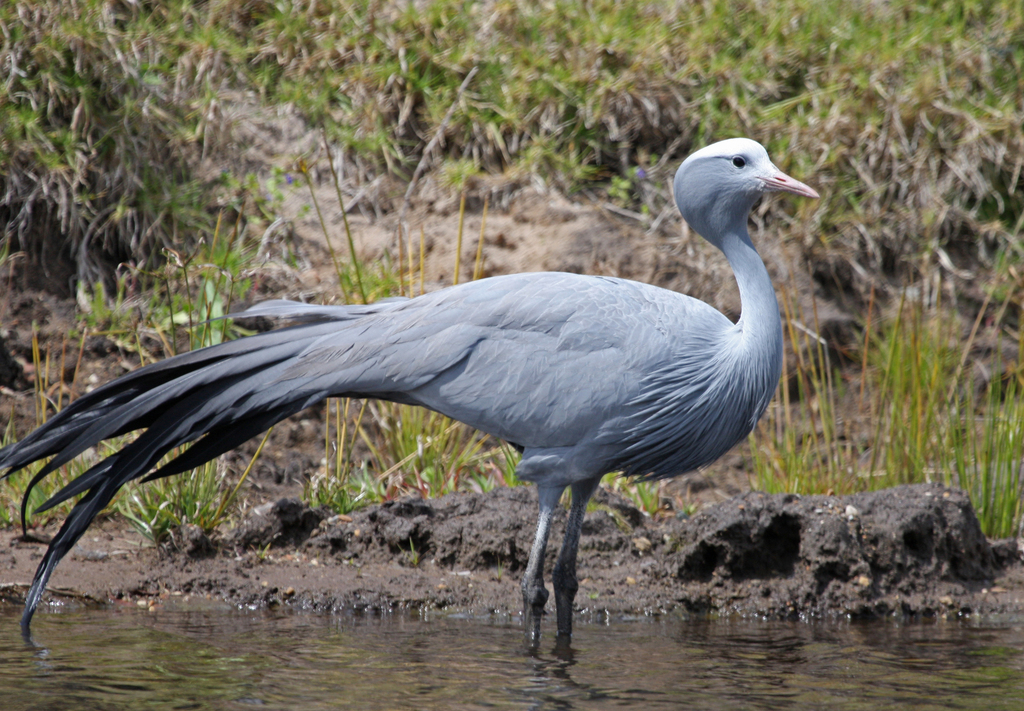
The blue crane is a tall, ground-dwelling bird, but is fairly small by the standards of the crane family. It is 100–120 cm (3 ft 3 in – 3 ft 11 in) tall, with a wingspan of 180–200 cm (5 ft 11 in – 6 ft 7 in) and weighs 3.6–6.2 kg (7.9–13.7 lb). Among standard measurements, the wing chord measures 51.4–59 cm (20.2–23.2 in), the exposed culmen measures 8–10 cm (3.1–3.9 in) and the tarsus measures 20.5–25.2 cm (8.1–9.9 in). This crane is pale blue-gray in color becoming darker on the upper head, neck and nape. From the crown to the lores, the plumage is distinctly lighter, sometimes whitish. The bill is ochre to greyish, with a pink tinge. The long wingtip feathers which trail to the ground. The primaries are black to slate grey, with dark coverts and blackish on the secondaries. Unlike most cranes, it has a relatively large head and a proportionately thin neck. Juveniles are similar but slightly lighter, with tawny coloration on the head, and no long wing plumes.
Range & habitat
Blue cranes are birds of the dry grassy uplands, usually the pastured grasses of hills, valleys, and plains with a few scattered trees. They prefer areas in the nesting season that have access to both upland and wetland areas, though they feed almost entirely in dry areas. They are altitudinal migrants, generally nesting in the lower grasslands of an elevation of around 1,300 to 2,000 m and moving down to lower altitudes for winter.
Wikipedia: “Habitat”
What it does
Of the 15 species of crane, the blue crane has the most restricted distribution of all. Even species with lower population numbers now (such as Siberian or whooping cranes) are found over a considerable range in their migratory movements. The blue crane is migratory, primarily altitudinal, but details are little known. The blue crane is partially social, less so during the breeding season. There is a strict hierarchy in groups, with the larger adult males being dominant. They overlap in range with three other crane species but interactions with these species and other "large wader" type birds are not known. They are aggressively protective of their nesting sites during the nesting season, even attacking innocent, non-predatory animals such as antelope, cattle, tortoises, plovers and the smallest of birds, such as sparrows. Humans are also attacked if they approach a nest too closely, with the aggressive male having torn clothes and drawn blood in such cases. Threats to their eggs and chicks include large savannah and white-throated monitor lizards, egg-eating snakes, foxes, jackals, birds-of-prey, meerkats, and mongoose.
Wikipedia: “Movements and behaviour”
Listen
Looking for field recordings…
Where it lives
Recorded sightings
—
geo-referenced records in GBIF, from museums, herbaria and field observers.
Drag the globe to turn it. Dots are where records exist, not a range map; darker means more records.
In the stacks
Searching the stacks…
Every page naming Grus paradiseus in the Biodiversity Heritage Library →
This page is assembled live from iNaturalist, GBIF, Wikipedia, the Source Library and the Internet Archive. It is not yet part of the hand-edited codex. iNaturalist taxon 47.