- Animals
- ›Chordates
- ›Vertebrates
- ›Mammals
- ›Therians
- ›Placental Mammals
- ›Ungulates, Carnivorans, and Allies
- ›Shrews, Moles, Hedgehogs, and Allies
- ›Shrews, Moles, and Hedgehogs
- ›Moles and Desmans
- ›New World Moles
- ›New World Moles
- ›Scapanus
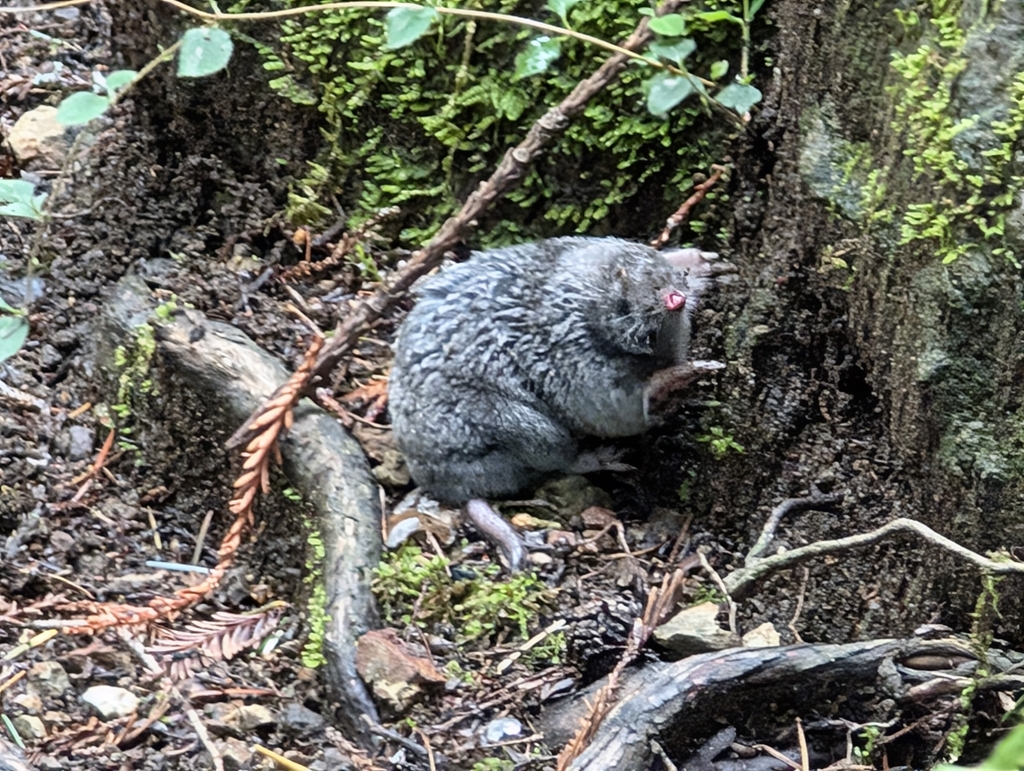
Northern Broad-footed Mole
Scapanus latimanus
The northern broad-footed mole (Scapanus latimanus) is a species of mammal in the family Talpidae. It is endemic to the United States, where it is found in northern California, Nevada and Oregon at elevations up to 9,800 feet (3,000 m) above sea level.
From the article Northern broad-footed mole on Wikipedia (CC BY-SA), quoted section by section
Description
The broad-footed mole can be distinguished from other species of Scapanus by its dark brown to silvery fur which is short, soft, and plush-like in texture with uniform coloration, and 40–44 unevenly spaced unicuspid teeth. Adults bodies are short and cylindrical with a long and pointed snout. The forefeet are greatly expanded with flattened palms and long heavy claws. The tail is scantily covered with coarse hair. On average, body lengths range from 5.5 to 7.1 inches (14 to 18 cm) in total length, with males slightly larger than females. Populations in more humid environments also tend to have larger individuals than those from southern, drier areas. The dental formula of Scapanus latimanus is 3.1.4.33.1.4.3 × 2 = 44. Its karyotype has 2n = 34, FN = 64. As with most moles, it requires moist, friable soils, where it eats earthworms, insects, other invertebrates and some plant matter. Scapanus latimanus is a fossorial mammal, living below ground for most of its life. Only one animal occupies a burrow at a time and if a burrow has been vacated, it is often reoccupied within 2 days. Tunnels are typically dug far below surface level and the excess earth is removed via shafts that run laterally and vertically up to the surface. …
Listen
Looking for field recordings…
Where it lives
Recorded sightings
—
geo-referenced records in GBIF, from museums, herbaria and field observers.
Drag the globe to turn it. Dots are where records exist, not a range map; darker means more records.
In the stacks
Searching the stacks…
Every page naming Scapanus latimanus in the Biodiversity Heritage Library →
This page is assembled live from iNaturalist, GBIF, Wikipedia, the Source Library and the Internet Archive. It is not yet part of the hand-edited codex. iNaturalist taxon 46994.