- Animals
- ›Chordates
- ›Vertebrates
- ›Mammals
- ›Therians
- ›Placental Mammals
- ›Ungulates, Carnivorans, and Allies
- ›Shrews, Moles, Hedgehogs, and Allies
- ›Shrews, Moles, and Hedgehogs
- ›Shrews
- ›White-toothed Shrews
- ›Suncus
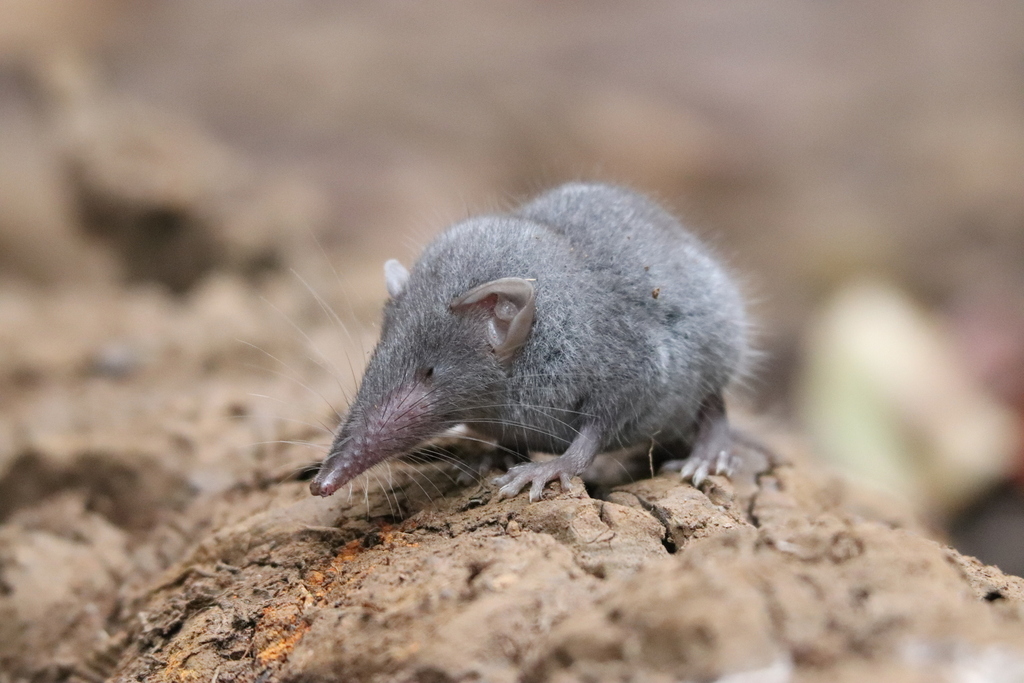
Asian House Shrew
Suncus murinus
The Asian house shrew (Suncus murinus) is a shrew species native to South and Southeast Asia that has been listed as Least Concern on the IUCN Red List since 2008 because of its large population and wide distribution. It has been introduced in several West Asian and East African countries. It is considered an invasive species and has been implicated in the demise of several island lizard species.
It is also called house shrew, grey musk shrew, Asian musk shrew or Indian musk shrew.
From the article Asian house shrew on Wikipedia (CC BY-SA), quoted section by section
Description
The house shrew has a uniform, short, dense fur of mid-grey to brownish-grey color. The tail is thick at the base and a bit narrower at the tip, and is covered with a few long, bristle-like hairs that are thinly scattered. They have short legs with five clawed toes. They have small external ears and an elongated snout. They also emit a strong odor of musk, derived from musk glands that are sometimes visible on each side of the body. The odor is especially noticeable during the breeding season. Like all shrews, the Asian house shrew is plantigrade and long-nosed. The teeth are a series of sharp points which enable them to poke holes in insect exoskeletons. It is the largest of the shrew species, weighing between 50 and 100 g and being about 15 cm long from snout to tip of the tail.
Range & habitat
The Asian house shrew is native to South and Southeast Asia and was introduced by humans to eastern Africa, Arabia, Madagascar, the Philippines and other islands in the Indian and Pacific Oceans.
Wikipedia: “Distribution”
What it does
The Asian house shrew is a voracious insectivore with little resistance to starvation. It is active during the night, spending the day in a burrow or hiding place in human habitations. They breed throughout the year, with each female averaging two litters per year. The gestation period is one month. One to eight young are born per litter, usually three young, in a nest made by both of the parents, wherein the young stay until they are nearly adult. It starts breeding when it is around one year old. Studies on this shrew have suggested its suitability for use in laboratory studies of reproduction and nutrition. It is widespread and found in all habitats, including deserts and human habitations. The house shrew has a habit of moving quickly along the edges of the walls when it enters human habitations. As it runs it makes a chattering sound which resembles the sound of jingling money, which has earned them the name "money shrew" in China. When alarmed, the house shrew makes an ear-piercing, high-pitched shriek, resembling the sound of nails scraping a chalkboard or a metal fork scraping glass, which repels house cats. …
Wikipedia: “Ecology and behaviour”
In human culture
In Shaiva Siddhanta, the Asian house shrew is the main vahana of Pillaiyar, and therefore it is sinful to kill one.
Wikipedia: “In culture”
Listen
Looking for field recordings…
Where it lives
Recorded sightings
—
geo-referenced records in GBIF, from museums, herbaria and field observers.
Drag the globe to turn it. Dots are where records exist, not a range map; darker means more records.
In the stacks
Searching the stacks…
Every page naming Suncus murinus in the Biodiversity Heritage Library →
This page is assembled live from iNaturalist, GBIF, Wikipedia, the Source Library and the Internet Archive. It is not yet part of the hand-edited codex. iNaturalist taxon 46531.