- Animals
- ›Chordates
- ›Vertebrates
- ›Mammals
- ›Therians
- ›Placental Mammals
- ›Ungulates, Carnivorans, and Allies
- ›Shrews, Moles, Hedgehogs, and Allies
- ›Shrews, Moles, and Hedgehogs
- ›Shrews
- ›White-toothed Shrews
- ›Suncus
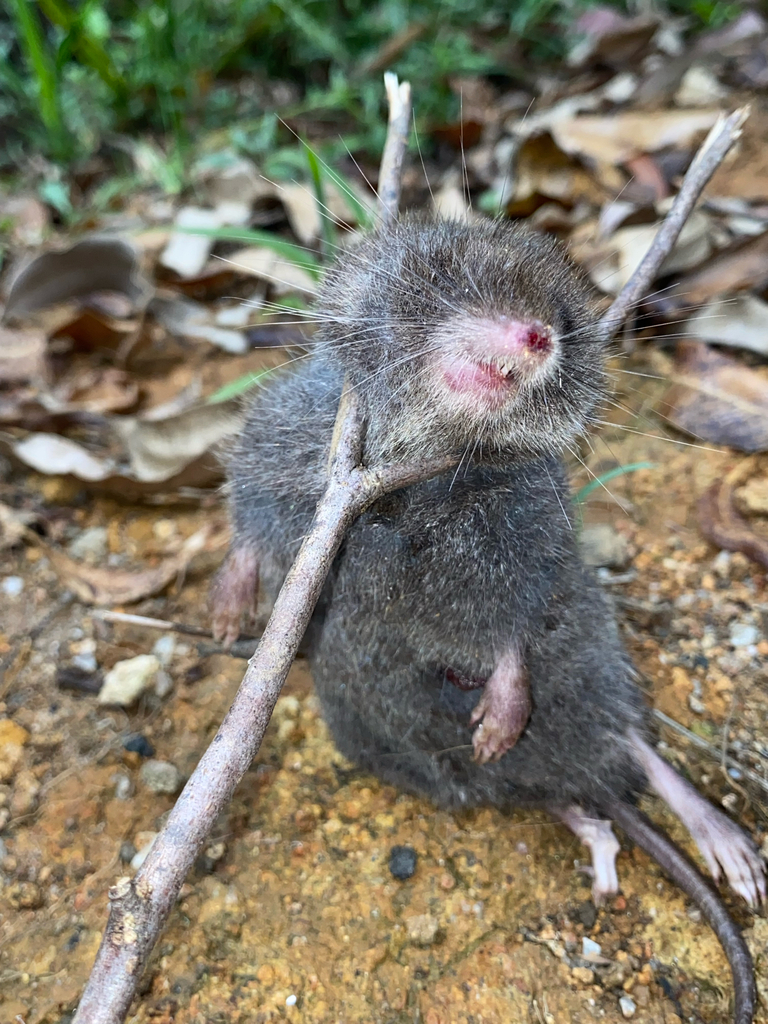
Jungle Shrew
Suncus zeylanicus
The jungle shrew (Suncus zeylanicus), also known as Sri Lankan shrew, is a species of mammal in the family Soricidae endemic to Sri Lanka. Its natural habitat is subtropical or tropical dry forests. It is threatened by habitat loss.
From the article Jungle shrew on Wikipedia (CC BY-SA), quoted section by section
Description
Its head and body are 10–12 cm (3.9–4.7 in) long, with an 8–9 cm (3.1–3.5 in) tail. Its pelage is dark gray above, and lighter in the underparts. Hairs appear dark at the base and lighter at the tip. The tail is short and gray, sometimes with a white tip.
Range & habitat
This species is endemic to Sri Lanka, where it is known from several distinctly fragmented locations across the Central, Western, and Sabaragamuwa provinces. Its known range was extended further south with confirmed records from the Sinharaja and Kanneliya forests. It occurs at elevations ranging from 150 to approximately 1,000 meters above sea level. Despite this relatively broad distribution, the species appears to be rare. Recent surveys involving over 2,000 night traps in its known range, including the type locality of Kitulgala, failed to record any individuals, with only a single specimen confirmed from Sinharaja in recent years.
Wikipedia: “Distribution”
What it does
This shrew is nocturnal, crepuscular, and terrestrial. It is a specialist of lowland wet zone rainforests and is thought to be insectivorous. Its absence from abandoned lands and plantation woodlands within its forest range indicates a high susceptibility to habitat loss and land conversion, likely contributing to its fragmented and rare status.
== References ==
Wikipedia: “Ecology”
Listen
Looking for field recordings…
Where it lives
Recorded sightings
—
geo-referenced records in GBIF, from museums, herbaria and field observers.
Drag the globe to turn it. Dots are where records exist, not a range map; darker means more records.
In the stacks
Searching the stacks…
Every page naming Suncus zeylanicus in the Biodiversity Heritage Library →
This page is assembled live from iNaturalist, GBIF, Wikipedia, the Source Library and the Internet Archive. It is not yet part of the hand-edited codex. iNaturalist taxon 46514.