- Fungi Including Lichens
- ›Ascomycete Fungi
- ›Sac Fungi and Lichens
- ›Common Lichens
- ›Shield Lichens, Sunburst Lichens, Rosette Lichens, and Allies
- ›shield lichens, rim lichens, and allies
- ›shield lichens and allies
- ›typical shield lichens
- ›Parmelia
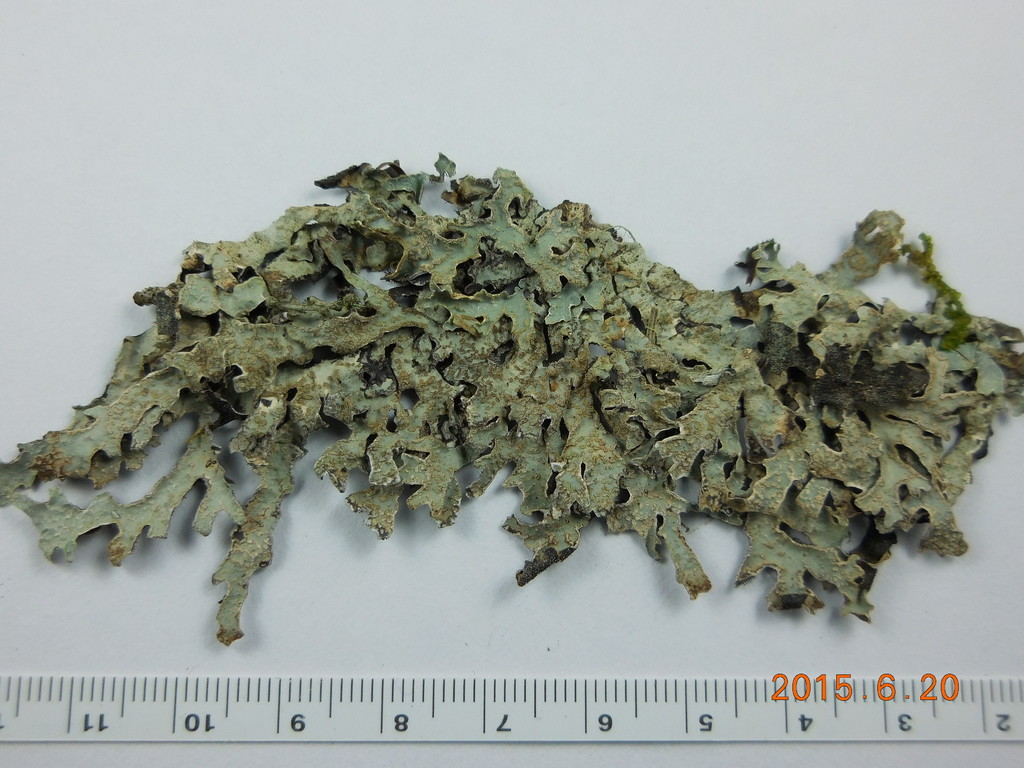
Parmelia barrenoae
Parmelia barrenoae is a species of foliose lichen in the large family Parmeliaceae. It was formally described as a new species in 2005. Before this, it was lumped together as one of several lichens in the Parmelia sulcata group—a species complex of genetically distinct lookalikes. Parmelia barrenoae is widely distributed, occurring in Europe, western North America, Africa, and Asia.
The greenish grey to whitish grey leafy thallus of Parmelia barrenoae grows up to 10 cm (4 in) in diameter. Features of the thallus surface include tiny pores for gas exchange, and vegetative propagules called soralia. The lichen usually grows on tree bark, but is occasionally found on moss-covered rocks in open and sunny places. The lookalike species Parmelia submontana and Parmelia sulcata can be distinguished from Parmelia barrenoae by small differences in morphology. Studies indicate that Parmelia barrenoae is sensitive to air pollution, and it has been proposed for use as an indicator of well conserved and sustainably managed forests.
From the article Parmelia barrenoae on Wikipedia (CC BY-SA), quoted section by section
Description
Parmelia barrenoae has a foliose (leafy) thallus with a tight to loose attachment to its substrate. It measures 5–10 cm (2–4 in) in diameter. The lobes are contiguous to overlapping, with short, rounded tips, measuring 2–7 mm wide. The older lobes tend to curve backwards. The upper surface of the thallus is greenish grey to whitish grey, with a texture that is initially finely foveolate (covered with small pits) before becoming reticulate (net-like) and cracked. The thickness of the thallus is somewhat variable; depending on whether the central areas or the margins are measured, ranging from 200 to 375 μm. Of this, the cortex is 25–37.5 μm thick, the photobiont layer about 30–40 μm thick, the medulla 120–200 μm thick, and the underlying darkened cortex 25–40 μm thick. The latter tissue layer, which gives the thallus underside its blackened colour, is paraplectenchyma—a type of tissue in which the fungal hyphae are oriented in all directions. …
Range & habitat
First described from Ávila, and a few years later from the Castellón mountains and Asturias, the geographical range of Parmelia barrenoae has increased expansively as other researchers have reported its occurrence in other locations. In 2010, the lichen was reported to occur in North America and Africa. The North American distribution includes the western United States, based on specimens collected in the states of California, Idaho, Oregon, and Washington. The African distribution includes the Middle Atlas mountain range of Morocco. In 2016, it was reported from Poland, in 2017 from Macedonia, and in 2018 from Turkey and Asia for the first time. In 2021 it was reported to occur in Hungary, Slovakia and Sweden. In some areas its precise range is not yet well known because of historical confusion with P. sulcata. In the Mediterranean, Parmelia barrenoae is widely distributed on oak bark and conifers. It is occasionally on moss-covered rocks in open and sunny places. The species occurs in Mediterranean areas at moderate altitudes between 800–1,800 m (2,600–5,900 ft). In this region it often co-occurs with Parmelia serrana and various species of Lobaria. In Hungary and Slovakia, the lichen was found in oak-hornbeam and oak forests at elevations between 260 and 500 m (850 and 1,640 ft). …
Wikipedia: “Habitat and distribution”
Where it lives
Recorded sightings
—
geo-referenced records in GBIF, from museums, herbaria and field observers.
Drag the globe to turn it. Dots are where records exist, not a range map; darker means more records.
In the stacks
Searching the stacks…
Every page naming Parmelia barrenoae in the Biodiversity Heritage Library →
This page is assembled live from iNaturalist, GBIF, Wikipedia, the Source Library and the Internet Archive. It is not yet part of the hand-edited codex. iNaturalist taxon 463659.