On eBird ↗
Lesser Frigatebird
Live sightings near you, the range map, bar charts of when it is seen, and Macaulay Library photos and recordings.
Lesser Frigatebird
Fregata ariel
The lesser frigatebird (Fregata ariel) is a seabird of the frigatebird family Fregatidae. Around 75 cm (30 in) in length, it is the smallest species of frigatebird. It occurs over tropical and subtropical waters across the Indian and Pacific Oceans, as well as off the Atlantic coast of Brazil.
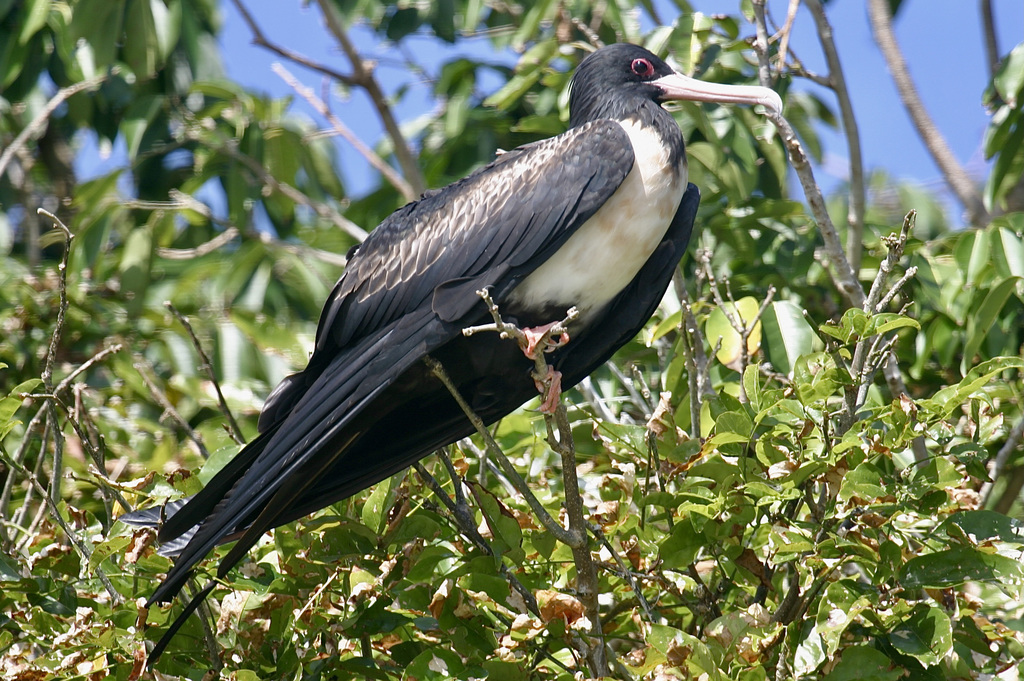
The lesser frigatebird is a lightly built seabird with brownish-black plumage, long, narrow wings, and a deeply forked tail. The male has a striking red gular sac, which he inflates to attract a mate. The female is slightly larger than the male and has a white breast and belly. Frigatebirds feed on fish taken in flight from the ocean's surface (often flying fish), and sometimes indulge in kleptoparasitism, harassing other birds to force them to regurgitate their food.
From the article Lesser frigatebird on Wikipedia (CC BY-SA), quoted section by section
Description
The lesser frigatebird is the smallest species of frigatebird and measures 66–81 cm (26–32 in) in length with a wingspan of 155–193 cm (61–76 in) and a long, forked tail. Male birds weight 625–875 g (1.378–1.929 lb). Female birds are heavier and weight 760–955 grams (1.676–2.105 lb). Like all frigatebirds, the male has a large, red sac on the front of the throat, which is inflated during courtship. Courtship display also involves a variety of calls, bill rattling, and spreading of the wings. The male is mostly all black save for a white patch on the flank that extends on to the underwing as a spur. Males also have a pale bar on the upper wing. Females have a black head and neck with a white collar and breast, as well as a spur extending on to the underwing. The female also has a narrow, red ring around the eye. Juveniles and immature birds are more difficult to differentiate, but the presence of the spurs of white in the armpits is a helpful distinguishing sign. Frigate birds are built for flying; they rarely swim and cannot walk, but can manage to climb around the trees and bushes in which they nest. They have a very light skeleton and long, narrow wings and are masters of the air. …
Range & habitat
The lesser frigatebird is said to be the most common and widespread frigatebird in Australian seas. It is common in tropical seas, breeding on remote islands, including Christmas Island in the Indian Ocean in recent years. These birds are most likely to be seen from the mainland prior to the onset of a tropical cyclone, and once this abates, they disappear again.
Wikipedia: “Distribution”
Listen
Looking for field recordings…
Where it lives
Recorded sightings
—
geo-referenced records in GBIF, from museums, herbaria and field observers.
Drag the globe to turn it. Dots are where records exist, not a range map; darker means more records.
In the stacks
Searching the stacks…
Every page naming Fregata ariel in the Biodiversity Heritage Library →
This page is assembled live from iNaturalist, GBIF, Wikipedia, the Source Library and the Internet Archive. It is not yet part of the hand-edited codex. iNaturalist taxon 4634.