- Fungi Including Lichens
- ›Ascomycete Fungi
- ›Sac Fungi and Lichens
- ›Arthoniomycetes
- ›Arthoniales
- ›Christmas lichens, comma lichens, and allies
- ›Herpothallon
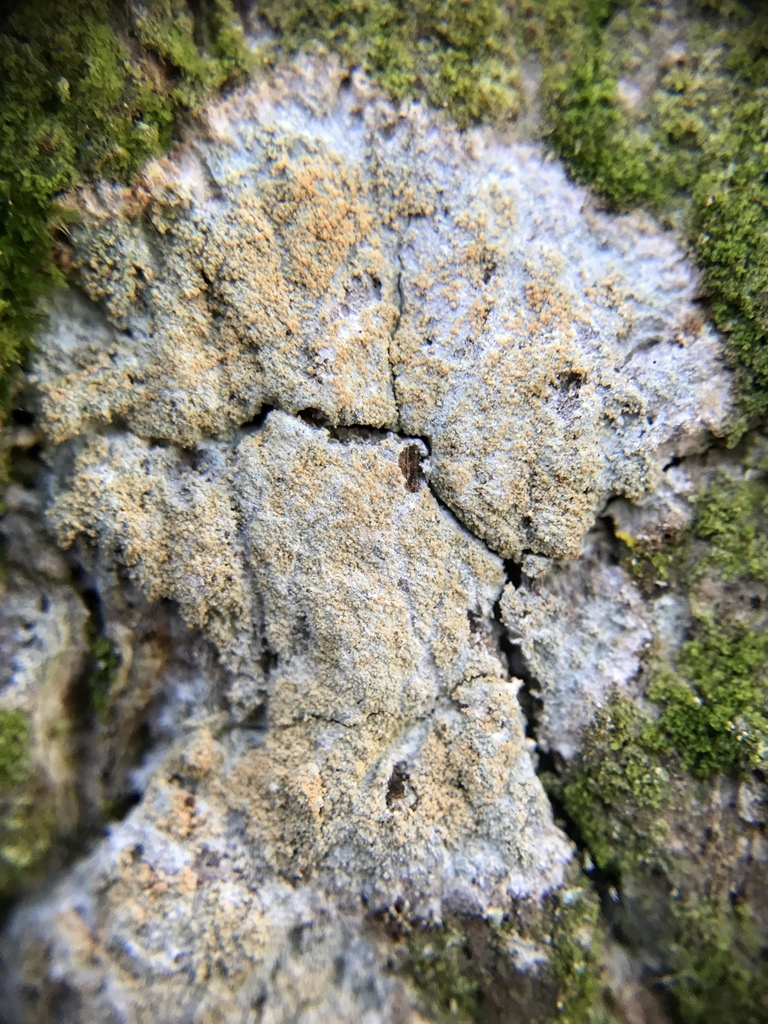
Herpothallon rubroechinatum
Herpothallon rubroechinatum is a species of corticolous (bark-dwelling), crustose lichen in the family Arthoniaceae. It is distinguished by its greyish-white to beige thallus and distinctive rust-red crystals that appear sprinkled on its reproductive structures. The species contains psoromic acid and reproduces primarily through vegetative means rather than spores. Initially documented in Florida, Costa Rica, and Peru, its known range expanded to the Galápagos Islands in 2013, where it inhabits the humid zone of Santa Cruz Island, growing on both native endemic trees and introduced species in semi-shaded to shaded environments.
From the article Herpothallon rubroechinatum on Wikipedia (CC BY-SA), quoted section by section
Description
Herpothallon rubroechinatum forms a crust-like growth on tree bark (corticolous). The thallus (lichen body) is clearly defined by a distinct border of white, radiating fungal filaments (hyphae) that typically contain at least some rust-red pigmentation. The main surface of the thallus appears greyish white, becoming beige with age, and lacks a protective outer layer (cortex). The thallus texture is cottony, in some areas appearing almost granular. The central part of the thallus is densely covered with slightly darker, compact reproductive structures called pseudisidia. These pseudisidia appear as if they were sprinkled with rust-red, needle-shaped pigment crystals, which is a distinctive characteristic of this species. The pseudisidia come in two forms (dimorphic): some are swollen and globular, containing a central pycnidium (structure producing asexual spores), while others develop into elongated, worm-like forms. The internal tissue (medulla) is white, containing brownish granules and sparse calcium oxalate crystals. When tested with chemical spot tests, the green-white parts of the thallus are K−, but the rust-red portions are (K+) purple. The thallus is P+ (bright yellow), C−, and KC−. It does not fluoresce under ultraviolet light (UV−), and shows no staining reaction with iodine (I−). …
Range & habitat
Herpothallon rubroechinatum has a neotropical distribution, occurring in tropical regions of the Americas. It was documented in the Galápagos Islands in 2013, representing a new record for both the archipelago and Ecuador. In the Galápagos, the few known specimens were collected in the humid zone of Santa Cruz Island, growing on both native endemic trees such as Scalesia pedunculata and introduced trees including Cinchona pubescens and Cedrela odorata. It prefers semi-shaded to shaded and sheltered habitats. The lichen is also found in Costa Rica and Peru.
== References ==
Wikipedia: “Habitat and distribution”
Where it lives
Recorded sightings
—
geo-referenced records in GBIF, from museums, herbaria and field observers.
Drag the globe to turn it. Dots are where records exist, not a range map; darker means more records.
In the stacks
Searching the stacks…
Every page naming Herpothallon rubroechinatum in the Biodiversity Heritage Library →
This page is assembled live from iNaturalist, GBIF, Wikipedia, the Source Library and the Internet Archive. It is not yet part of the hand-edited codex. iNaturalist taxon 463099.