On eBird ↗
Red-throated Loon
Live sightings near you, the range map, bar charts of when it is seen, and Macaulay Library photos and recordings.
Red-throated Loon
Gavia stellata
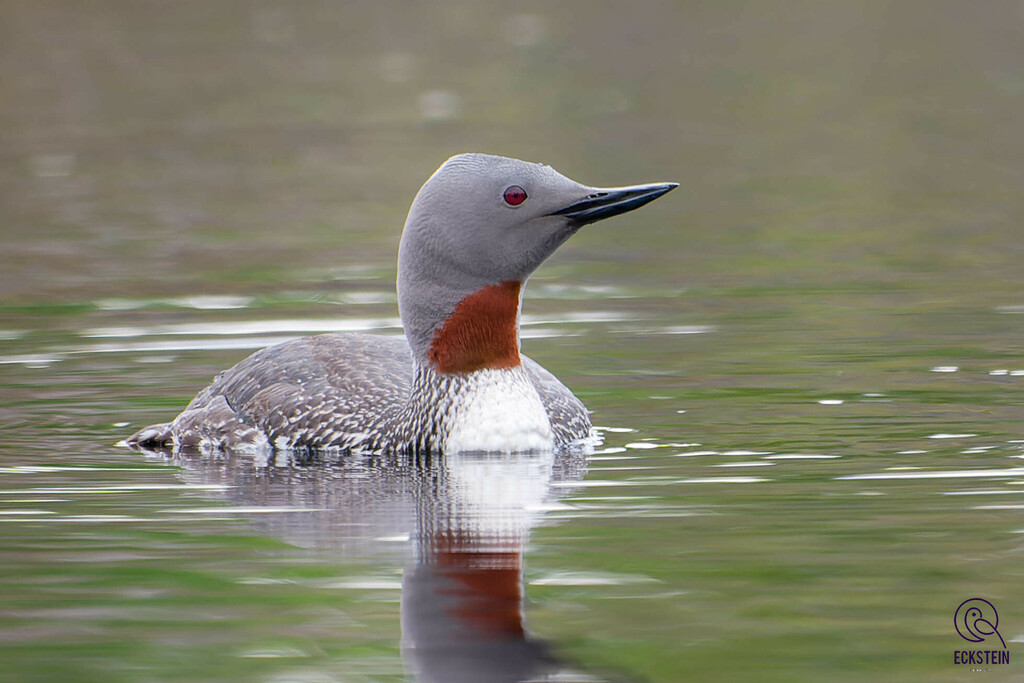
The red-throated loon (North America) or red-throated diver (Britain and Ireland) (Gavia stellata) is a migratory aquatic bird found in the Northern Hemisphere. The most widely distributed member of the loon or diver family, it breeds primarily in Arctic regions, and it winters in northern coastal waters. Ranging from 55 to 67 centimetres (22 to 26 in) in length, the red-throated loon is the smallest and lightest of the world's loons. In winter, it is a nondescript bird, greyish above, fading to white below. During the breeding season, it acquires the distinctive reddish throat patch, which is the basis for its common name. Fish form the bulk of its diet, though amphibians, invertebrates, and plant material are sometimes eaten as well. A monogamous species, red-throated loons form long-term pair bonds. Both members of the pair help to build the nest, incubate the eggs (generally two per clutch), and feed the hatched young.
The red-throated loon has a large global population and a significant global range, though some populations are declining. Oil spills, habitat degradation, pollution, and fishing nets are among the major threats this species faces. Natural predators—including various gull species, and both red and Arctic foxes, will take eggs and young. The species is protected by international treaties.
From the article Red-throated loon on Wikipedia (CC BY-SA), quoted section by section
Description
Like the other members of its genus, the red-throated loon is well adapted to its aquatic environment: its dense bones help it to submerge, its legs—in their set-back position—provide excellent propulsion, and its body is long and streamlined. Even its sharply pointed bill may help its underwater streamlining. Its feet are large, its front three toes are fully webbed, and its tarsus is flattened, which reduces drag and allows the leg to move easily through the water. The red-throated loon is the smallest and lightest of the world's loon species, ranging from 53 to 69 cm (21 to 27 in) in length with a 91–120 cm (36–47 in) wingspan, and weighing 1–2.7 kg (2.2–6.0 lb). Like all loons, it is long-bodied and short-necked, with its legs set far back on its body. The sexes are similar in appearance, although males tend to be slightly larger and heavier than females. In breeding plumage, the adult has a dark grey head and neck (with narrow black and white stripes on the back of the neck), a triangular red throat patch, white underparts, and a dark grey-brown mantle. It is the only loon with an all-dark back in breeding plumage. The non-breeding plumage is drabber with the chin, foreneck, and much of the face white, the top of the head and back of the neck grey, and considerable white speckling on the dark mantle. …
Range & habitat
In contrast to other loons, its main fishing grounds are not the breeding lake, but larger lakes or the sea. Several nests close to each other may occur in the same breeding lake. The red-throated loon breeds primarily in the Arctic regions of northern Eurasia and North America (generally north of 50°N latitude), and winters in northern coastal waters, sometimes in groups of considerable size. More than 4,400 spend the winter in a loose concentration on the eastern part of the German Bight, for example. Unlike other loons, it regularly uses very small freshwater lakes as breeding sites. Its small size renders it more versatile, but it is less able to feed on deeper prey. The increase in size and diversity of the remaining species of loons suggests that the benefits of larger size outweigh the limitations. In North America, it winters regularly along both coasts, ranging as far south as the Baja California Peninsula and the Gulf of California in north-western Mexico; it has been recorded as a vagrant in the interior Mexican state of Hidalgo. Some of its folk names in north-eastern North America—including cape race, cape brace, cape drake and cape racer, as well as corruptions such as scapegrace—originated from its abundance around Cape Race, Newfoundland. …
Wikipedia: “Habitat and distribution”
What it does
Because its feet are located so far back on its body, the red-throated loon is quite clumsy walking on land, but it can use its feet to shove itself forward on its breast. Young use this method of covering ground when moving from their breeding pools to larger bodies of water, including rivers and the sea. It is the only species of loon able to take off directly from land. If frightened, it may submerge until only its head or bill shows above the surface of the water. It differs from other loons by nesting in small lakes but feeding in larger lakes or the sea. The nesting lake may host several nests, close to each other, with much agonistic behavior among pairs. This territorial behavior is performed pairwise, with vocalisation (long call, plesiosur race). The red-throated loon is a diurnal migrant, which travels singly or in loose groups, often high above the water. In eastern North America (and possibly elsewhere), it tends to migrate near the coast rather than farther offshore; Siberian populations travel for hundreds of miles over land en route to their southern European wintering grounds. It is a strong flier, and has been clocked at speeds between 75 and 78 kilometres per hour (47 and 48 mph). …
Wikipedia: “Behaviour”
In human culture
First described by Danish naturalist Erik Pontoppidan in 1763, the red-throated loon is a monotypic species with no distinctive subspecies despite its large Holarctic range. Pontoppidan initially placed the species in the now-defunct genus Colymbus, which contained grebes as well as loons. By 1788, German naturalist Johann Reinhold Forster realized that grebes and loons were different enough to warrant separate genera, and moved the red-throated loon (along with all other loon species) to its present genus. Its relationship to the four other loon species is complex; although all belong to the same genus, it differs from the others in terms of morphology, behaviour, ecology and breeding biology and may be the sister group to all other species in the genus. Analysis of molecular data together with the fossil record suggests the lineage of the red-throated loon diverged from that giving rise to the other loon species around 21.4 million years ago in the Miocene, and that it may be most closely related to the fossil Pliocene species Gavia howardae. The red-throated loon is thought to have evolved in the Palearctic, and then to have expanded into the Nearctic. The genus name Gavia comes from the Latin for "sea mew", as used by ancient Roman naturalist Pliny the Elder. …
Wikipedia: “Taxonomy and etymology”
Listen
Looking for field recordings…
Where it lives
Recorded sightings
—
geo-referenced records in GBIF, from museums, herbaria and field observers.
Drag the globe to turn it. Dots are where records exist, not a range map; darker means more records.
In the stacks
Searching the stacks…
Every page naming Gavia stellata in the Biodiversity Heritage Library →
This page is assembled live from iNaturalist, GBIF, Wikipedia, the Source Library and the Internet Archive. It is not yet part of the hand-edited codex. iNaturalist taxon 4627.