On eBird ↗
Yellow-billed Loon
Live sightings near you, the range map, bar charts of when it is seen, and Macaulay Library photos and recordings.
Yellow-billed Loon
Gavia adamsii
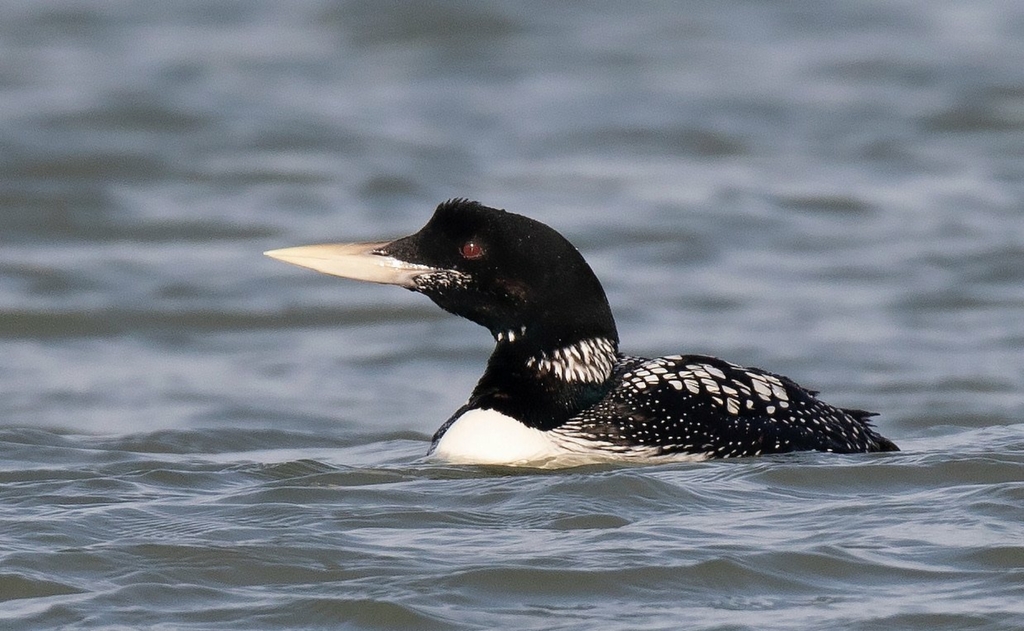
The yellow-billed loon (Gavia adamsii), also known as the white-billed diver, is the largest member of the loon or diver family. Breeding adults have a black head, white underparts and a chequered black-and-white mantle. Non-breeding plumage is drabber with the chin and foreneck white. Its main distinguishing feature is the long straw-yellow bill, which, because the culmen is straight, appears slightly uptilted.
It breeds in the Arctic and winters mainly at sea along the coasts of the northern Pacific Ocean and northwestern Norway; it also sometimes overwinters on large inland lakes. It occasionally strays well south of its normal wintering range and has been recorded as a vagrant in more than 22 countries. This species, like all divers, is a specialist fish-eater, catching its prey underwater. Its call is an eerie wailing, lower-pitched than the common loon.
From the article Yellow-billed loon on Wikipedia (CC BY-SA), quoted section by section
Description
With a length of 76 to 97 cm (30 to 38 in), a wingspan of 135 to 160 cm (53 to 63 in), and a weight ranging from 4 to 6.4 kg (8.8 to 14.1 lb), the yellow-billed loon is the largest member of the loon (diver) family. The adult is primarily black and white in breeding plumage, with a purple gloss on its head and neck.
Range & habitat
The yellow-billed loon is an Arctic species, breeding primarily along the coasts of the Arctic Ocean as far north as 78° N and wintering on sheltered coastal waters of the northern Pacific Ocean and the northwestern coast of Norway. It has been recorded as a breeding bird in Russia, Canada and the United States. Though it winters primarily to the north of 50° N, its winter range extends south to 35° N off the coast of Japan, and it has been recorded as a vagrant in more than 20 countries, including some as far south as Mexico and Spain.
Wikipedia: “Habitat and range”
What it does
The yellow-billed loon is a specialist fish eater, yet it also takes crustaceans, molluscs and annelids, especially for its young. It dives in pursuit of prey, which is caught underwater. Probably as a way to avoid spreading parasites, it defecates ashore, in the breeding lake.
Wikipedia: “Feeding”
In human culture
First described by English zoologist George Robert Gray in 1859 based on a specimen collected in Alaska, the yellow-billed loon is a monotypic species, with no subspecies despite its large Holarctic range. It is closely related to the common loon, which it strongly resembles in plumage and behaviour; some taxonomists consider the two species to be allopatric forms of the same superspecies. Both are thought to have evolved from a population of black-throated loons which colonized the Nearctic and were subsequently cut off from other populations. The genus name Gavia comes from the Latin for "sea mew", as used by ancient Roman naturalist Pliny the Elder. The specific epithet adamsii honours Edward Adams, a British naval surgeon and naturalist who sketched and collected numerous species, including this one, on several trips to the Arctic. The word "loon" is thought to have derived from the Swedish lom, the Old Norse or Icelandic lómr, or the Old Dutch loen, all of which mean "lame" or "clumsy", and is a probable reference to the difficulty that all loons have in moving about on land. "Diver" refers to the family's underwater method of hunting for prey, while "yellow-billed" and "white-billed" are references to the bird's distinctively pale bill.
Wikipedia: “Taxonomy and etymology”
Listen
Looking for field recordings…
Where it lives
Recorded sightings
—
geo-referenced records in GBIF, from museums, herbaria and field observers.
Drag the globe to turn it. Dots are where records exist, not a range map; darker means more records.
In the stacks
Searching the stacks…
Every page naming Gavia adamsii in the Biodiversity Heritage Library →
This page is assembled live from iNaturalist, GBIF, Wikipedia, the Source Library and the Internet Archive. It is not yet part of the hand-edited codex. iNaturalist taxon 4622.