- Animals
- ›Chordates
- ›Vertebrates
- ›Mammals
- ›Therians
- ›Placental Mammals
- ›Primates, Rodents, and Allies
- ›Rodents
- ›Squirrels, Dormice, and Mountain Beavers
- ›Squirrels
- ›Ground and African Tree Squirrels
- ›African Tree Squirrels
- ›Myosciurus
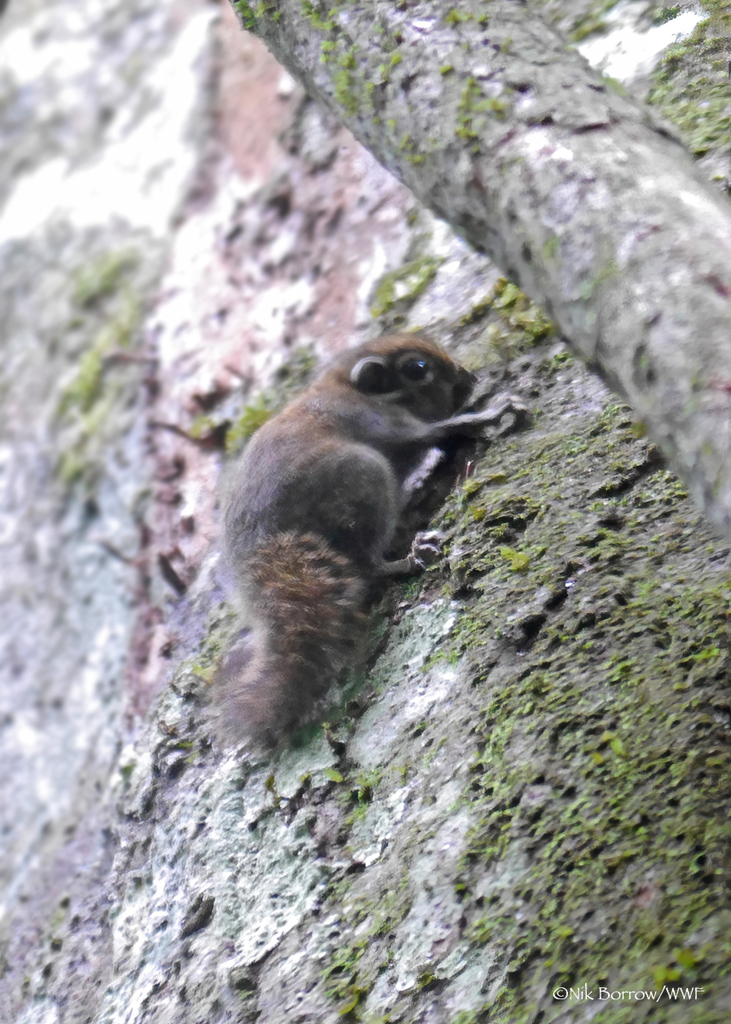
African Pygmy Squirrel
Myosciurus pumilio
The African pygmy squirrel (Myosciurus pumilio) is a species of rodent in the family Sciuridae. It is monotypic within the genus Myosciurus. It is found in tropical rainforests in Cameroon, the Republic of the Congo, Equatorial Guinea, and Gabon. It is not considered threatened, but likely declines locally due to habitat loss. Together with the least pygmy squirrel of Asia, the African pygmy squirrel is the world's smallest squirrel measuring about 12–14 cm (4.7–5.5 in) in total length and just 15–18 g (0.53–0.63 oz) in weight, which is less than a typical house mouse.
From the article African pygmy squirrel on Wikipedia (CC BY-SA), quoted section by section
Range & habitat
African pygmy squirrels are diurnal and live in trees. These squirrels are found in many forests in Central Africa. They prefer lower levels of the canopy, and spend most of the time at heights up to five meters.
Wikipedia: “Habitat”
What it does
Information regarding the African pygmy squirrel's reproduction has not been fully defined. Generally arboreal squirrels have a polygamous mating system, where there is male-male competition for access to females. Eventually the female mates with the most competitive, and they will mate in a protected area to prevent attacks or threats during copulation. The average number of offspring is about 2. It has been indicated that breeding occurs early during the year. Breeding appears to be concentrated seasonally based on observations of similar squirrel species, but it is not known which season favors breeding. Females provide all the parental care for the offspring, but researchers have not defined the details.
Wikipedia: “Reproduction”
At the table
Unlike most squirrels, African pygmy squirrels don't cache food, meaning they don't hide and store their food. Myosciurus pumilio species are omnivorous. These squirrels eat scrapings from bark, insects, and fruit. It is theorized that oily spores from microscopic fungus may be the primary substance these squirrels obtain from the bark. African pygmy squirrels are bark gleaners and forage incessantly.
Wikipedia: “Food habits”
Listen
Looking for field recordings…
Where it lives
Recorded sightings
—
geo-referenced records in GBIF, from museums, herbaria and field observers.
Drag the globe to turn it. Dots are where records exist, not a range map; darker means more records.
In the stacks
Searching the stacks…
Every page naming Myosciurus pumilio in the Biodiversity Heritage Library →
This page is assembled live from iNaturalist, GBIF, Wikipedia, the Source Library and the Internet Archive. It is not yet part of the hand-edited codex. iNaturalist taxon 46120.