- Animals
- ›Chordates
- ›Vertebrates
- ›Mammals
- ›Therians
- ›Placental Mammals
- ›Primates, Rodents, and Allies
- ›Rodents
- ›Squirrels, Dormice, and Mountain Beavers
- ›Squirrels
- ›Typical and Flying Squirrels
- ›Typical Squirrels
- ›Microsciurus
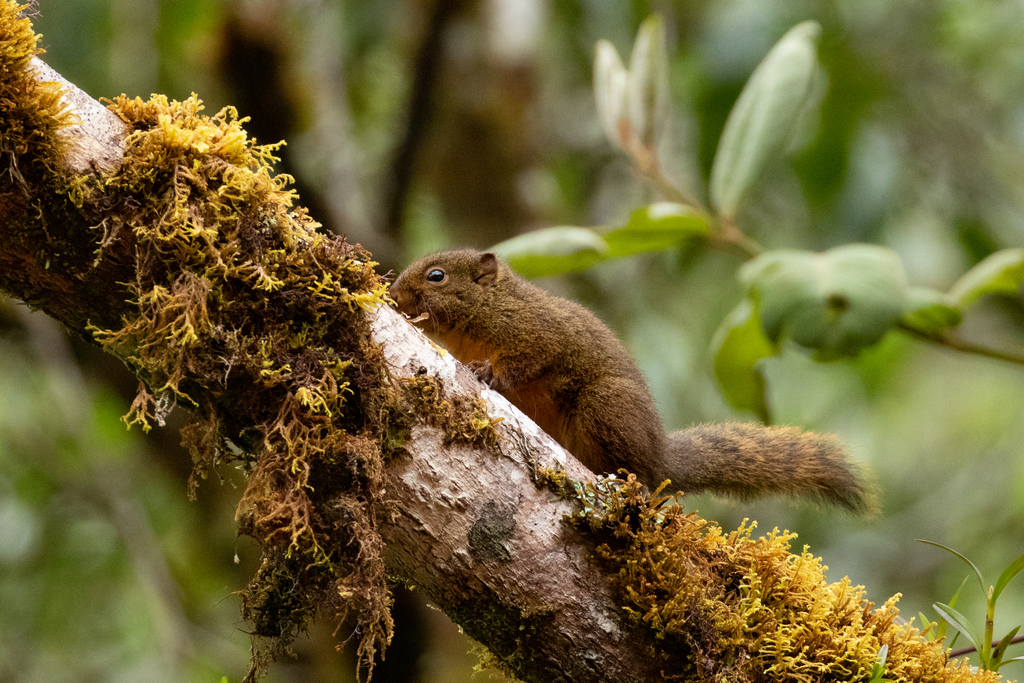
Amazon Dwarf Squirrel
Microsciurus flaviventer
The Amazon dwarf squirrel (Microsciurus flaviventer) is a chipmunk-sized tree squirrel native to South America.
From the article Amazon dwarf squirrel on Wikipedia (CC BY-SA), quoted section by section
Description
As its name suggests, the Amazon dwarf squirrel is relatively small, with a head-body length of 12 to 16 cm (4.7 to 6.3 in) and a tail 8 to 16 cm (3.1 to 6.3 in) long. Adults weigh between 86 and 132 g (3.0 and 4.7 oz), with males being slightly larger than females. The fur varies from reddish to dull brown, fading gradually to yellow or greyish on the underparts. There is a distinctive patch of pale yellow fur behind the ears, while the tail has faint yellowish bands and white frosting. The limbs are unusually long for tree squirrels. In the forelimbs, the humerus and radius are of equal length, an adaptation thought to increase the squirrel's ability to climb large trees, compensating for a lack of shoulder mobility. The longer hindlimbs allow for stronger muscles, so that the squirrel can leap over larger gaps, relative to its size, than more typically sized squirrels can.
Range & habitat
The squirrels are found in the upper Amazon Basin, broadly west of the Purus and Rio Negro rivers, in Brazil, Bolivia, Peru, Ecuador, and Colombia. They typically inhabit evergreen tropical rainforests at up to 2,000 m (6,600 ft) elevation, although they may sometimes be found in more disturbed habitats.
Subspecies. Eight subspecies of Amazon dwarf squirrel are generally recognised. Recent studies have indicated that the subspecies M. f. otinus, M. f. sabanillae, M. f. similis, and M. f. simonsi are their own distinct species rather than subspecies. The same study also showed that M. f. otinus and M. f. similis are more closely related to Microsciurus mimulus and Sciurus pucheranii than they are to M. flaviventer.
Wikipedia: “Distribution and habitat”
What it does
The squirrels use all levels of the forest, from the ground to the tree canopy, but are most commonly found in the understory. They feed on arthropods, tree bark, and fungi, and have been observed to closely follow flocks of birds while foraging, although the reason for this is unclear. They are diurnal and highly arboreal, even for tree squirrels, frequently jumping from branch to branch. They spend the night in nests formed from plant fibres, and located several metres above the ground. They are mostly solitary, but may be found with others feeding on the same tree. Their calls include a bird-like "trill" and a series of soft "chucks" used as an alarm call. Very little is known of their reproduction, although litters are thought to be small.
Wikipedia: “Biology and behaviour”
Listen
Looking for field recordings…
Where it lives
Recorded sightings
—
geo-referenced records in GBIF, from museums, herbaria and field observers.
Drag the globe to turn it. Dots are where records exist, not a range map; darker means more records.
In the stacks
Searching the stacks…
Every page naming Microsciurus flaviventer in the Biodiversity Heritage Library →
This page is assembled live from iNaturalist, GBIF, Wikipedia, the Source Library and the Internet Archive. It is not yet part of the hand-edited codex. iNaturalist taxon 46100.