- Animals
- ›Nematodes
- ›Chromadoreans
- ›Chromadoria
- ›Rhabditida
- ›Tylenchina
- ›Tylenchoidea
- ›Meloidogynidae
- ›Meloidogyne
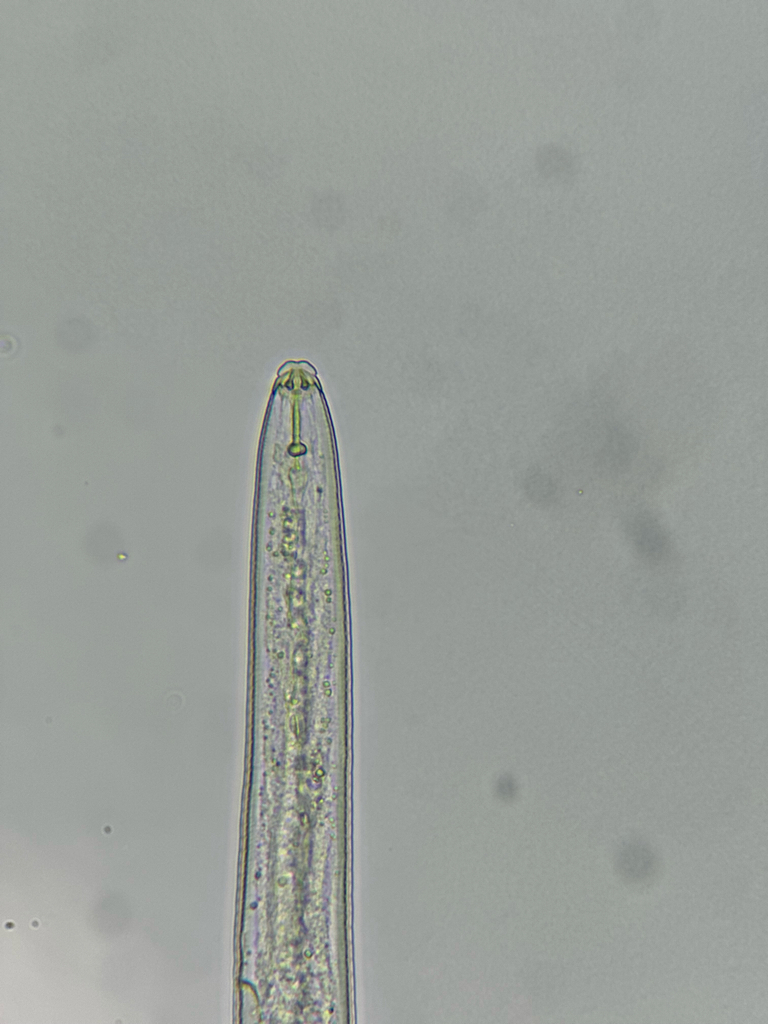
Southern root-knot nematode
Meloidogyne incognita
Meloidogyne incognita (root-knot nematode, RKN), also known as the southern root-nematode or cotton root-knot nematode, is a plant-parasitic roundworm in the family Heteroderidae. This nematode is one of the four most common species worldwide and has numerous hosts. It typically incites large, usually irregular galls on roots as a result of parasitism.
M. incognita can move along shallower temperature gradients (0.001 °C/cm) than any other known organism, an example of thermotaxis. The response is complicated and thought to allow the nematodes to move toward an appropriate level in soil, while they search for chemical cues that can guide them to specific roots.
From the article Meloidogyne incognita on Wikipedia (CC BY-SA), quoted section by section
Description
Females of M. incognita are pear-shaped with no posterior protuberance. Their stylet ranges from 15 to 16 μm long, and knobs are rounded and offset. Perineal pattern is oval to rounded, typically with high dorsal arch, striae usually wavy, and lateral field absent or weakly demarcated. Males have a not offset head with an elevated labial disc without lateral lips (usually). Their stylet ranges from 23 to 26 μm long, and knobs are rounded to oval and offset. Juveniles' second stage body size ranges from 350 to 450 μm long. Their tail has a rounded tip and ranges from 43 to 65 μm in length with a 6 to 14 μm long hyaline region.
Wikipedia: “Morphology”
Range & habitat
Meloidogyne incognita is widely spread around the globe and found in many different soil types.
Wikipedia: “Distribution”
What it does
Within the egg, the first molt occurs and a juvenile first state (J1) becomes a juvenile second stage (J2). Under favorable conditions (temperature, moisture, host stimulus) the J2 hatches, reaches and penetrates the host root. Root tips are the primary infection court. Once inside the roots, J2 migrate through cortical tissues towards the vascular zone where they establish a permanent feeding site called giant cell. At this point the nematode enlarges acquire a "sausage" shape and becomes sedentary. Three more molts occur, J2 becomes J3, J4 and then adult. M. incognita is sexually dimorphic. Females acquire a globose shaped body while males become vermiform and leave the roots. Upon maturity females lay eggs into a gelatinous mass that protect them against unfavorable environmental conditions, and the life cycle is repeated. It takes 37 days at 21 °C (70 °F) for M. incognita to complete its life cycle.
Wikipedia: “Life cycle”
Where it lives
Recorded sightings
—
geo-referenced records in GBIF, from museums, herbaria and field observers.
Drag the globe to turn it. Dots are where records exist, not a range map; darker means more records.
In the stacks
Searching the stacks…
Every page naming Meloidogyne incognita in the Biodiversity Heritage Library →
This page is assembled live from iNaturalist, GBIF, Wikipedia, the Source Library and the Internet Archive. It is not yet part of the hand-edited codex. iNaturalist taxon 460863.