- Animals
- ›Chordates
- ›Vertebrates
- ›Mammals
- ›Therians
- ›Placental Mammals
- ›Primates, Rodents, and Allies
- ›Rodents
- ›Squirrels, Dormice, and Mountain Beavers
- ›Squirrels
- ›Typical and Flying Squirrels
- ›Typical Squirrels
- ›Sciurus
- ›Parasciurus
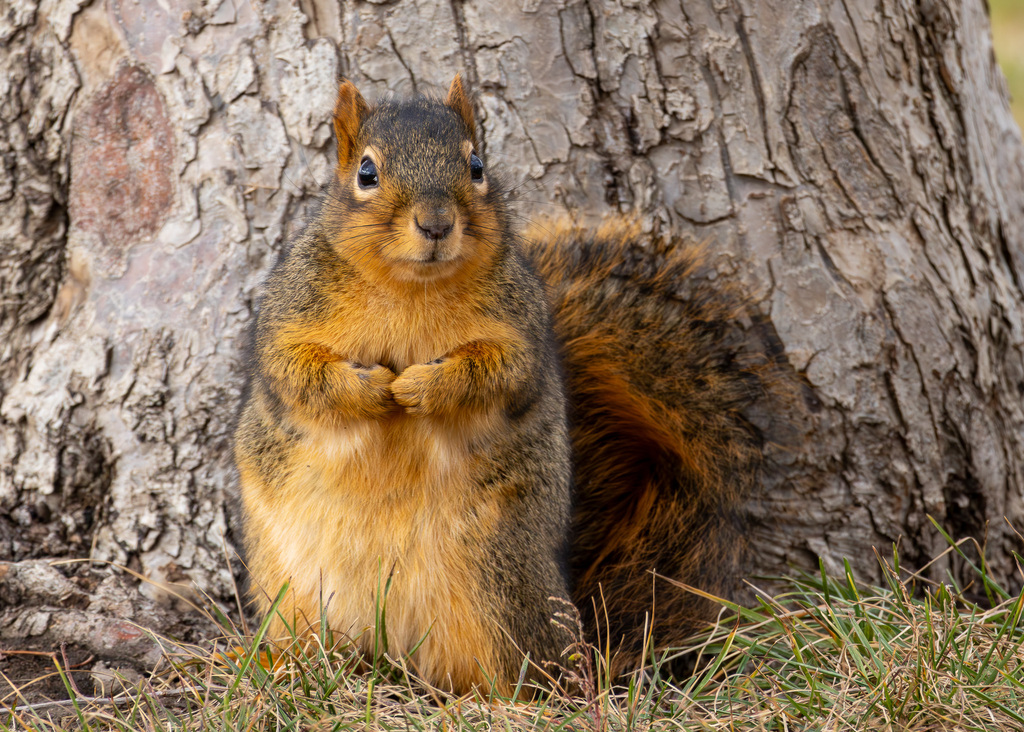
Eastern Fox Squirrel
Sciurus niger
The fox squirrel (Sciurus niger), also known as the eastern fox squirrel or Bryant's fox squirrel, is the largest species of tree squirrel native to North America. It is sometimes mistaken for the American red squirrel or eastern gray squirrel in areas where the species coexist, though they differ in size and coloration. The word Sciurus came from the ancient Greek words skia, meaning shade, and oura, meaning tail. Niger refers to the black coloration.
From the article Fox squirrel on Wikipedia (CC BY-SA), quoted section by section
Description
The fox squirrel's total length measures 20 to 30 in (50.8 to 76.2 cm), with a body length of 10 to 15 in (25.4 to 38.1 cm) and a similar tail length. They range in weight from 1.0 to 2.5 lb (453.6 to 1,134.0 g).The length of its hind foot is 5.1 to 8.2 cm. There is no sexual dimorphism in size or appearance. Individuals tend to be smaller in the West. There are three distinct geographical morphs in coloration. In most areas, the animal's upper body is brown-grey to brown-yellow with a typically brownish-orange underside, while in eastern regions, such as the Appalachians, there are more strikingly-patterned dark brown and black squirrels with white bands on the face and tail. In the South and parts of Nebraska and Iowa along the Missouri River, there are populations with uniform black coats.
To help with climbing, the squirrels have sharp claws, developed extensors of digits and flexors of forearms, and abdominal musculature. Fox squirrels have excellent vision and well-developed senses of hearing and smell. They use scent-marking to communicate with other fox squirrels. "Fox squirrels also have several sets of vibrissae, hairs or whiskers that are used as touch receptors to sense the environment. These are found above and below their eyes, on their chin and nose, and on each forearm." The dental formula of S. niger is 1.0.1.31.0.1.3 × 2 = 20.
Range & habitat
The fox squirrel's natural range extends through most of the eastern United States, north into the southern prairie provinces of Canada, west to the Dakotas, Colorado, and Texas, and south to the northern parts of Coahuila, Nuevo León (as far south as the Valle de las Salinas) and Tamaulipas. It is absent (except for vagrants) in New England, New Jersey, most of New York, northern and eastern Pennsylvania, Ontario, Quebec, and the Atlantic provinces of Canada. It has been introduced to both northern and southern California, Oregon, Idaho, Montana, Washington, New Mexico, and Utah,, as well as Ontario and British Columbia in Canada. While very versatile in their habitat choices, fox squirrels are most often found in forest patches of 40 hectares or less with an open understory, or in urban neighborhoods with trees. They thrive among oak, hickory, walnut, pecan and pine trees, storing their nuts for winter. Western range extensions in Great Plains regions such as Kansas are associated with riverine corridors of cottonwood. Some subspecies native to several eastern U.S. states are the Delmarva Peninsula fox squirrel (S. n. cinereus), and the southern fox squirrel (S. n. niger). Fox squirrels are most abundant in open forest stands with little understory vegetation; they are not found in stands with dense undergrowth. …
Wikipedia: “Distribution and habitat”
What it does
Fox squirrels are strictly diurnal, non-territorial, and spend more of their time on the ground than most other tree squirrels. They are still, however, agile climbers. They construct two types of homes called "dreys", depending on the season. Summer dreys are often little more than platforms of sticks high in the branches of trees, while winter dens are usually hollowed out of tree trunks by a succession of occupants over as many as 30 years. Cohabitation of these dens is not uncommon, particularly among breeding pairs. Fox squirrels will form caches by burying food items for later consumption. They like to store foods that are shelled and high in fat, such as acorns and nuts. Shelled foods are favored because they are less likely to spoil than non-shelled foods, and fatty foods are valued for their high energy density. Fox squirrels are not particularly gregarious or playful; in fact, they have been described as solitary and asocial creatures, coming together only in breeding season. They have a large vocabulary, consisting most notably of an assortment of clucking and chucking sounds, not unlike some "game" birds, and they warn of approaching threats with distress screams. In the spring and autumn, groups of fox squirrels clucking and chucking together can make a small ruckus. They also make high-pitched whines during mating. …
Wikipedia: “Behavior and ecology”
Listen
Looking for field recordings…
Where it lives
Recorded sightings
—
geo-referenced records in GBIF, from museums, herbaria and field observers.
Drag the globe to turn it. Dots are where records exist, not a range map; darker means more records.
In the old herbals & bestiaries


In the stacks
Searching the stacks…
Every page naming Sciurus niger in the Biodiversity Heritage Library →
This page is assembled live from iNaturalist, GBIF, Wikipedia, the Source Library and the Internet Archive. It is not yet part of the hand-edited codex. iNaturalist taxon 46020.