On eBird ↗
Oriental Pratincole
Live sightings near you, the range map, bar charts of when it is seen, and Macaulay Library photos and recordings.
Oriental Pratincole
Glareola maldivarum
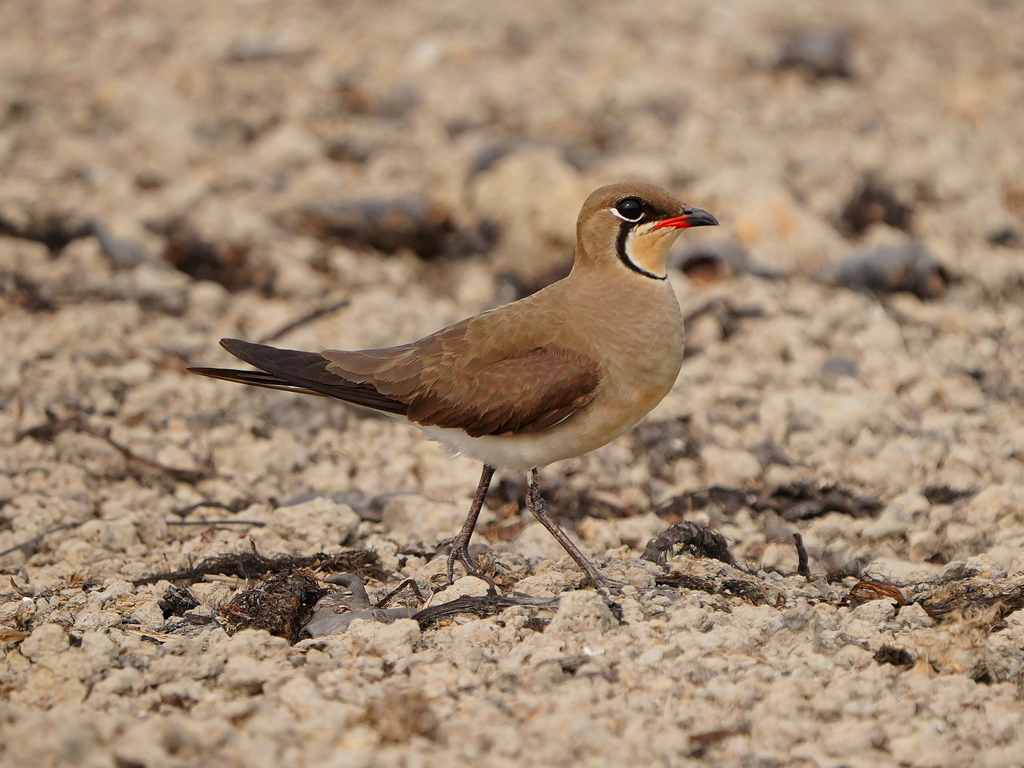
The oriental pratincole (Glareola maldivarum), also known as the grasshopper-bird or swallow-plover, is a wader in the pratincole family, Glareolidae.
From the article Oriental pratincole on Wikipedia (CC BY-SA), quoted section by section
Description
The Oriental pratincole has short legs, long pointed wings and long forked tails. It has a short bill, which is an adaptation to aerial feeding. The back and head are brown, and the wings are brown with black flight feathers. The belly is white and the underwings are chestnut. Very good views are needed to distinguish the species from other pratincoles, particularly the very similar collared pratincole, which also has a chestnut underwing. The black-winged pratincole shares the black upperwing flight feathers, and lacks a white trailing edge to the wing. Those features are not always readily seen in the field, especially because the chestnut underwing appears black unless excellent views are obtained.
Range & habitat
The Oriental pratincole is native to Asia, breeding from North Pakistan and the Kashmir region, and sporadically southwards towards the Maldives and Sri Lanka, Indochina, eastern China, Manchuria and the Philippines. It is migratory and winters throughout the Indomalayan realm and northern Australia.
Wikipedia: “Distribution”
In human culture
The genus name is a diminutive of Latin glarea, "gravel", referring to a typical nesting habitat for pratincoles. The species name, maldivarum, refers to the type locality, the ocean near the Maldive Islands. The type specimen, caught alive at sea, survived for a month on flies.
Wikipedia: “Etymology”
Listen
Looking for field recordings…
Where it lives
Recorded sightings
—
geo-referenced records in GBIF, from museums, herbaria and field observers.
Drag the globe to turn it. Dots are where records exist, not a range map; darker means more records.
In the stacks
Searching the stacks…
Every page naming Glareola maldivarum in the Biodiversity Heritage Library →
This page is assembled live from iNaturalist, GBIF, Wikipedia, the Source Library and the Internet Archive. It is not yet part of the hand-edited codex. iNaturalist taxon 4601.