- Animals
- ›Chordates
- ›Vertebrates
- ›Mammals
- ›Therians
- ›Placental Mammals
- ›Primates, Rodents, and Allies
- ›Rodents
- ›Squirrels, Dormice, and Mountain Beavers
- ›Squirrels
- ›Typical and Flying Squirrels
- ›Flying Squirrels
- ›Petaurista
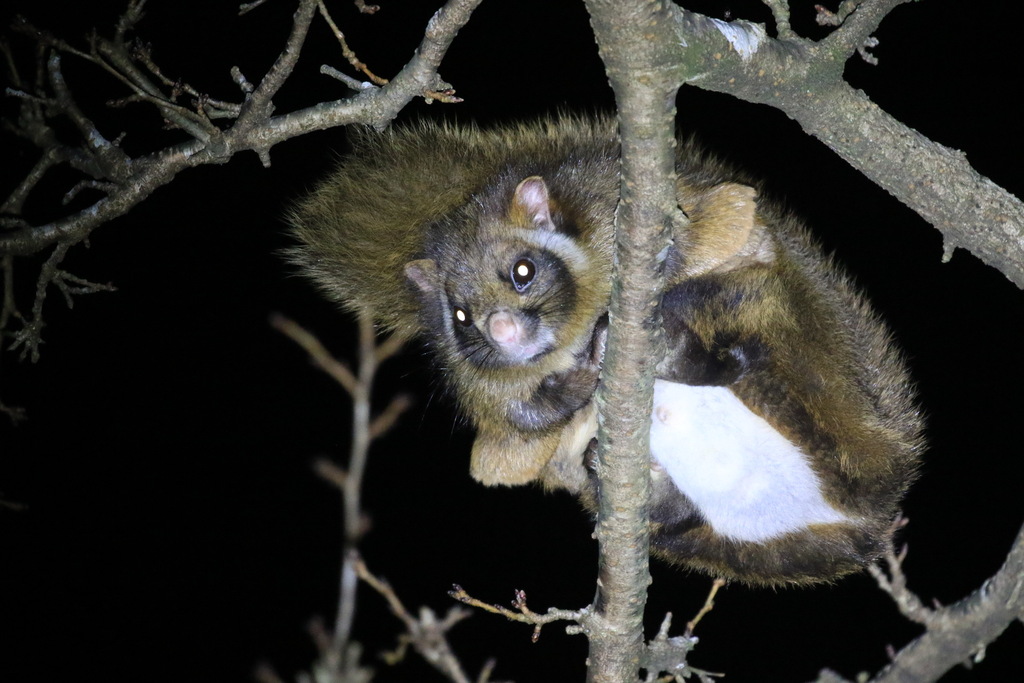
Japanese Giant Flying Squirrel
Petaurista leucogenys
The Japanese giant flying squirrel (ムササビ, musasabi, Petaurista leucogenys) is a species of flying squirrel, one of eight species of giant flying squirrels. It is native to Japan where is inhabits sub-alpine forests and boreal evergreen forests on Honshu, Shikoku and Kyushu islands. It grows to a head-and-body length of 50 cm (20 in) with a tail nearly as long again, and has a membrane connecting its wrists and ankles which enables it to glide from tree to...
From the article Japanese giant flying squirrel on Wikipedia (CC BY-SA), quoted section by section
Description
Like other flying squirrels, it has a web of skin between its legs which it uses to glide between trees. Glides of 160 metres (520 ft) have been recorded. The tail is used for stability during flight. The body is about 25–50 cm (9.8–19.7 in) long, and the tail a further 30–40 cm (12–16 in). It weighs between 700 and 1,500 g (25 and 53 oz). It is much larger than the related Japanese dwarf flying squirrel which does not exceed 220 g (7.8 oz). It eats fruit and nuts and lives in holes in large trees. The female has a home range of about a 1 hectare (2.5 acres) and the male about two hectares (4.9 acres).
Range & habitat
It is native to Japan, where it inhabits sub-alpine forests and boreal evergreen forests on the islands of Honshu, Shikoku and Kyushu.
Wikipedia: “Distribution and habitat”
What it does
Sexual maturity is reached after about two years. From winter to early summer the males compete for females. During mating, after ejaculation, the male produces a sticky protein called a coitus plug from his penis which becomes firm and blocks the female's vagina. This may stop semen from leaking out and heighten the chances of fertilization. It also prevents other males from mating with the same female. However males can use their penis to remove the coitus plug. Gestation lasts about 74 days and one or two young are born in early autumn.
== References ==
Wikipedia: “Reproduction”
Listen
Looking for field recordings…
Where it lives
Recorded sightings
—
geo-referenced records in GBIF, from museums, herbaria and field observers.
Drag the globe to turn it. Dots are where records exist, not a range map; darker means more records.
In the stacks
Searching the stacks…
Every page naming Petaurista leucogenys in the Biodiversity Heritage Library →
This page is assembled live from iNaturalist, GBIF, Wikipedia, the Source Library and the Internet Archive. It is not yet part of the hand-edited codex. iNaturalist taxon 45987.